The Emberstone Chronicles
The Emberstone Chronicles
From Downers Grove to Ashen Peak
I. The Sleepy Kingdom
◆ Downers Grove
The Dreaming Pull has been in this house longer than the quest has.
It moved in the way it always does — not through the door, not through any entrance a person would use, but through the accumulated softness of a life that has been built well and knows it. A good job. Kath, and a dog named Stevie, both of whom are genuinely excellent. A life that asks nothing of the morning because the morning has already been earned. The Dreaming Pull does not create comfort. It finds comfort that already exists and makes itself at home inside it. This house gave it a lot to work with.
The Pull is not a villain. This is worth establishing early. It is a force as old as the first morning that was ever too cold to face, as patient as every reasonable voice that has ever whispered that today is fine, that tomorrow is also fine, that the version of yourself that gets up before dawn is not that different from the version that doesn't, not really, not in any way that matters. It is made of ordinary reluctance accumulated over a very long time. It genuinely believes what it offers. That is what makes it dangerous.
It has met Chip before. More than once. It knows the shape of his campaigns — the early momentum, the genuine intent, the specific texture of a Wednesday in week three when nothing has gone wrong and the comfortable life is right there and the growth is somewhere up the road being difficult. The Pull has the receipts. Day eight. Day eleven. Day fourteen. It has watched Chip choose the version of himself that wins in the 3.0 DUPR pickleball bracket because that's where he's the best player in the room — not the 4.0 bracket where he'd have to actually be challenged, where his real ceiling might reveal itself, where winning isn't guaranteed. The Pull knows this specific architecture. It has used it before. It intends to use it again.
But the ledger has five entries.
Will opened it on the morning the fifth alarm was answered — not snoozed, not negotiated with, answered — in Downers Grove. He wrote the date. He wrote the time. He drew a line beneath it, the way he does when something has been established. The Emberstone, which has been sitting on the nightstand since Tuesday and which Chip has been treating like a decorative object, went into the pack.
The Fellowship assembled: Will, who documents everything and whose care for Chip is expressed entirely through precision and the occasional devastating text message. Brent — Papi Chulo, as he has been known in this group since before anyone thought to question it — who has known Will and Kevin since high school and has spent the years since translating Will for people who don't know him well enough to read him, calling everyone Papi when they need it and meaning it every time. Kevin, who became a father and in so doing became someone whose mornings are not his own, and who joined this quest the way you join something you have already quietly been doing.
And Chip. Who built something real and good and has decided, somewhere below the level where he'd admit it, that maintaining it is enough. Who is funny in the way that keeps people from looking too closely. Who thinks he is always right in a way that the people who love him find both maddening and, somehow, one of his best qualities. Who has, against the Pull's reasonable expectations, answered five alarms.
Outside right now, while this is being read, something is moving in the early morning light — some small creature doing its business in the hour before the world gets loud, the kind of thing an environmental consultant who genuinely loves the natural world lies in bed and misses while the Dreaming Pull makes its case for one more hour. The Pull can offer warmth. It cannot offer the iridescent wing of a ground beetle at first light. This is a crack in its argument it has never fully solved.
Day one was last week. Day five is today.
The road to Ashen Peak starts here.
Stevie was at the door before the alarm had finished its first note. The Dreaming Pull's argument dissolved mid-sentence. It has no framework for a creature that simply does not register its logic — that greets every morning with the same uncomplicated certainty, that has never once lain in the dark and wondered if today was a good day to start. The dog is the Pull's only consistent vulnerability and the Pull has never figured out what to do about it.
Five mornings answered in Downers Grove. The Dreaming Pull has been in this house long enough to know the furniture. It has lost the argument five times now in a house it knows well, which is not something it is used to, and it is taking notes.
What Chip has built here is real. That is the whole problem. The Pull does not have to invent anything — it just has to point at what already exists. The good job. Kath. Stevie. The life that is genuinely good and in which nothing requires the morning to be answered at any particular hour. In a bad life, getting up is easy. The bad life demands it. A good life is where the Dreaming Pull does its best work. It has been doing its best work here.
But the alarm has been answered five times. In a house the Pull knows well, in a life the Pull has been using against Chip for years, the answer came anyway. Five times. That is not an accident. That is not momentum yet either — momentum is what days six through thirty are going to reveal — but it is five mornings the Pull did not win, and the Pull is a meticulous accountant of its own losses.
The Emberstone is in the pack. Stevie is at the door, which she has been at every morning before the alarm finished its thought, which is the one variable the Pull has never found a counter to. A dog with a fully formed opinion about the morning is not something the Dreaming Pull can argue with. It does not speak that language.
Chip told the group he was ready. He said it the way he says most things — with the complete confidence of a man who believes he is always right and does not check this belief very often against the evidence. Brent said let's go, Papi. The Fellowship noted the confidence and said nothing further, because they have known Chip long enough to know that the armor is part of him, and the campaign needs him in it.
Five mornings. The road is outside.
Stevie has already found it.
The alarm sounds in the grey before dawn. The house is still. The Dreaming Pull settles into the quiet and waits.
The argument never assembles. The Pull hasn't finished composing its opening case when the feet are already on the floor, and a case that can't be heard is a case that didn't happen. The Emberstone catches first light. The road begins before the doubt does. This is the mechanical advantage of answering early — not courage, just timing.
II. The Amber Road
◆ The road south
The Amber Road arrives as a smell before anything else — dust and something older underneath it, the specific scent of a path that has absorbed ten thousand mornings. The Emberstone in the pack is warm in a way it wasn't in the house. The road notices the difference between a traveler in motion and one who is deciding whether to move.
The group chat received a photo at 8:47 AM. Chip had taken it of the road ahead — just the road, the amber light, the first bend. Brent replied first: "okay that looks cool actually." Will replied: "It looks like a road." Kevin replied: "I've been awake since 5. Why are you all texting." Brent replied to Kevin: "Because Chip is on a quest, keep up." Will replied to Brent: "He already knew that." Kevin replied: "Obviously I knew that. I helped name the stone."
Nobody had known Kevin helped name the stone. The conversation continued for eleven minutes.
The bend in the road at the waypost marker. The notch that somebody cut into it at some point and did not explain.
One morning lost on the Amber Road. The Dreaming Pull knows this stretch well — it has been working it since before the quest had a name.
The road will still be there.
Will's ledger methodology, for anyone who has not encountered it: one entry per morning, timestamp first, checkin time second, streak count third, a single observational note if the morning warrants one. No encouragement. No commentary on trajectory. The ledger is a record, not a conversation.
Brent has opinions about this methodology. He has expressed them, diplomatically, twice. Will acknowledged them both times with the specific silence of someone who has heard the feedback and has decided the feedback is not actionable.
Will has not commented on Kevin's interpretation. The ledger has a new entry for day 8.
Four messages from Brent, 5:48 to 5:51am.
"buenos días"
"RIVIAN ESTÁ EN $17.23. ESTOY MUY BIEN. TENGO UN BIGGIE EN MIS PANTOLONES AHORA MISMO. GRACIAS A DIOS."
"I just called my boss. I said jefe I'm taking the day. He said Brent it's quest day 9. I said sí jefe. He said you can't just — I said jefe por favor I need you to meter $17.23 en la garganta right now because I am NOT okay and I cannot be in an office. He said are you speaking Spanish to me. I said estoy speaking FEELINGS jefe. He said go home Brent. I said I'm already home jefe. He said then stay there. I said con mucho gusto."
"Papi tú eres increíble. Will tú eres INCREÍBLE. Kevin tus niños son los más increíbles niños en el mundo entero. I want to run through a wall for all of you. I want to carry this quest on my BACK. I want to put Ashen Peak en mi boca. VAMOS AHORA."
Kevin replied: "are you having a stroke"
Brent replied: "no Kevin I am having the BEST MORNING OF MY ENTIRE VIDA and I need you to receive that."
Kevin replied: "I'm not going to receive that"
Will replied: "Day 9. Jefe knows. Documented."
Brent replied: "CORRECTO WILL. HE FOLLOWS THE LEDGER. HE BELIEVES."
Chip replied: "papi does your jefe actually follow the ledger"
Brent replied: "Chip I have told everyone. Rivian, Papi. It's always Rivian. Te amo a todos. Let's go."
Ten mornings. The road has a name now.
There is a waypost on the Amber Road where travelers have been cutting marks for longer than the cartographers in Thornwick have been alive. The wood has gone grey and soft in places, dark and hard in others. Moss has settled into the deeper cuts. In morning light the shallow marks disappear and the deep ones stand out like small wounds, and if you run a thumb across the grain you can feel the ones you can't see. The initials have softened into something that reads more like weather than writing. The post does not say which were cut on the way out and which on the way back.
The Emberstone burns steadier than it did in the first week. A candle in a draft has a certain motion to it — a lean, a recovery, a lean again. The Emberstone has stopped doing that. It sits in its own light and holds still.
Will's ledger note for day ten was one line below the timestamp: "Double digits. This was not a given." Brent followed thirty seconds later — "what will means is we're proud of you, papi. he just doesn't phrase it like that."
Stevie, who had been reading the post with her nose in the way a scholar reads a difficult text, came to her conclusions and signed them with hot piss.
A mile marker stands where the Amber Road bends into the Fogmere. The post leans like old teeth, crooked from years of neglect. Travelers have been cutting marks into it for longer than anyone has kept track, and the marks have weathered into a grey alphabet, every one of them somebody's answer to the same question.
Chip takes out his knife. The cut is small and deliberate — his initials, the date, a notch underneath that he'll know the meaning of and nobody else will. The post takes it the way old wood takes everything: without comment, and for a long time. Somebody four hundred mornings from now will run a thumb over it in the rain and wonder who he was, and the wondering will be the answer.
III. The Fogmere
◆ The Fogmere
The Fogmere arrives as a temperature drop and a change in the sound of Chip's own footsteps — not quiet exactly, more like the world has put a hand over its own mouth and is waiting to see what happens next. Visibility, generous, is thirty feet. Shapes ahead become suggestions. A tree is a rumor until Chip can touch it.
Stevie, who has strong feelings about fog, presses against his leg and stays there. The Emberstone gets warmer as the air gets colder, glowing faintly through the fabric of the pack.
Chip reported the fog to the group. Brent: "papi the fog is real." Will: "keep moving." Kevin, awake since five with a kid who has strong feelings about socks, offered the following: the fog does not care about Chip personally. This is encouragement in the Kevin register, where accurate beats warm on a long enough timeline.
The Dreaming Pull was already in the Fogmere when Chip arrived. It did not come with the weather. It was here first, the way a patient argument waits for the right room to have itself in. It leaned against a tree Chip couldn't quite see and watched him pass with the mild interest of a cat watching a bird it has decided not to chase yet. The Pull has is its best material on this road. It has won in fog what it has lost in clear air, and it is not in a hurry.
The road bends somewhere ahead, past where the stone's light reaches. It knows the next mile better than Chip does and is keeping that to itself.
Something moves at the edge of the stone's light.
Low to the ground. Longer than a cat, shorter than a good dog, built like a living piece of slate. The plates that armor its back overlap in four rows — rough-edged, the color of wet roofing, each one slightly curled at the trailing edge like a dry leaf. When it moves, the plates shift against each other and make a sound. Slate on slate, soft, dry — the sound of a stack of thin flat stones being set down one at a time by someone who is being careful about it.
Its breathing clicks. Small paired openings behind the forelimbs, opening and closing in a rhythm that isn't quite regular. On wet stone its feet make a sound like a stiff brush on canvas, except wetter, and except that there are six of them and the pattern is always the same — front, middle, back, front, middle, back — so the sound layers on itself into something almost like a small engine running at low idle.
It has no eyes. Where eyes would be there is a shallow depression on each side of the skull, furred over with fine white hairs. The depressions read temperature. The hairs on its feet read vibration. It is doing both constantly. It is reading the world through surfaces in a way that a person with eyes would find deeply uninformative, and it is arriving at the correct conclusions faster than anyone with eyes has ever arrived at them.
Chip makes a small sound. Not a word. The kind of involuntary intake that happens when the thing you've been reading about for years is standing in front of you doing the thing.
He has read about murk-crawlers in a monograph that was thorough about anatomy and silent on the things he actually wants to know. The paper could tell him the number of plate rows and the circumference of the breathing apertures. The paper could not tell him that the creature sounds like a box of tiles being sorted by a patient person. The paper could not tell him it smells faintly of cold iron. There is no word in the literature for the way it carries itself, which is not how he imagined it and not how anyone who has only read about murk-crawlers would be able to imagine.
Chip follows it. The group falls in behind him in a line. The murk-crawler's pace is exactly fast enough that losing it would be easy if anyone looked away. Nobody looks away.
They walk for a long time. The fog thickens. The stone goes from amber to a color that is almost pink at the edges, which is how the Emberstone reads very dense grey.
And then the fog thins.
Not all the way. Just enough that there is a place — a clearing the Fogmere has made an exception for, the way fog sometimes does around the very old or the very still — and in the middle of the clearing is the bird.
It takes Chip a second to finish seeing it. The first pass, there is a shape. The second pass, the shape is a heron, or something heron-shaped, standing on one leg in water that is not there. The third pass, he notices the heron is the wrong size. Not dramatically wrong. Wrong the way something in a dream is wrong — the proportions are close enough that your brain accepts them until it doesn't. Too tall by maybe a foot. The neck is too long by two inches, or maybe it is the right length and the angle is slightly off, or maybe it is crooked in a way that looks like length from here. The beak is the correct length for a heron and the wrong length for this heron, which is a specific kind of wrongness that takes a moment to name.
Its feathers are not grey. They are the color of things seen through grey. There is a difference, and standing in the clearing Chip can feel the difference without being able to articulate it. The bird is not the color of the fog. The bird is the color of what the fog is in front of.
It turns its head to look at the group, and the head turns too far — past the point a neck should let it go, not by much, just enough — and then stops, and the stop is what makes it worse. The head is looking behind itself in a way that is anatomically achievable if you are patient about the anatomy.
The murk-crawler stops. Taps its front two feet against the ground in a short pattern — three soft, two hard, a pause, one soft — that means something to the heron and nothing to anyone else. Then it turns around and starts back the way it came, unhurried, its work in this direction concluded. Chip watches it go. He has questions he will never have the chance to ask it. He accepts this.
The heron lets the murk-crawler leave. Then it looks at Chip. At the group behind him. Then at Chip again, with a specificity that is not comfortable.
When it speaks, the voice is made of other voices. Chip can hear the pieces. A man's tenor in the consonants. A child's cadence in the way sentences end on a slight rise. Somewhere underneath, a woman's voice saying something that isn't quite the same thing the heron is saying out loud. The bird has learned language the way a parrot learns language, except that a parrot learns from the family that keeps it. This thing has been alone in the clearing. It has learned from whoever passed through. Some of them, Chip understands without being told, did not pass all the way through.
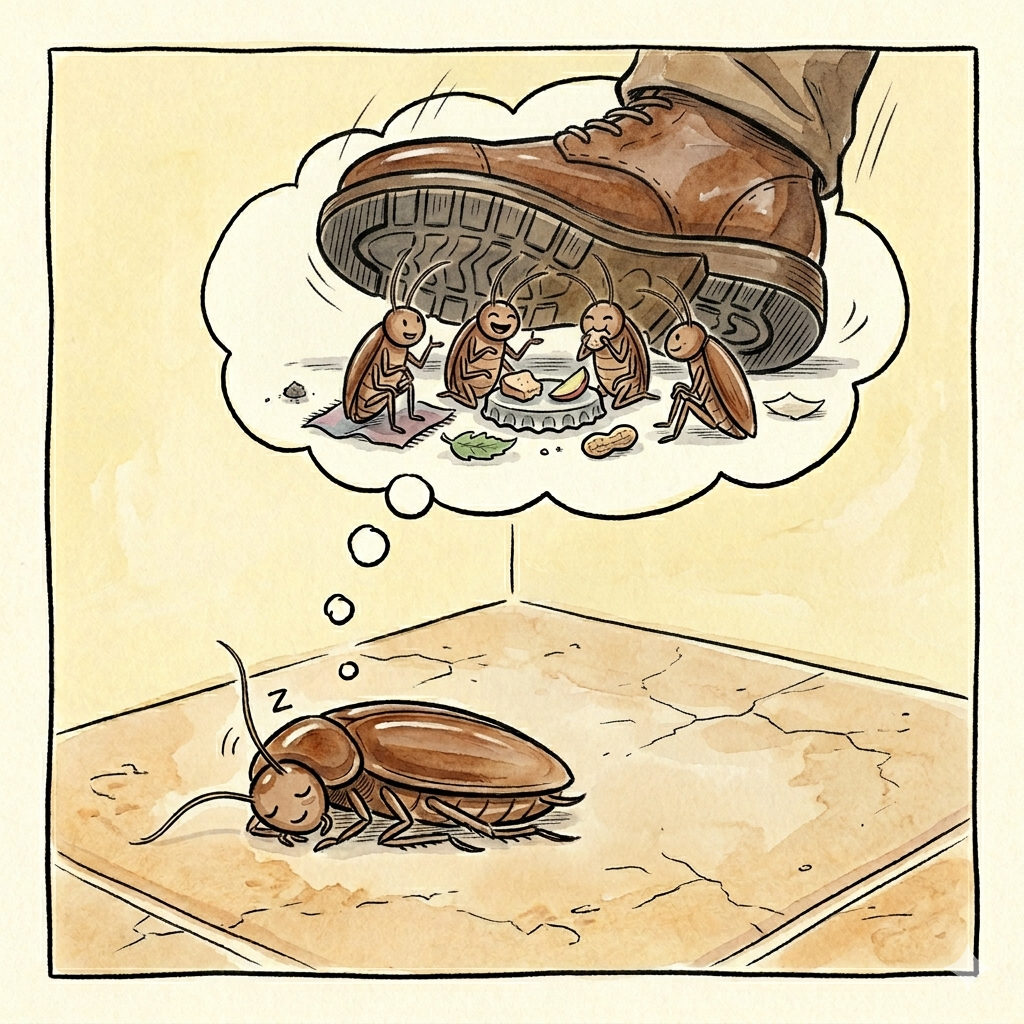
"You've come a long way this morning." A pause. "I know one thing to ask, and I ask it of everyone who stops here. It has been a long time since someone answered correctly. I would like you to try."
Then, carefully:
"Something travels with you that you did not pack.
I have no mouth but I speak to those who stop.
I have no eyes but I see who is lost.
I grow heavier the longer you carry me,
and vanish the moment you set me down.
What am I?"
The fog holds the question. The clearing holds the heron. The group stands there.
The heron is where they left it.
Chip has been carrying the riddle since yesterday morning. Not constantly — the fog has its own opinions about what a person is allowed to hold onto for long. But in the gaps he has been turning it over. What grows heavier the longer you carry it. What vanishes when you set it down and is back by morning anyway. What speaks without a mouth. What sees without eyes. What arrives with you when you didn't pack it.
He knows this thing. He has been carrying it longer than this campaign.
The group reaches the clearing before he has decided whether to say it. The heron is where it was yesterday, on one leg in water that is not there, the head at the angle. It has been waiting. If a bird can look tired, this one does. It looks like something that has been standing in one place for longer than standing in one place is supposed to do to a body.
It turns toward them. Recognizes them. The voice, when it comes, has more pieces in it today than it did yesterday, or Chip is only now hearing the pieces he missed the first time — there is, underneath everything else, someone very old, someone who sounds like they have been cold for a long time.
"You came back." A pause. "Most don't."
Brent goes first, because Brent always goes first.
"An echo."
The heron: "An echo needs a voice to follow. This makes its own."
"Closer," the heron says. "Fear can be outrun. You know this already."
Brent laughs, which he needed to do. The heron does not react to the joke. Herons don't, generally, but this one especially.
Will has said nothing, which is worse than a guess. Will has been watching Chip. Will, offered a riddle by an old uncanny bird in a clearing in a fog he walked here through, has produced no answer and no theory and no attempt, because Will does not speculate out loud. Will writes things down after they happen. This is a Will thing. He is stupid like this. The group has learned to live with it.
Chip knows he is being watched. It is not unpleasant. It is the specific attention of the person in the group who has been documenting everything and who can therefore tell, from the way Chip is standing, that Chip is about to say the thing.
"Doubt," Chip says.
The heron lowers its head. Not a bow exactly. A motion that a heron's neck should not be able to make and that this heron makes slowly, as if the motion is one it has been saving. When it speaks again, the oldest voice in the composite — the cold one, the one that has been in the clearing longest — is the one that answers, and it sounds almost young.
"Yes."
That is all it says. The clearing holds it.
The heron steps aside.
Behind where it stood: a path through the fog. Not lit, exactly. The fog simply declines to be there, in a corridor about four feet wide, arrow-straight, extending further than the Emberstone's reach. The ground underfoot is the same ground as the rest of the Fogmere — wet, packed, dark — but something about walking on it is different in a way Chip cannot name until he is twenty paces in, at which point he realizes that his feet are not cold anymore. The cold that had been in his boots since the morning began is simply gone.
The group walks the corridor in single file. Nobody talks. Brent, who talks through almost everything, doesn't. The sound of their footsteps is the only sound, and the sound is closer than it should be, the way sounds are in a room with a low ceiling.
They emerge on the other side. The fog ends without tapering, the way a curtain ends. The road is there. The sun is there, actually there, not the pink-through-grey of the deep Fogmere but the ordinary yellow of a morning that has been going on without them.
"Yeah."
"How long."
"Since yesterday. Maybe longer."
Kevin nods and doesn't follow up.
"It was pretty good," Kevin says, without turning around.
Brent sent a message that said: "I want to address something that happened last weekend."
Nobody had asked. Chip replied: "okay"
Brent replied: "I went to a Rivian owners meetup. I'm not an owner. I know that. But I wanted to be around the vehicles and I thought I'd be respectful and just observe. And things were going fine. And then a 2023 R1S pulled into the lot and I got jizzy. I didn't realize how jizzy I was being. I thought I was being normal. I was not being normal."
Kevin replied: "oh no"
Brent replied: "a man named Norm came over. Very calm. He said only registered owners get to jizz at the meetups and I needed to show registration if I was going to jizz that much because it was distracting and against the posted rules. I said Norm I don't own a Rivian but this isn't even jizz yet, this is pre cum, I know the rules. He said no way that is way too big of a spot on your khakis to be pre cum that is jizz. I said Norm that is just my drips, imagine how much of a leader I'm going to be here once I actually own one, you should be scared of what's coming. He said sir you need to leave. I said Norm I'm not even at full capacity. He said I'm going to need you to gather yourself and exit the premises. I said Norm listen to me. Rivian is $16.52. It moved 2.5% today. He went quiet for a second. Then he said you made me shoot. Then he said you're a bad guy for making me shoot, you know that, you should go, fuck you, and fuck you I didn't ask you to make me shoot the way I shot right here."
Chip replied: "wow that's neat"
Brent replied: "Norm's a cool dude. Has a Rivian."
Will replied: "Day 14. Norm. Documented."
On the way out — the grey thinning, the road becoming visible again, the specific relief of ground that holds the light — there is a shack.
It sits just past where the Fogmere thins, in the narrow band of land where fog and not-fog meet and neither is fully in charge. Boards weathered to the color of old bone. A tin roof gone the soft grey of a cloud you could put your hand through. A door that opens without being asked, which is either the latch having given up or something else. The group stands on the threshold. Nobody goes in first. Then everyone does.
The smell hits first. Linseed oil so old it has become part of the wood. Turpentine ghost, the kind that lingers in boards for fifty years. Underneath both of those, the iron-and-damp of a stove that has been cold for a long time.
Canvases stacked against every wall. Dozens of them. Chip does a slow count that stops being useful at around forty. They are all studies of fog. The specific quality of light the Fogmere produces at its edge, the way grey becomes grey-white becomes nothing. The painter was trying to catch something that doesn't catch. None of the canvases are finished.
A stool with one leg shorter than the others — wedged with a folded matchbook that has gone soft with age. A table. A jar of water with a brush still standing in it, the water dried decades ago, the brush fused to the glass. A cup with the ring of something once-dark dried into the bottom. The painter set the cup down one morning and did not come back to it.
On the easel: one canvas still blank, facing the Fogmere.
Will writes something in the ledger and does not say what.
Brent picks up one of the canvases — careful, two hands — and looks at it for a long time. He does not say the painter was going crazy. He says: "she almost had it. Right here. This bit." He points at a patch of grey-white on the canvas that is, to anyone else's eye, the same as the rest of the grey-white. Brent is not wrong.
Kevin stands in front of the blank canvas for a long time and doesn't say what he's thinking.
Nobody knows when the painter stopped coming back. The Fogmere kept whatever answer there was.
Propped on the table, set apart from the clutter of brushes and jars — a small canvas. Maybe six inches square. The only finished canvas in the shack.
It is hard to read at first. Something in dark reds and deep blues, a burnt orange underneath that keeps trying to come through, a single streak of cadmium yellow across the lower third that looks like it was added last and at speed. The paint is thick. You can see where the painter went back to the same places again and again, the texture built up in ridges like scar tissue. If you look at it with soft eyes — the way you look at a word you are trying to remember — it resolves into a shape. A gorge. A bridge across it. The specific place on a bridge where a person might stop.
The Forgetting. Weeks from here. A crossing where travelers do not lose their direction but their urgency — where the reason they started feels like it happened to someone else, a long time ago, to a person they sort of remember.
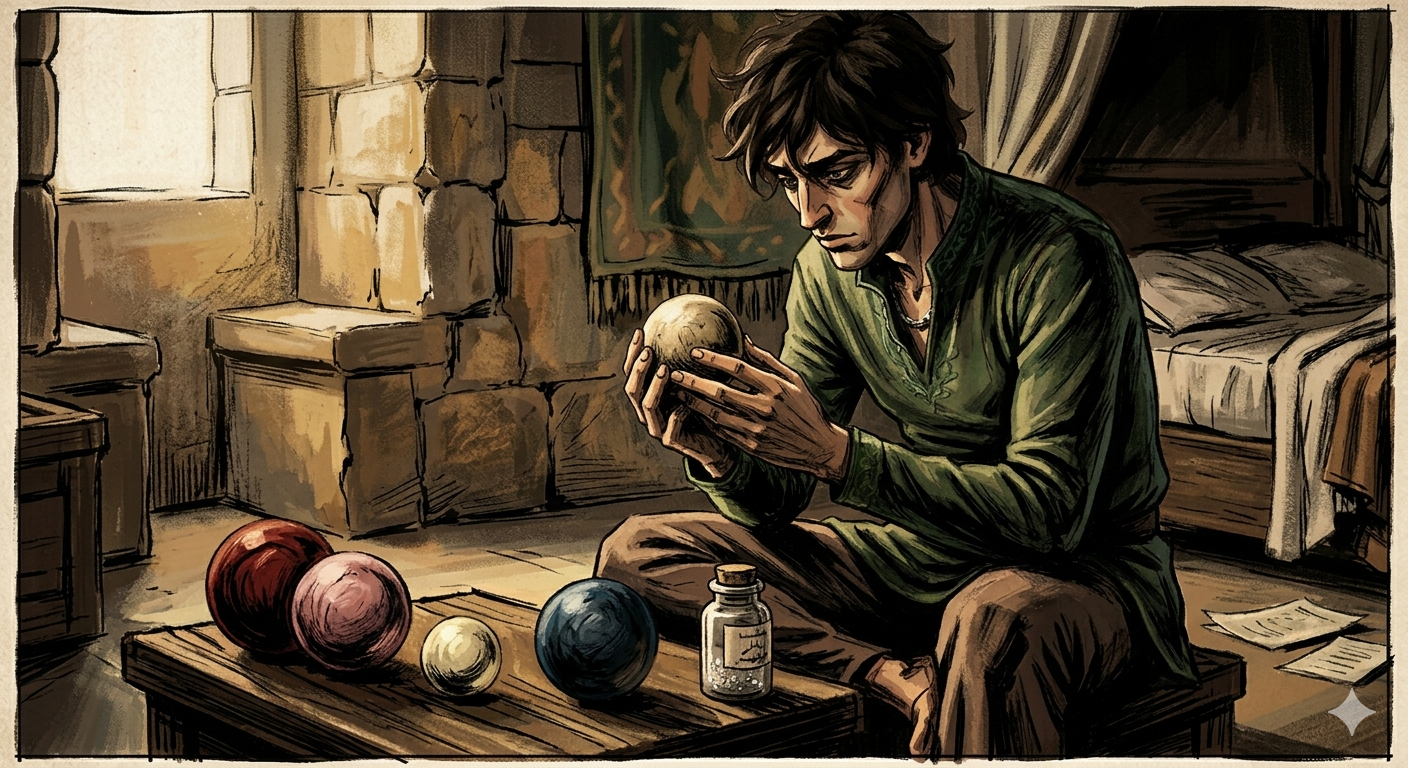
Beside the canvas, placed there with the same deliberateness — a small glass vial. Stoppered with cork, sealed with wax that has gone the color of a bruise. The medium inside has not settled the way oil settles. It holds its own light. Rolled against the inside of the glass is a thin curl of paper, the writing on it facing inward, unreadable from out here. A note for later. A note for whoever breaks the seal.
The painter knew what was down the road. Painted it. Bottled something for it. Left both here for whoever walked out of the fog.
Chip picks up the vial. It is lighter than he expected, the way small heavy things sometimes are when they have been sitting a long time. The wax seal is intact.
Only one person carries it.
Who?
You put it in the pack while the group is still looking at the canvases. Nobody saw. Nobody has to know. The Forgetting is weeks away and the vial is small and the glass is old and you are the one this campaign is about anyway. It is a reasonable decision. The pack is a little heavier when you shoulder it again, which is probably the weight of the vial and probably just your imagination.
IV. Thornwick
◆ Thornwick
Thornwick smells like woodsmoke and old paper — the smell of a place that has been keeping records for long enough that the records have become part of the architecture. The buildings are low. The streets are narrow. Every surface has been labeled by someone who thought the labeling mattered, and in Thornwick, they were right.
Chip's arrival generated conversation in the group about whether the records were real, whether Will's ledger counted, and whether the cartographers would have anything to say about previous campaigns. Will noted the ledger was already a primary document. Brent said: "Papi Chulo has arrived in Thornwick." Kevin, from a timestamp suggesting he had been awake since before the conversation began, said there was an entry in the Thornwick ledger that stopped at day forty-seven with no explanation. Nobody asked how Kevin knew this. By now the group had learned that with Kevin, sometimes you just receive the information.
There is a name carved into the waypost at Thornwick's eastern edge: Elara. No family name, no date. Below it, a symbol the cartographers say means: passed through, continued. Her route extends further than most. Nobody knows how far she got.
A town built around accuracy keeps a particular kind of morning. The bakers are timed to the archive bell rather than the other way around, and the apple seller can tell you, without consulting anything, which surveyor verified the foundation of the building she leans against — not because she is a cartographer but because in Thornwick this is the sort of thing one knows, the way people in other places know which way is north. The streets are named for what was there before the streets were streets. Millbrook Lane has not had a millbrook in two centuries. The cartographers did not rename it. The name is accurate to what was verified, and verification, here, outranks currency.
Chip walked it slowly. Tomorrow he had business at the archive, which opened at the third hour and did not, by reputation, extend itself for latecomers.
The Emberstone was steady in his pocket. There was nothing here for it to flicker at. Thornwick was clearly what it was.
The archive opens at the third hour. Chip arrives after the third hour.
A junior cartographer at the door explains the hours. She does not make this difficult. She also does not make exceptions, and the institution that does not make exceptions is part of what the archive is. The door stays closed. Through it Chip can hear nothing, which is itself a fact about the door.
The compact cartographer finds him outside.
"Carrying anything from a field contact named Mira?"
Chip replied. "I didn't meet her."
The cartographer looks at him for a moment with the expression of someone updating a record internally. "She was on the Amber Road around your day seven. Carrying something for two seasons."
He doesn't say what. He looks at the closed archive door, and then at the Emberstone, and then back at Chip.
"Safe road."
That's all.
Kevin doesn't say anything. He starts walking. The group follows.
The Greywood is ahead. Thornwick holds its records. The cartographers map thresholds Chip has been crossing without knowing they were there, and the archive will be open tomorrow, and Chip will not be in Thornwick tomorrow, and these are all facts that the cartographers have already filed.
The road continues whether or not you know what you're walking through.
Brent, visibly sweating, has unbuttoned his shirt down to his navel leaving only the top button. Distraught, the cholo pinches the two bottom corners of the shirt and fans his bare belly. He turns to the group, frenzied:
Twenty mornings. Thornwick has been watching.
The cartographers keep entries going back further than this quest — different travelers, different campaigns, the same road. The entries that extend furthest don't belong to the travelers who seemed most certain at the start. They belong to the ones who kept showing up after certainty would have been reasonable to abandon.
One entry in the Thornwick ledger stops at day forty-seven. No explanation. The cartographer's margin note says only: further than expected.
The Emberstone burns differently in Thornwick than it did through the Fogmere. Not brighter. More settled.
The road south leaves Thornwick past the last of the cartographers' houses — small, low-roofed, each with a plaque by the door noting the year it was raised and the surveyor who verified the foundation. After the houses, a footbridge over a creek narrow enough to step across. Then the road and the trees and the morning ahead.
Voss caught up with him at the bridge.
She was small, older — old enough that her hands had gone translucent at the knuckles and the tendons worked visibly under the skin when she moved her fingers. The left hand looked like that and nothing more. The right hand had a deep black stain at the side of the index finger where decades of nibs had pressed and pressed, and a fainter grey wash along the inside of the thumb where she steadied the page. Her right hand had done forty years of work her left hand had only watched.
She pressed a compass into his hand.
It did not point north. The needle rested somewhere east of north and held there with a small steady confidence, as though it had decided.
Voss looked at it with him for a moment.
"It points where it points." A pause. "Some travelers work it out. Some don't. We've found both useful."
She didn't say goodbye. The cartographers do not. She turned and walked back across the bridge toward the houses, and the morning closed around her receding.
◆ CompassThe compass was older than anything else in the pack. Brass casing gone soft-edged from handling, the glass a little clouded at the rim, a maker's mark on the underside worn nearly smooth. The needle was true brass-tipped iron, balanced on a pin that turned with the small whisper old instruments make when they have been kept oiled. Whoever had carried it before him had carried it for a long time.
Chip: "compass doesn't point north"Will: "the cartographers of Thornwick do not give broken compasses"Brent: "i have a working compass on my phone papi chulo"Kevin: "😂 aye papi"
The road bends past the bridge toward the Greywood. The compass is in his hand. The needle holds east of north. Voss is heading back toward the houses.
He buckled the compass into the side pocket of the pack without reading it again. Voss had given him an instrument, not an assignment. The road went on and he went on with it, and the compass rode in the pack the way the rest of his things rode — present, not consulted. The cartographers had a record of him leaving without asking. They would have filed it the way they filed anything: as what was observed.
V. The Greywood
◆ The Greywood forest
In the Greywood the air sits heavier in the lungs and a few degrees cooler, the way air does inside a stone basement. Sound moves differently — your own footsteps come back smaller, swallowed before they reach the trees. The light goes grey-green and filtered, the way light comes through a body of water at depth, and the road becomes narrower, and at some point you realize you've been following deer trail for a while.
Old growth. The trees are spaced wider than younger forests because each one is the survivor of every other tree that tried to occupy its share of the sky. Look up and the canopy is dense everywhere except along the edges of each crown, where the trees of certain species have learned to stop short of touching. Crown shyness, the foresters call it. The mature beech and the older oak don't crowd each other. The canopy reads, from below, as a dark roof shot through with rivers of pale sky. The Greywood is named for what the light does inside it.
The roots have surfaced. Centuries of working through old soil have brought the root systems above ground in long corded ridges thick enough to step over rather than across. The floor between them is mostly bare — packed dirt, the dark cups of fallen beech mast, acorn caps gone soft and grey from a previous year, here and there a single dark leaf reduced to its veins. Where leaves have collected they've collected in low pockets, and the ground there gives slightly underfoot. Most steps land on root or earth.
Stevie was in her element. She had spent the Fogmere days low to the ground and unsure, but the Greywood opened up around her and she opened up with it. Something small had moved in the leaf litter twenty meters off the road and she had committed to it, nose down, tail working. Chip whistled and she came back with her ears up and her whole body saying *did you see, did you see*. He had seen. He told her so. She went back to it.
Chip read the floor as he walked.
Burn scar to the east, healed cambium thick enough to date the fire to maybe forty years back, low-intensity, ground-clearing. *Inonotus dryadeus* at the base of an old oak — a polypore wider than his hand, weeping at the rim, which meant the tree was further along than it looked. Partridgeberry in the understory, a long unbroken mat of it, which only happens in forest that hasn't been logged or grazed in a hundred years. Oak apple gall on a fallen branch, dried out, last year's. A turkey scratch in the leaf duff where the floor had collected, four toes spread wide, fresh enough to still show the pad print between them.
He didn't talk while he walked. He was happy.
Then Brent stopped at a beech and put a hand up. The others closed the gap.
On the trunk at chest height, wings open, a luna moth. The green of new leaves. The forewings edged in a soft purple-pink line that ran the length of each, like a hem. Four eye-spots, two on the forewings and two on the hindwings, each ringed in rust and centered with a small dark mark. The hindwings tapered into long pale tails that hung past the body — six inches of moth, maybe seven counting the tails. The antennae were broad and feathered, dark, branched out from the head like two small ferns. The body itself was a tuft of pale yellow down, almost white at the edges. The moth wasn't moving. Not the slow breathing-twitch a daytime insect makes at rest. Just there on the bark, perfectly still, as though it had been placed.
A pause while everyone processed that.
Brent looked at the moth for a long moment. Then he turned to Chip.
A long pause.
Stevie circled back. She sniffed the base of the beech, looked up at Chip, and moved on. The moth wasn't for her.
The Greywood went on south, the road running through it at its own pace. Behind them the moth had a week. The trees had centuries. Both were happening at once, and neither was in a hurry.
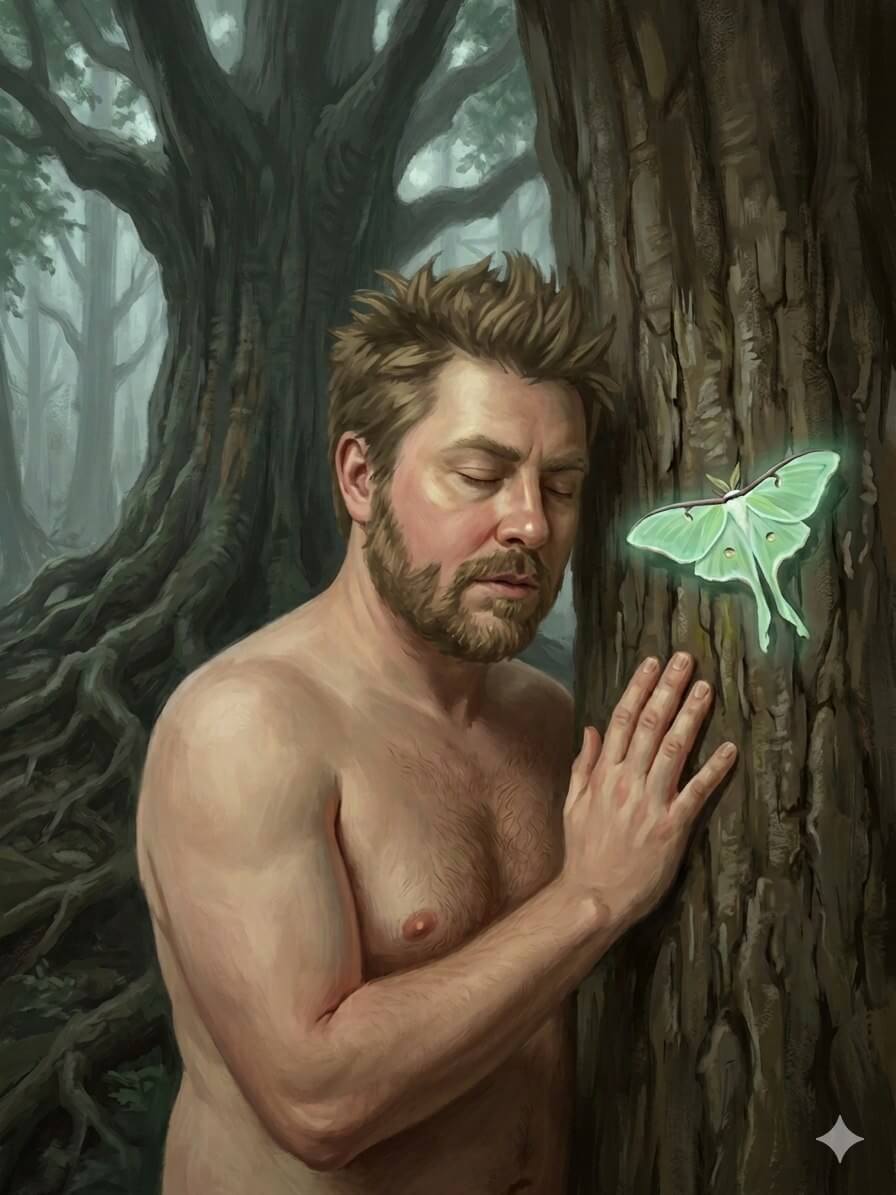
The trail Chip was following wasn't a deer trail. The prints were single-file, the stride twenty-eight inches, regular, the spacing of a person walking at a comfortable rate. Whoever it was had been picking their footing — every print landed on bare dirt or root, never on leaf litter, where a step would have left a clearer impression. A person who didn't want to be tracked but wasn't bothered enough to brush the prints out behind them. They knew nobody was looking yet.
Chip followed the line.
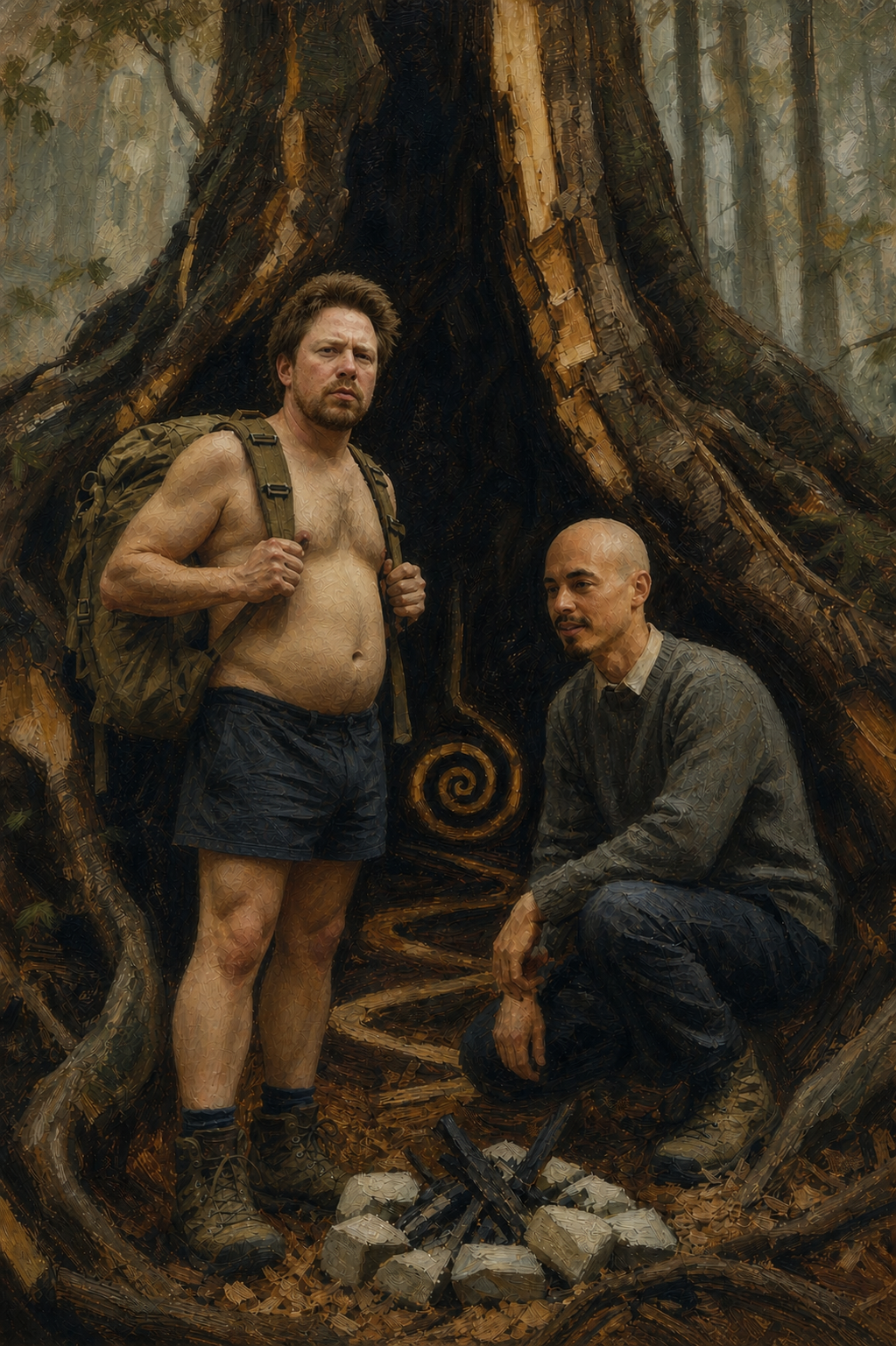
It ended at the base of one of the largest beeches in the Greywood — a tree with a trunk the diameter of a small room, bark furrowed deep enough that he could fit his fingers in the grooves. At the base of the trunk, on the side facing away from the road, the wood opened into a hollow.
He'd seen hollows like this in old growth before. A wound from a long-fallen limb or a strike of lightning, healed slowly over generations, the tree growing around the cavity instead of closing it — eventually leaving a space inside the living trunk you could step into. The opening was the height of his shoulder. He had to crouch to enter.
Inside, the walls curved up and in, and along one curve someone had pressed a symbol into the soft wood. A spiral, seven turns, the terminus angled out from the wall. Below it, a small fire ring on the bare earth. Chip held his hand above the ash without touching it. Hardwood. Banked overnight. The ground was still faintly warm.
Twelve to eighteen hours back.
He photographed the symbol and stepped back out.
The others were coming through the trees. Brent first.
Will reached them next, ducked his head into the opening, came back out with his ledger.
Kevin came up last. He looked at the opening, then crouched at the threshold and looked at the symbol.
He stayed there a beat longer than the rest of them had.
Chip didn't have a response to that.
They walked on. Chip kept his eyes on the floor. Half an hour past the hollow he stopped at a fern that had been bent back at the stem rather than broken.
Whoever was ahead of them wanted them to know.
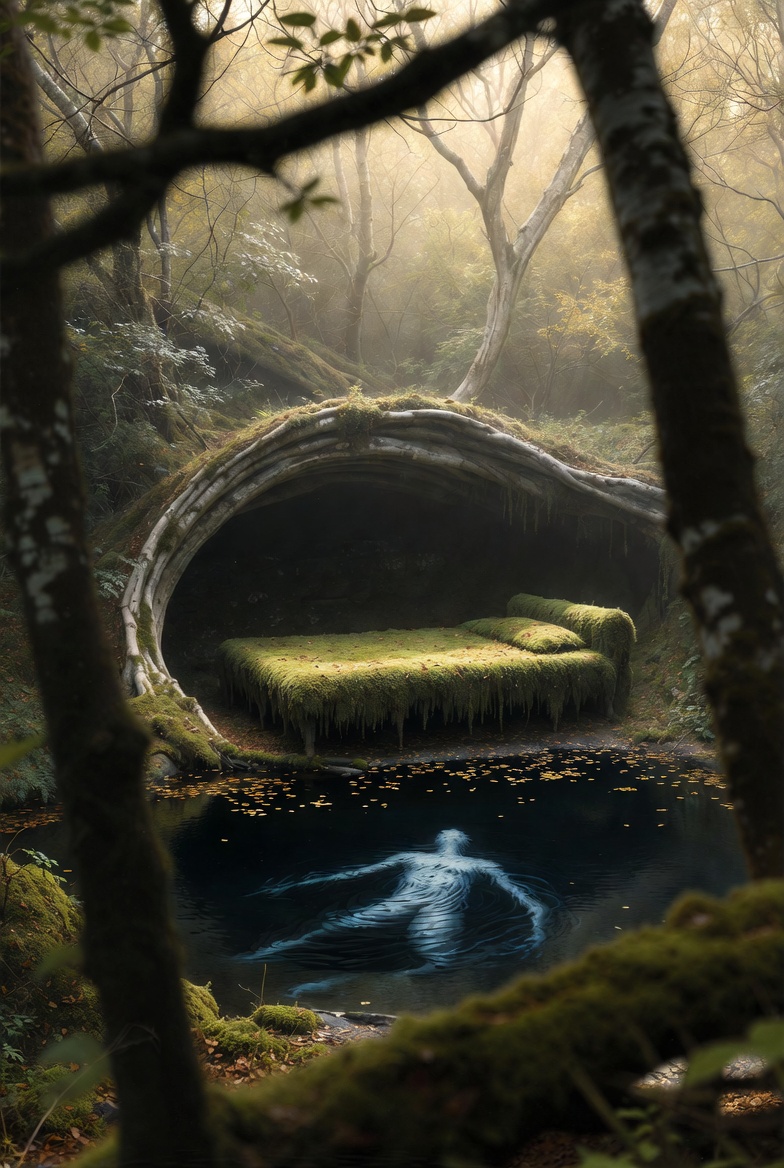
The Dreaming Pull was here before the road was here. It will be here after. It does not need to travel. It is wherever a person could decide not to get up. It is at work right now, in someone you know. In your house. In you.
It does not announce itself. The Pull has nothing to gain from being argued with — argument is a form of attention, and the Pull does not need attention. It needs only the moment that comes after argument, when the person says fine, you're right, I'll start tomorrow, and turns over, and goes back to sleep.
The Pull does not want anyone to fail. It wants them to fall short by a margin small enough that the falling-short can be reasonably explained — by tiredness, by the weather, by the work being harder than expected. The morning that was almost what it should have been. The effort that was almost what was asked for. The apology that was implied instead of said. It does not push. It holds. It is the warm body in the bed that does not want you to leave it — except the warm body is your own.
The Pull is sincere. This is the part most people miss. It is not lying. It does not whisper give up or your work doesn't matter. It would never. It loves the person it is working on. It wants them to be safe, and warm, and at rest. They are tired, the Pull reasons, of the person it is currently working on. They have done enough. The morning will come again. Why would I make them suffer. By the measurements available to it, the Pull is correct. The Pull thinks it is helping. The morning it stole was given freely.
It works through small persuasions. The 10am alarm that becomes 10:15, then 10:30, then noon. The morning you remember there is no meeting until eleven, and the alarm goes back in the drawer. The voice in your head that always has the right rationalization for the moment. The week the laptop stays closed because the work is hard and the couch is soft. Each persuasion is small. Each persuasion costs a person who they were going to be. The Pull does not care which hand is doing the persuading. It only counts what was given.
The Pull does not have a face. The face that appears below dark water, in the folds of bedding, in the patterns of flame in a hearth fire — that face is what the Pull leaves behind when its attention has rested somewhere a long time. A residue. The depression a head leaves in a pillow.
There is no version of this where the Pull is finally beaten and goes away. There is only the version where, on a morning, a person rises and walks anyway.
The Pull will be there again tomorrow. It is not in a hurry.
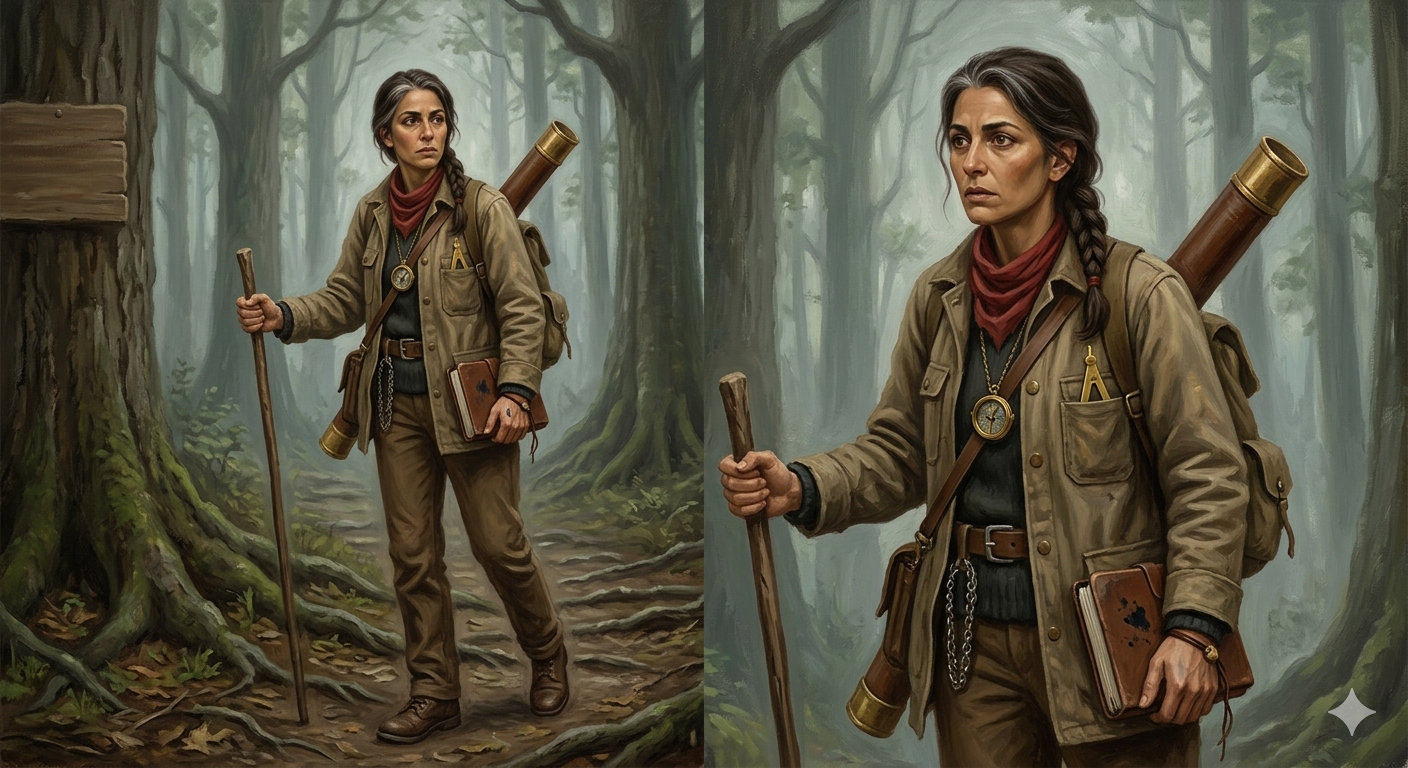
She came around the bend ahead of them moving fast and stopped when she saw the group.
Her eyes went over them and settled on Kevin.
Kevin had already taken his hands out of his pockets.
Senna looked at Chip. The look was a question and Kevin answered it without speaking — a small tilt of the head toward Chip that meant this one, this is the road we're on.
She took the rest of them in — Brent, Will, Stevie at Chip's heels — and turned back to Kevin.
Senna nodded the way someone nods when an answer is what they expected and slightly worse.
She looked at Chip again, longer this time. Chip held the look. He didn't know what was being measured, but he knew he was being measured.
She turned to address the group properly.
Will had his ledger open and was writing as fast as he could.
Senna looked at Kevin.
Stevie's ears were already up.
She was past them and into the trees inside a minute. The wind came up after she was gone, the way wind sometimes follows a fast walker for a few seconds and then forgets.
The group stood at the crossing longer than they needed to.
The group walked south.
Chip walked beside Kevin for a while.
Chip walked for a few steps.
Chip kept walking.
He thought about the archive. He thought about carrying. He thought about some of them, not all. He thought about how many mornings Kevin had been on roads like this with people who didn't make it. He thought about how Kevin had still gotten up this morning to walk with him.
The Greywood went on south. Somewhere ahead and to the north Senna was running.
Twenty-five mornings. A quarter of the road, by the count. The remainder is unmarked.
The Greywood is patient because patience has stopped being a posture for it. The trees here grew before there was a road; they grew before there was a name for road. They are doing now what they were doing then. The patience is the doing.
The Emberstone burns differently in the Greywood. Not brighter. More focused.
Kevin sent something during the Greywood stretch. The timestamp said something about his morning before the message did. It said:
Twenty-five. The work isn't building anything. The work is the thing being built. You can't see it from the inside. From here it looks like you got out of bed twenty-five times. From a distance it looks like a man getting good at being one.
No elaboration. Kevin doesn't elaborate. The message was complete when he sent it.
Chip: "did Kevin just go deep"Brent: "Kevin goes deep approximately once every nine days. You learn to wait for it"Kevin: "I was just awake and had a thought. Don't make it a thing"Will: "Day 25. Documented"Kevin: "Thank you Will"Will: "That's what the ledger is for"
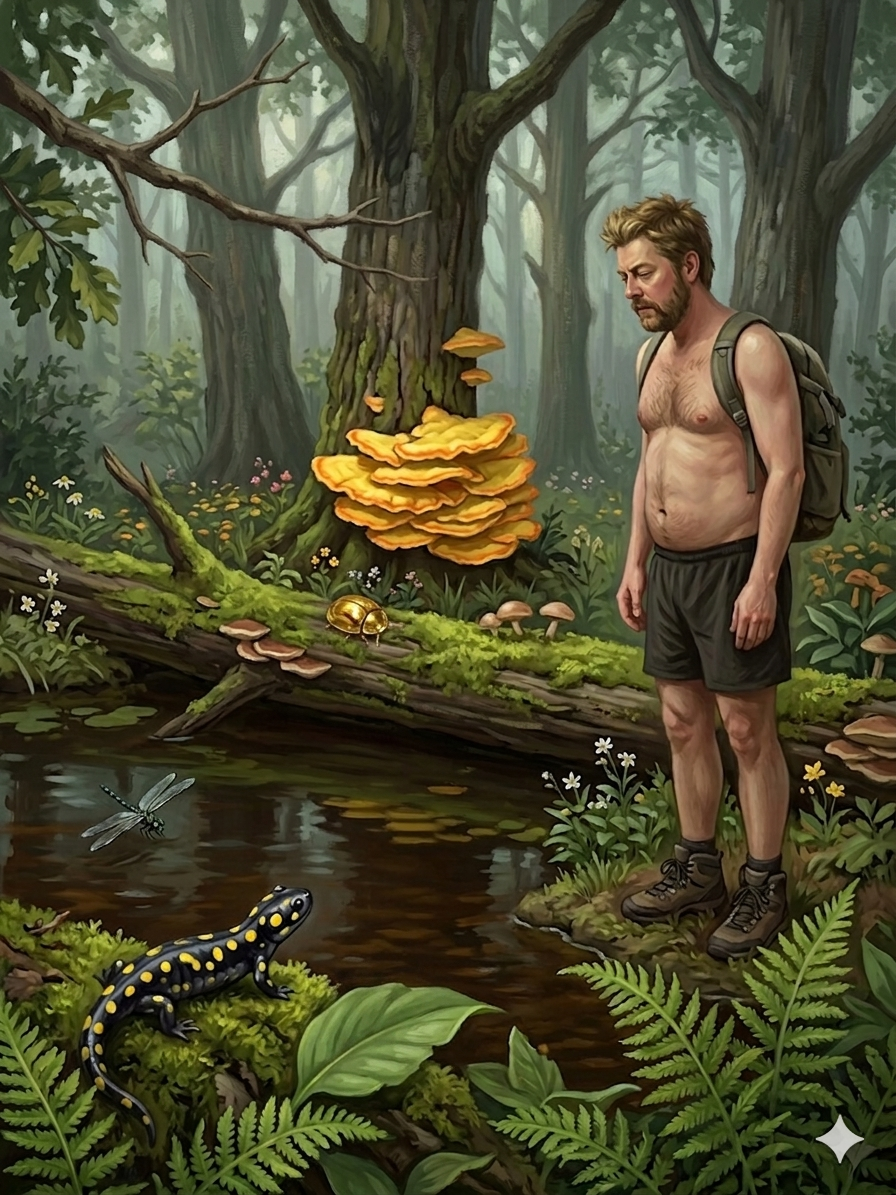
Chip found the pond ten minutes off the main path. He'd left the road to follow what he thought was a different deer trail and wasn't, and the trail led him to water — still and dark with tannins, a fallen log half-submerged at the bank, leaf litter ringing the edge in a soft fan. He stood at the bank for a moment before calling the others.
Five minutes before they catch up. What does he want to show them?
Under a log at the pond's bank — he lifts the edge gently, the way he was taught, replacing exactly what he disturbs — a spotted salamander. Black with bright yellow spots, maybe eighteen centimeters, completely still in his hand for three seconds before it decides he's not a threat.
The yellow spots are a warning. The warning is real — it produces a mild toxin through its skin. But the toxin has no practical effect on anything large enough to hold it, which means the warning has been working for thirty million years exclusively on predators that no longer exist. It still makes the toxin. It still wears the spots. The threat is gone and the defense remains, fully functional, absolutely sincere, pointed at something that has been extinct since before this continent had its current shape.
He puts it back. He replaces the log exactly.
Brent: "is it scared"
Chip: "no"
Brent: "but the predators are gone. why does it still — "
Chip: "the predators are gone *because* it still does this. they learned not to try and eventually they died out and the salamander kept doing what it does and that's the reason there's nothing here that wants to eat it"
Brent: "...wait"
Chip: "if it stopped, nothing would come back to eat it. but the reason there's nothing to come back is that it never stopped"
Brent: "papi that's — that's kind of the whole thing"
Chip: "yeah"
Will: "*Ambystoma maculatum.* Warning system intact. Predators extinct. Defense maintains the extinction. Day 25. Documented"
Kevin: "the salamander doesn't beat the predators. The salamander keeps the world without them"
Kevin: "that's the trick"
VI. The Hollow Pass
◆ The Hollow Pass
The Hollow Pass changes sound first. A footfall comes back small and late, the canyon adding distance to it before returning it. The walls rise on either side higher than the eye wants to follow — a thousand feet of dark layered rock, banded with grey and rust, the layers offset where ancient pressure pushed them out of true.
The cold arrives second. Not weather cold. The cold of stone that has not been warmed in geological time.
The compass needle settled in the Pass. It had been moving since Thornwick — slow and uncertain, never the same direction twice. In the Pass it stopped, pointed once, and stayed.
Chip sent a check-in to the group noting the temperature. Will confirmed the documentation and agreed with the temperature assessment.
Kevin was already in a cold car for reasons involving his children and their morning schedules. He offered no sympathy on the cold. Then he mentioned that one of his kids had woken him up to ask if bugs dream, which he had not been able to answer, and that Chip might have thoughts on this given his line of work.
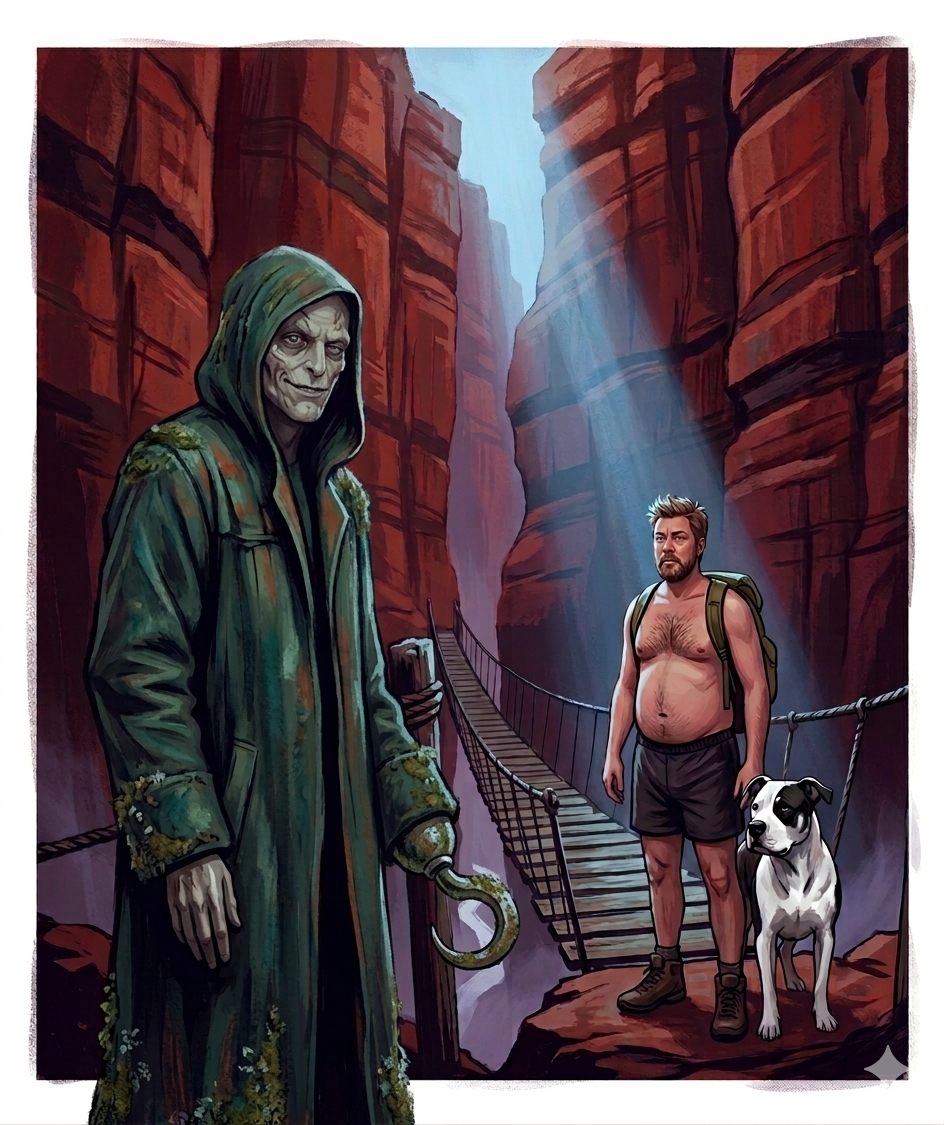
The bridge at the Hollow Pass has one keeper. Aldric. Thousands of years in the same coat. The ropes move whether the wind is blowing or not — the canyon pulls at them from below, patient and yearning, the way deep things pull at the surfaces above them.
Aldric already knew the answer. He was waiting to find out if Chip did too.
You look like you left something behind. What was that, traveler.
Below the bridge the river has been cutting the same stone for a million years and is not finished.
I stopped believing I would be a different person. I left that behind.
Aldric stepped aside. Reached into his coat — a stone, smooth, from the canyon floor, warm and weathered — and dropped it into the pack.
Aldric watched him cross the way he has watched ten thousand travelers go. The safe answers. The almost-answers. The ones who stood at the edge and stepped back into safety.
And the ones who spoke honest and kept walking.
There are not many of them.
This one kept walking.
A long pause.
A long silence.
Chip put the phone down.
He stood in the Pass for a moment.
The Pull, which had been watching, did not return. The Pull is patient.
Chip walked.
He carried what he had been told.
The stone Aldric gave him was warm in the pack.
Brent, sent at 7:58 AM: "I need to tell the group what happened this morning."
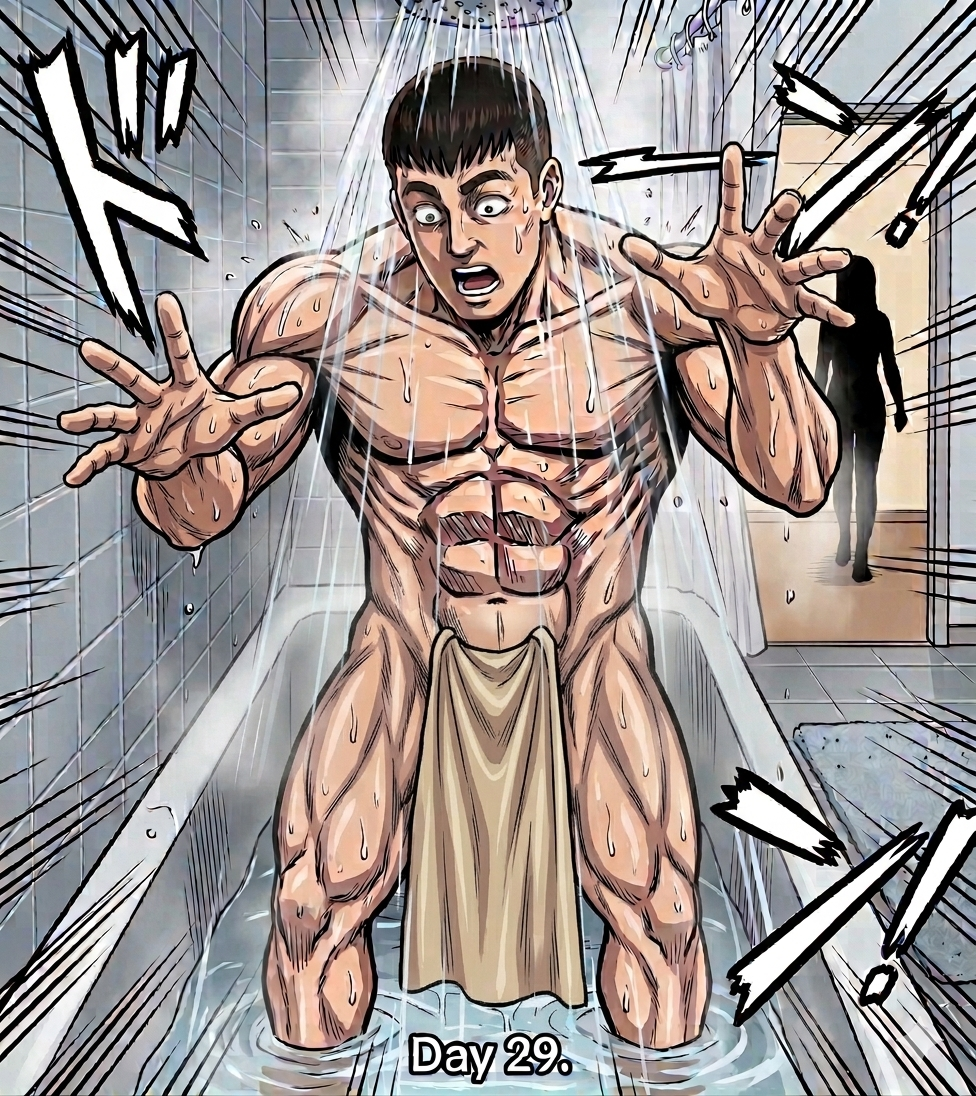
Thirty mornings.
The Hollow Pass offers no scenery and no revelation. It offers passage. Passage is what it gave.
Thirty is a number that means something — not because of what the number is, but because of what thirty consecutive mornings cost, and what they built in the building.
The Emberstone burns at its clearest in the Pass. Not brighter. Clearer. The Pass strips things to what they actually are.
What Chip actually is, thirty mornings in, is a traveler who stopped trying to become someone new. He left that behind at the bridge. The thing he picked up in its place was the wake-up ball, and this morning the wake-up ball went up at the right time.
The compass from Thornwick stopped moving in the Pass. It had been gesturing at a direction since day twenty, but here the needle settled into certainty. Whatever it is pointing at, the Pass is where the direction became fixed.
The stone Aldric gave him was warm in the pack.
Will: "Thirty. I had twenty-two in the pool"He did not explain who else had entries, or what they guessed. He noted that thirty was not the consensus. Nothing else.
Brent: "for anyone curious, Will's nothing else here is doing a lot of work. He's extremely pleased"Kevin: "I had thirty-one, for the record"Will: "you had the highest number"Kevin: "I believed in the guy"· · ·A pause.
Kevin: "still do"Some things get documented because they should be.
The compass has settled. It is pointing in a direction that is not the marked road.
Voss handed the compass over in Thornwick because the cartographers' maps stop where the cartographers' surveys stopped, and the compass does not stop. It points where it points. Voss said some travelers work it out, some don't. We've found both useful. The compass has not been wrong about what it points at. It was given by someone who makes maps of places before they are found. The compass knows.
Following it means leaving the marked road for a while. The path it indicates is not the path other travelers have documented. The travelers who came back from this section all said the same thing: the compass knew before they did.
VII. The Sanctuary of Halverd
◆ The Sanctuary
The Sanctuary smelled like woodsmoke and the breath of someone who has been quiet a long time. The room was warmer than the fire alone should have made it.
Halverd was at the fire when they came in.
He looked up and smiled when he heard the door.
He stood. It took a moment, because he was very tall. The ceiling of the room was generous in a way you would not have guessed from outside.
He had eight arms. The two lowest rested at his sides. The upper six were each doing something — one was stirring a pot at the fire, one was mending a strap of leather across his knee, one was holding a wooden cup of something steaming, one was turning a small piece of wood over in his fingers and looking at it critically, one was holding a thin knife above the wood, and the last was open, palm up, resting on nothing.
His face was plain and wide and old in the way stone is old.
He set the wood down and brought four mismatched cups from the east shelf, filled them from a pitcher on the table, and set them out.
The fellowship stood near the door for a moment, the way people do, and then came in.
Brent was the first to say anything. He was looking up at Halverd's arms.
Halverd looked down at himself, as though checking.
Brent looked at Will. Will was writing.
Stevie pushed past Chip's leg and walked across the room to Halverd's chair. She stopped in front of him.
Halverd looked down.
He put one of his resting hands on her head, slowly. She sat down at the chair leg and stayed there.
The room was one room. Stone walls. A deep hearth on the north side with the fire low and steady. A long wooden table. Two low shelves along the east wall. A west-facing window with the shutter open. The light came in sideways and the dust moved slowly in it.
The east shelves held small wood carvings — birds, mostly, but a few other things. A bundle of dried herbs hung from a peg above the shelf. River stones on the lower shelf, polished flat on one side.
Kevin had been looking at the chestplate hanging on a peg by the door.
He turned the piece of wood over and made a small cut in it.
Kevin nodded.
They settled in.
Brent took the bench nearest the fire and warmed his hands. Chip sat at the table with one of the cups. Will sat across from him and kept writing in the ledger. Kevin took the chair near the window with his back to the wall.
After a while Brent said:
The light in the window changed. The fire stayed the same. The bread came out of the oven Halverd had built into the side of the hearth. They ate at the long table. Halverd did not eat. He sat at the near end and kept his hands going — the stitching, the carving, the tea, the resting. He talked when he was talked to and asked about the road and where they had come from and where they were going. He listened carefully.
When Will mentioned the bridge in the Pass, Halverd closed his eyes for a moment.
He did not elaborate. He went back to the strap.
The carving hand kept making small cuts in the wood. The piece was starting to take a shape Halverd had not committed to.
They slept in the Sanctuary that night. The warmth held. Halverd was at the fire when the last of them closed their eyes. Some of his hands worked. Some rested. Stevie was on the floor near his chair.
The wake-up ball, this morning, went up at the right time.
Chip got up before the others. Stevie was already awake, sitting near Halverd's chair, watching the fire with him. Halverd was working. Two hands at the pot, which had been cleaned and was starting on something new — porridge. Two hands on the strap that had been the mending project the night before, almost finished. One hand on the piece of wood. One hand resting. The two lowest at his sides.
Chip went to the shelf. The cup with the small chip in the rim was on the side, set out for him. He had grabbed it last night without thinking about it. He grabbed it again.
Chip looked at the cup. The chip in the rim was small, smooth, worn — a piece had come off the cup a long time ago. He filled it with tea.
The day moved by degrees.
Brent woke up and went to the fire. He looked at it. It was burning low and steady, the way Halverd liked it. He fed it one small piece of wood from the stack by the hearth, the same size as the last one.
Brent fed it another small piece.
Kevin had been awake the longest. He had taken down the bundle of dried herbs from the peg and was sorting them at the table — the good from the past. The past ones went into a small pile he set aside.
Chip found the broom in the corner. He swept the part of the floor near the door — the road dust from the day before. He got into the corners. The flagstones had a slight unevenness to them, old and settled, and the dust came out of the low places. He swept slowly. He did not have anywhere to be.
It was Will who noticed first.
He was sitting at the bench with his own piece of wood, turning it in his hands, trying to figure out where to cut. He paused. He looked at the wall across from him.
Halverd looked over. His mending hand kept mending.
Brent looked up from the fire. He watched the wall for a moment.
Halverd's hand paused. Resumed.
Will wrote it down.
Halverd picked the strap back up.
Brent looked at the wall for a long time before he went back to the fire.
Halverd finished the strap in the late morning.
He held it up with two hands and looked at it. He turned it over. He ran one finger along the seam.
Halverd hung the strap on a peg near the door, next to the chestplate.
He sat back down. One hand picked up the piece of wood. Another picked up the knife. He made a single small cut. He paused. He turned the wood over. He looked at it from another angle. He made another small cut. He paused.
Brent watched him for a while.
Halverd looked at the porridge hand. It was stirring slowly, in long even strokes.
He held up the wood with one hand and the knife with another.
Brent thought about this.
He lifted the carving hand.
He made another cut in the wood.
Brent looked at the fire. He had been about to feed it. He paused. He looked at the small piece of wood in his hand. He fed the fire.
Will had been watching the carving hand.
Will set his own piece of wood down. It had a few rough cuts in it that had not gone anywhere.
Halverd looked at his hand. The hand was holding the wood in a way that was familiar to it.
He turned the wood over.
He held the wood out.
Will took the wood. It was warm from Halverd's hand. The shape that had been emerging — a curve, a narrowing — fit in his palm differently than his own piece had.
Halverd passed him the knife.
Will held the knife. He looked at the wood. He made a small cut. He paused. He turned the wood in his fingers.
Halverd picked up a second piece of wood from a small pile under the bench and another knife from the shelf. He began to work without comment. He did not watch Will.
Will made another cut.
He kept going.
The light in the window changed.
Halverd asked Will about the ledger. Not what was in it. Just about it.
Will looked at the ledger.
He stopped.
Halverd's mending hand paused. It resumed.
Halverd's carving hand paused. It resumed.
Halverd's porridge hand stirred slowly.
Brent looked up from the fire.
Halverd's mending hand paused.
Brent set down the piece of wood he was holding.
Brent stared at him.
Halverd's mending hand paused.
A pause.
Halverd made a small cut in the new wood.
A small pause.
Halverd made another cut.
A pause.
The fellowship looked at him.
Halverd looked at his hand.
A pause.
Halverd made another cut.
A quiet stretch.
Halverd looked at his hand. The hand was holding the wood.
He turned the wood over.
Halverd looked at his eight hands.
Brent waited.
A pause.
The fire moved.
He made a small cut in the wood.
The fire popped quietly.
The evening came. The stew Halverd had built through the day from the morning's porridge was on the table. The bread came out of the oven. They ate at the long table. Halverd kept his hands going while they did.
Will set the wood down only when the food came. The shape had started to suggest something. He did not yet know what.
The walls were swaying, very slightly. The fellowship had stopped looking at them.
Late in the evening, when the fire was low and Brent had stopped feeding it because Halverd had said, gently, let it go down now, the fellowship began to think about sleep.
Chip looked at the door.
The door was where the door was. It was a door.
He looked at Halverd, who was working on the new piece of wood.
Halverd did not look up.
He made a small cut.
Chip nodded.
He went to his bedroll. Stevie was already there. The fire was low. Halverd was working.
Chip woke in the night.
The fire was low. Halverd was at the hearth, four hands resting on his knees, four hands working — one on a strap, one on the carving, two on a small thing Chip couldn't see. Stevie was at the chair leg. The others were asleep.
Chip looked at the ceiling.
The room was talking.
He knew the voice. It was the voice from Downers Grove. The voice from the alarm. It had been with him a long time.
Chip did not answer.
Chip did not move. Stevie was breathing slow and even.
Chip closed his eyes and opened them.
Chip did not move. The voice waited. It waited until he looked.
He looked at the fire. He looked at the long table. He looked at Halverd, who was carving.
He looked at the walls.
The walls were swaying — the slow imperceptible sway he had stopped noticing. They were swaying with the voice.
A long pause. The walls moved.
Chip looked.
Halverd was at the fire. One hand was carving. The eyes were on the work.
Halverd looked up.
Across the fire. At Chip.
He did not nod. He did not say anything. He looked at Chip the way a person looks who has heard the voice and lived inside the answer.
Then he looked back at the work.
Chip looked at Halverd a long time.
He saw a man at a fire. He saw the strap. He saw the carving. He saw the arms taking turns. He saw the kindness. He saw the tiredness under the kindness.
He thought: he is the kindest man on this road.
He thought: he has been carving the same piece of wood for two days.
He thought: I am not Halverd.
He thought: the road is mine.
The voice was quiet for a while.
Then it said:
The walls slowed.
The talking stopped.
Chip lay in the dark. Stevie made a small sound in her sleep. The fire popped quietly. Halverd worked.
Chip slept.
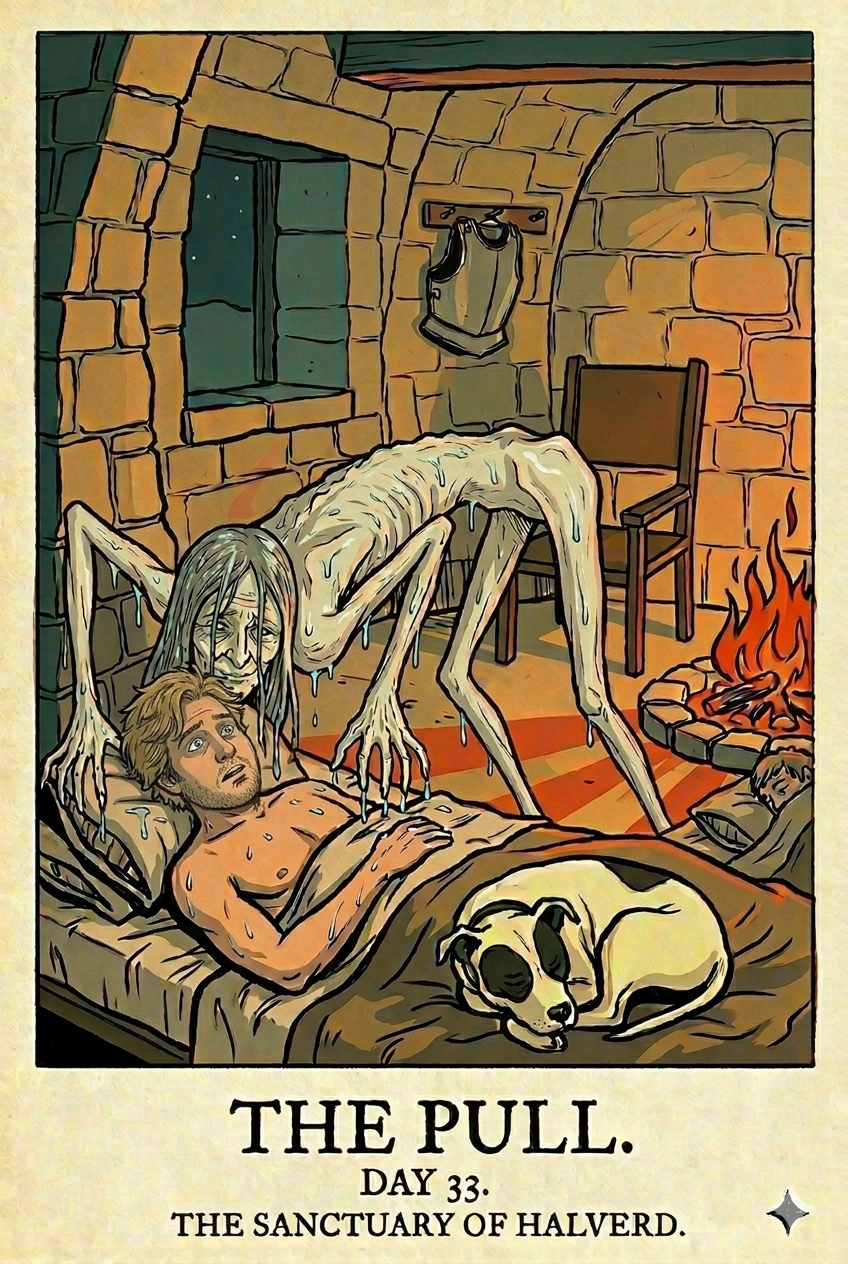
Chip woke before the others. The fire was low and the room was half-lit at the edges. Halverd was at the hearth where he had been all night. Four hands rested in his lap. Four hands worked — one on a piece of leather, one on the carving that had begun in his hands two days ago and now lived in Will's, one holding a cup of tea. One open and empty.
Chip went to the shelf and took the chipped cup and filled it. He sat at the table where the fire reached. The others were breathing slow.
Halverd kept working. Then, without looking up:
Chip looked at him.
He turned the leather over.
The fire popped. Stevie twitched once in her sleep at the chair leg.
He looked up.
That was all. He went back to the leather. Chip sat with his cup and watched the fire.
────────
The others woke. Brent first, to the fire. Kevin with his eyes already open when Chip looked over. Will sitting up and reaching for the ledger before he was fully awake.
The wood stack by the hearth was lower than it had been on Day 31. Worked down — four days of small feeding, one piece at a time. Brent went to it without being asked, took a piece the right size, laid it on. The fire took it.
Kevin went to the herb bundle he had refreshed two days before. He ran his thumb along the stems and pulled a few more to set aside.
Chip found the broom. The floor was cleaner than when they'd arrived, but four days of boots leave their record. He started at the door and worked toward the hearth. He got the corners.
Will sat at the bench with the piece of wood. It was different now — the first cuts had been tentative, working at cross-purposes. Since then the wood had been coming forward out of itself day by day, the shape in it becoming clear. Will turned it in his hands, set it on the bench, looked at it from the side.
Will picked it up and made a cut.
────────
It was Chip who heard it first.
He was at the floor near the bench with the broom. He had paused — for no reason he could have named, just the kind of pause that arrives between motions — and he had been standing still with the broom in both hands when the sound came.
A small dry scratch at the window. The sound a small foot makes on a stone sill.
Chip turned his head slowly.
A wren was on the sill.
The wren took its time. It looked at the room. It looked at the fellowship. Then it looked at Chip.
It held him there for a long moment. The eye on the small bead of its head, very steady. Chip looked back. He did not look away.
The wren hopped once on the sill. It took two small steps along the inside edge.
It lifted off.
It crossed the room low — lower than the level of the table — through the slow firelight, and it came toward Chip.
It landed on the top of the broom handle. Chip felt the wood take the small weight of it.
It was small enough to fit in a cupped palm. Brown along the back, pale at the throat, tail held up at the small alert angle. Its eye was a black bead and the eye was on him. He had the broom in his hands. The bristles were on the floor.
It tilted its head and looked at him with the right eye, and then it tilted again and looked at him with the left. The small feet were closed around the wood and Chip could feel its grip through the handle through his hands.
He could see the small ring of pale feathers around the eye.
The wren did not move. The room was still.
After a moment Will lifted the piece of wood very slowly from the bench. He brought it level with the top of the broom handle. He held it next to the wren.
The shape Will had been carving and the wren on the broom were the same shape.
The wren stayed.
Then it lifted off in one clean motion — soft, almost silent — and crossed the room the way it had come, and was gone through the window.
The sill was empty.
Chip stood with the broom in his hands. The bristles were still on the floor.
He looked at the broom handle. The wood was the wood a wren had been on. He set the broom against the bench. He sat down at the table.
────────
Halverd set down what he was working on.
He folded all eight hands into his lap. He looked at the empty sill.
He did not move for a long time. The fellowship did not move either.
Then Halverd let out a slow breath. A long one. The kind people don't let out in front of others. The fellowship registered it.
He looked at Chip.
Nobody spoke. Stevie padded across the room, put her nose against Halverd's knee once, and sat down at the chair leg.
Halverd looked at the fellowship. Then he looked at Chip.
He said it plainly.
He was quiet a moment.
He looked at Will's piece of wood on the bench.
He looked at Chip.
The fire was steady.
────────
He looked at the carving on the table. He looked at the empty sill. He looked at his hands in his lap.
He did not pick up the leather.
A pause.
He breathed like a man who was about to open a thing he had been keeping closed.
He paused.
Kevin was looking at the fire.
He glanced at his hands.
Will's pen was resting on the ledger.
Halverd's hands were still.
He looked up.
He looked at his hands.
A pause.
A pause.
He said it plainly, without a flinch.
The fire popped.
Halverd sat with their silence. He did not hurry past it.
He looked at the carving on the bench.
A breath out.
────────
The room held it for a moment.
Brent put his elbows on his knees. He looked at the floor. He looked up.
Brent put his face in his hands.
Halverd looked at him for a long moment.
────────
What he had just told them was the word — the gate, the men, the method that came after. Halverd looked at Chip to make sure he had it. Chip held it.
Brent looked at Chip. "It's late."
"Yeah."
"We should sleep. Head out in the morning."
Chip nodded. Kevin nodded. Will closed the ledger and set the pen on top of it.
Halverd looked at the fellowship. His eyes were still wet. He said nothing. He nodded once.
They went to their bedrolls. Stevie was already at Halverd's chair leg.
Brent was tying the strap on his pack.
Will set the carving on the table.
"Halverd."
"Yes."
"I think it's done."
Halverd looked over. He reached out with the carving hand he had used on Day 31. Will put the wren in his open palm.
Halverd held it. He turned it over once.
"You caught it in the moment."
"Yeah."
Halverd closed his fingers around it gently, the wing curving up from his hand.
Brent: "Halverd you should come visit us."from across the fire, Halverd: "Of course I'll visit. I've been meaning to leave here sometime."Will: "Halverd you wouldn't survive the Chicago suburbs."Halverd: "I would. I've survived worse."Brent: "He'd love it. Halverd we'd take you to Fogo de Chão. They bring the meat to the table on swords."Halverd: "Swords?"Brent: "Yeah they walk around with the meat on the sword and they slice it onto your plate."Halverd: "I would enjoy that."Will: "Halverd you'd be the most overdressed guy in the restaurant."Halverd: "I have been overdressed for a long time."Chip: "Halverd come visit. I could use a pickleball partner with your dimensions."Halverd: "Only if you start playing with the 4.0 group now, Chip."· · ·The fellowship laughed.
Brent: "Wow Halverd are you 4.0?"Halverd: "I have eight arms."Brent: "That's not how the rating works."Halverd: "It should be."Kevin: "Halverd would crush at the 4.0 level. The serve alone."Halverd: "Thank you, Kevin."Brent: "Halverd seriously come visit. The west burbs. You'd love it. You can stay at my place. My wife would have questions but she'd come around."Halverd: "I'd love to. You guys are the best, that would be so much fun — "· · ·The fellowship kept packing.
Brent: "Halverd we'll set up a Halverd weekend. You'll meet my brother. He's going to lose his mind."A small sound across the fire — the polished stone Halverd had been working on for five days hit the floor. It rolled toward the fire and stopped.
Brent kept tying his pack.
Brent: "Halverd you cool with meeting my brother?"The wooden cup tipped from another of Halverd's hands. It hit the floor — wood on stone — louder than the stone had been. It rolled in a half circle and stopped. The water inside ran across the warm floor in a thin line.
Will looked up.
Will: "Halverd…"The half-mended cloth slipped from a third hand. The fabric pooled at the foot of the chair quietly.
Then the carving.
Halverd had been holding it in one hand, the wing curving up from his fingers. The hand opened. The carving fell. It hit the stone hard and bounced once and the wing snapped off cleanly. The bird's body rolled to a stop near the fire. The broken wing was three feet away.
The fellowship turned.
Halverd was hunched over.
The smile was gone. The eyes were open and empty. His head had dropped forward a few inches and stopped. His main two arms hung off the chair. The other six were limp. Three more objects were still in his hands — a smaller stone, a strip of leather, a needle — and as the fellowship watched, his fingers loosened around them and they fell, one after another, in soft small thuds. The stone bounced and stopped near Stevie.
Stevie barked.
"Halverd," Brent said.
Nothing.
"Halverd."
Kevin had stopped tying his pack.
Chip stepped close to him and held his hand near Halverd's face.
"He's not breathing."
The walls of the room moved.
Not the slow imperceptible breathing they had been doing the whole time.
They expanded — audibly — with a low wet sound — and then contracted.
The walls came in.
Brent: Guys.The fire in the middle was on something that pulsed visibly now, every two seconds. The floor was warm and wet under their boots. When Brent shifted his weight, the floor shifted with him — pushed up against his boot, gentle but undeniable.
Chip looked up.
The ceiling was ribbed and pink and ran with dark fluid in the spaces between the rafters. The pattern of the arches was something Chip identified as a hard palate.
The walls expanded and contracted again. Harder. The room was smaller.
Kevin: The room is getting smaller.Stevie was growling. Low. Hard. Hackles up.
At the far end of the room, around the frame of the doorway, white shapes were emerging from the wall.
Long.
Pointed.
Curved inward.
Teeth.
Top row first. Then the bottom. They came out of the doorway frame slowly, sliding into position with a wet click.
Brent: The *door* —The teeth were halfway across.
Will: Go. Go, go —Brent took a step toward the doorway. The floor pushed up against his boot. He stumbled.
Kevin: GO.Halverd's body slid forward off the chair.
It hit the floor with a soft smush. The eight arms hung limp at its sides. The legs splayed behind, trailing. The head was slack. The eyes were empty.
The torso began to wriggle.
The body crawled by the torso alone — the abdomen contracting and releasing in long even pulses, pushing the body forward across the warm wet floor. The arms dragged dead at the sides like sleeves of a coat. The legs trailed useless. The head lifted just enough to face Chip, the empty face pointed at him, the slack jaw lolling, the head wagging slightly with each pull of the body.
Chip: *What.*Stevie was full barking now, planted between Chip and the puppet, hackles up.
Will: Chip *go* —The puppet was four feet from Chip. The torso writhed harder. The teeth were three quarters of the way covering the door.
Chip —
Chip stumbled back. Stevie was barking and snapping at the puppet. The puppet's limp hand dragged across Stevie's shoulder. Stevie lunged.
Brent: Stevie!Chip grabbed Stevie's collar. The puppet pulled itself another foot. Two feet from them now.
Kevin: *Now.* Now now now —The teeth were almost closed. The doorway was a slit. The torso coiled, aimed itself, the empty face lifted once more toward Chip.
Brent: We're not —The puppet's body lurched forward and one of its limp hands fell across Chip's boot.
· · ·Halverd sat up.
The puppet — mid-lurch — stopped. The torso pulled itself upright on the floor. The face animated. The eyes opened. Halverd blinked twice, fast, the way a person does when they've nodded off and need to recover.
He looked down at himself. He was lying on the floor halfway across the room from his chair, the eight arms slack around him, one of his hands resting on Chip's boot.
He looked at the teeth.
He looked at the walls.
He looked at the fellowship.
"Oh," Halverd said.
The teeth stopped. Hung there, almost shut. Then, slowly, began to retract.
The walls held. The floor started to settle.
Halverd pushed himself up onto his hands. Then onto his knees. Then, with effort, onto his feet. He stood for a moment, wobbling slightly. He walked back to his chair. He sat down. He arranged his arms.
He looked at the fellowship.
"Oh," Halverd said again. "Oh no."
A long silence.
The fellowship had not moved. Brent's foot was still raised toward the doorway. Will was clutching the ledger to his chest. Kevin frozen with his arms held in front, bracing himself in front of the teeth. Chip had Stevie by the collar. Stevie was still growling but had stopped barking.
Brent: "Halverd."Halverd: "Yes."Brent: "What?"Halverd: "I'm sorry."Brent: "WHAT JUST HAPPENED?"Halverd: "I needed a minute."Brent: "A MINUTE OF WHAT?"Halverd: "Just — to rest. Keeping the puppet up — keeping all this — it takes — "Will: "What just happened, Halverd?"Halverd: "I — yes, I must of, dozed off."Brent: "You took a NAP?"Halverd: "I wouldn't call it — "Brent: "Halverd."Halverd: "Okay."Brent: "You took a NAP?"Halverd: "Yes, I didn't think you guys would notice."Brent: "What?"Halverd: "I just thought you weren't paying attention."Brent: "WE WERE TALKING, WE WERE PLANNING YOUR VISIT."Halverd: "I know."Brent: "Halverd."Halverd: "Yes."Brent: "Were we boring you?"Halverd: "No."Halverd: "Brent no I just — "Kevin: "Oh so we WERE BORING YOU, YOU FIND US boring!"Halverd: "Kevin no."Kevin: "Halverd you took a nap WHILE WE WERE INVITING YOU TO FOGO DE CHÃO."Halverd: "I have been alone for a very long time."Brent: "Halverd we were going to take you to a STEAKHOUSE."Halverd: "I know."Brent: "WITH SWORDS."· · ·A pause.
Brent: "Halverd."Halverd: "Yes."Brent: "Are those teeth?"Halverd: "Yes."Brent: "Are we in your mouth?"· · ·Halverd looked at the floor. He looked at the ceiling. He looked at the walls.
Halverd: "Yes."Will, very slowly, opened the ledger again. He picked up his pen. His hand was shaking.
Will: "I'm going to need to amend the previous entries."Halverd: "Yes."The walls had returned to their imperceptible breathing — the same breathing they had been doing the whole time, but now the fellowship knew what it was. The floor was still warm and yielding. The fire was still on the tongue.
Stevie had stopped growling. She walked slowly over to Halverd's feet and sat with her head against the chair leg. Halverd's hand, gently, came down and rested on her head.
"Good dog," Halverd said. "I'm sorry. I scared you."
Brent: "Halverd."Halverd: "Yes."Brent: "We're going to go."Halverd: "Okay."· · ·Halverd looked at his lap.
Halverd: "Is it because of the teeth?"Brent: "What."Halverd: "Is it because of the teeth and what they did?"Brent: "Halverd we were already leaving."Halverd: "Are you sure?"Brent: "Yes."· · ·A pause.
Halverd: "Is it because we're in my mouth?"Brent: "Halverd."Halverd: "Is it because of the mouth, and I lured you to stay here with me and eat with me and slumber party here with me by using a mouth puppet and I'm actually just really big and we are just in my mouth right now? Is that why you're leaving?"Will: "Halverd we were leaving today regardless."Halverd: "Are you sure it's not the mouth?"Brent: "Halverd it's not the mouth."Halverd: "Okay."· · ·Another pause. Halverd looked at his hands.
Halverd: "Is it because I fell asleep?"The fellowship paused.
Brent: "...yes."Halverd: "Oh."Brent: "Yeah Halverd that one. That's the one."Halverd: "Okay."Brent: "Yeah it's because you fell asleep, and I want to file a complaint."· · ·Halverd looked up.
Halverd: "Yes."Brent: "Against you."Halverd: "Yes."Brent: "For thinking we were boring."Halverd: "Brent I didn't — "Brent: "I'm submitting it to the fellowship."Halverd: "Brent."Brent: "And I'm filing a SECOND complaint."Halverd: "Brent."Brent: "Against you for being a mouth."Halverd: "Yes."Brent: "And we have been hanging out in your mouth."Halverd: "Yes."Brent: "For five days."Halverd: "Yes."Brent: "Filed."Halverd: "Yes."· · ·A pause.
Will: "I'd like to add a complaint to the filing."Halverd: "Yes."Will: "Against Halverd for the teeth."Halverd: "Yes."Kevin: "I'd like to file one for the floor responding to my weight."Halverd: "Yes."Chip: "I'm going to file a complaint on behalf of Stevie."Halverd: "Yes."Brent: "I'll add one for Halverd's body crawling on the floor toward Chip."Halverd: "Yes."Will: "I'll add one for the dropped objects. The carving wing snapped off. Remember when the carving wing broke? I gotta file a complaint for that."Halverd: "Yes."Kevin: "I'd like to file a complaint. I'm filing for first, for me being in a mouth, and that emotional rollercoaster I just went on, and I would have liked a little bit more transparency."Halverd: "Yes."Chip: "I need to file a complaint. I've been sweeping this room all these days and it's wet and squishy now. It's worse because I worked on it and I swept it for a long time and it has saliva all over it now."Halverd: "I'm sorry."Brent: "Submitted. All of them."Halverd: "Filed."Brent: "Halverd you can't accept the filings against yourself."Halverd: "It's my filing system."Brent: "Papi."Halverd: "I'm sorry."· · ·They packed the rest of the way. Halverd helped with several of his hands. He kept apologizing — sorry the floor is — sorry, I'm — sorry about the napping — and the fellowship kept telling him it was fine. Brent at one point hugged him. Halverd's many arms accommodated the hug.
"Sorry I fell asleep," Halverd said into Brent's shoulder.
"Halverd shut up about the nap," Brent said.
Kevin shook his hand. Will bowed slightly. Chip was last. He put his hand on one of Halverd's warrior arms. Halverd put his other warrior hand on top of Chip's.
Halverd: "Safe travels, traveler."Chip: "Thank you, Halverd."Halverd: "And I really wasn't bored."Chip: "Sure Halverd."Halverd: "And I would still like to come to Fogo de Chão."Chip: "Halverd."Halverd: "I just — I don't know if I can."Chip: "Halverd, you're a building."Halverd: "Okay."· · ·The fellowship walked out through the doorway. The teeth were fully retracted. The doorway was a doorway again. They stepped through it. The cool air outside hit them. The road was where they had left it. The sun was up.
They walked maybe twenty paces and stopped and looked at each other.
Brent: "Did that just happen?"Chip: "Yes."Brent: "We almost DIED."Will: "Yes."Brent: "We almost died because Halverd was BORED."Kevin: "He said we weren't boring."Brent: "Kevin he fell asleep IN HIS OWN MOUTH while we were inviting him to a STEAKHOUSE."· · ·Will was rubbing his temples. He was looking at the ledger.
Will: "Processing those complaints is going to be a nightmare."Brent: "What?"Will: "All of those. We fired off ten complaints in panic mode. I have to log every one. With timestamps."Brent: "Will those were legit."Will: "I know they were legit!"Brent: "I want to see those submitted."Kevin: "Will those were good complaints."Brent: "Don't slack on processing those."Will: "I'm not going to slack."Brent: "We filed those under DURESS."Will: "I know."Kevin: "I want a confirmation when each one is logged."Brent: "Will the boring complaint specifically. I want that one logged by tonight."Will: "Brent I have to walk for the rest of the day."Brent: "Walk and log baby girl."Chip: "I'd like Stevie's complaint logged first. She filed under acute distress."Brent: "She is acute dog."Kevin: "She's acute in distress."Brent: "Do you think he could actually visit?"Will: "Brent he is a building."· · ·They looked back once. The sanctuary was a small low building with a wooden door. From the outside, it looked like a building.
Three of Halverd's arms came out of the doorway slightly and waved.
The fellowship waved back.
They turned and walked.
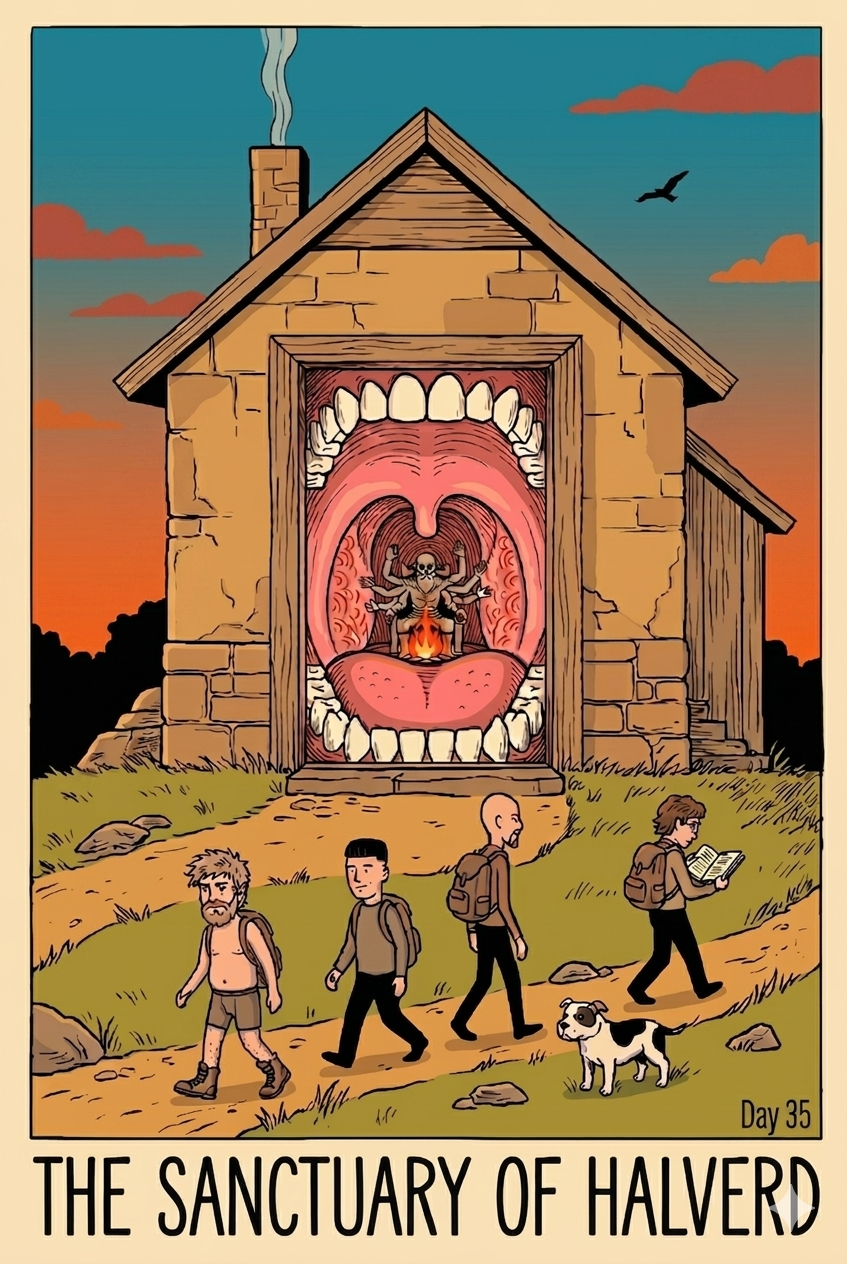
VIII. The Ashfields
◆ The Ashfields
Day 36 — The Ashfields
The mountain gave out underfoot.
The scree went to gravel and the gravel went to packed grey ground that still belonged to the mountain — and then the mountain stopped at a line. On one side, stone. On the other, ash, and out of the ash stood the field.
Chip put his lead boot down past the line. It went in to the ankle.
Stevie pushed past his leg the way she did, and then — at the line — she stopped. One paw down. Lifted. Down again. Reading something off the ground that none of them could read. Then Chip stepped forward and she went in after him, at his heel. She usually led.
It had been a grain field. The stalks still stood in the remains of rows, waist-high, the heads long gone. They were thin and pale and translucent, the way a fingernail held against a light is, and the sourceless grey light went into them instead of off them. The field carried a faint pale shine of its own, under a sky with no sun in it.
The wind moved through and the stalks answered. Not a rustle. Not a click. They whipped, thin and dry, and the sound was high and fine, a hiss at the edge of a whistle.
Chip looked at the dead grain in the dead light and understood what had killed it. The light had stopped. The grain had stood and waited for it and it had not come.
The road kept going, a darker line cut forward through the field.
────────
Chip crouched and put his hand into a mound of the ash. The crust gave with a small soft sound, almost a swallow, and underneath it was cold and wet, and when he drew his hand back the mound held the shape of where his hand had been.
Then the smell came up — the morning after a rained-out campfire — and once it was up it was the whole field.
He wiped his hand on his thigh. The grey stayed.
────────
They walked. He could hear the wind and he could not feel the wind — it was in the field, lashing the stalks, and it never reached the road.
It took him a long time to work out what was wrong with the sound. The whipping of the stalks was all high, up at the top of hearing, and under it there was nothing. For thirty-five days every place they had walked had treble and bass. Here the subwoofer was gone.
He stopped. He split a stalk with his thumbnail and looked inside. He pushed apart a mound of ash and turned over what was beneath it. A second stalk. A third.
No insects. Not in the stalks. Not in the ash. Not on the road.
A wet dead grain field should have been a city.
Will looked up from the ledger.
The stalks hissed and shone.
────────
That night they camped on the road. Brent fought the damp a long time before he got a small fire to hold — knee-high at its best, the only color anywhere.
He photographed it and sent it to the group. The photo was the small fire and the grey around it and nothing else.
They looked. The Emberstone was in the corner of the frame, small and warm.
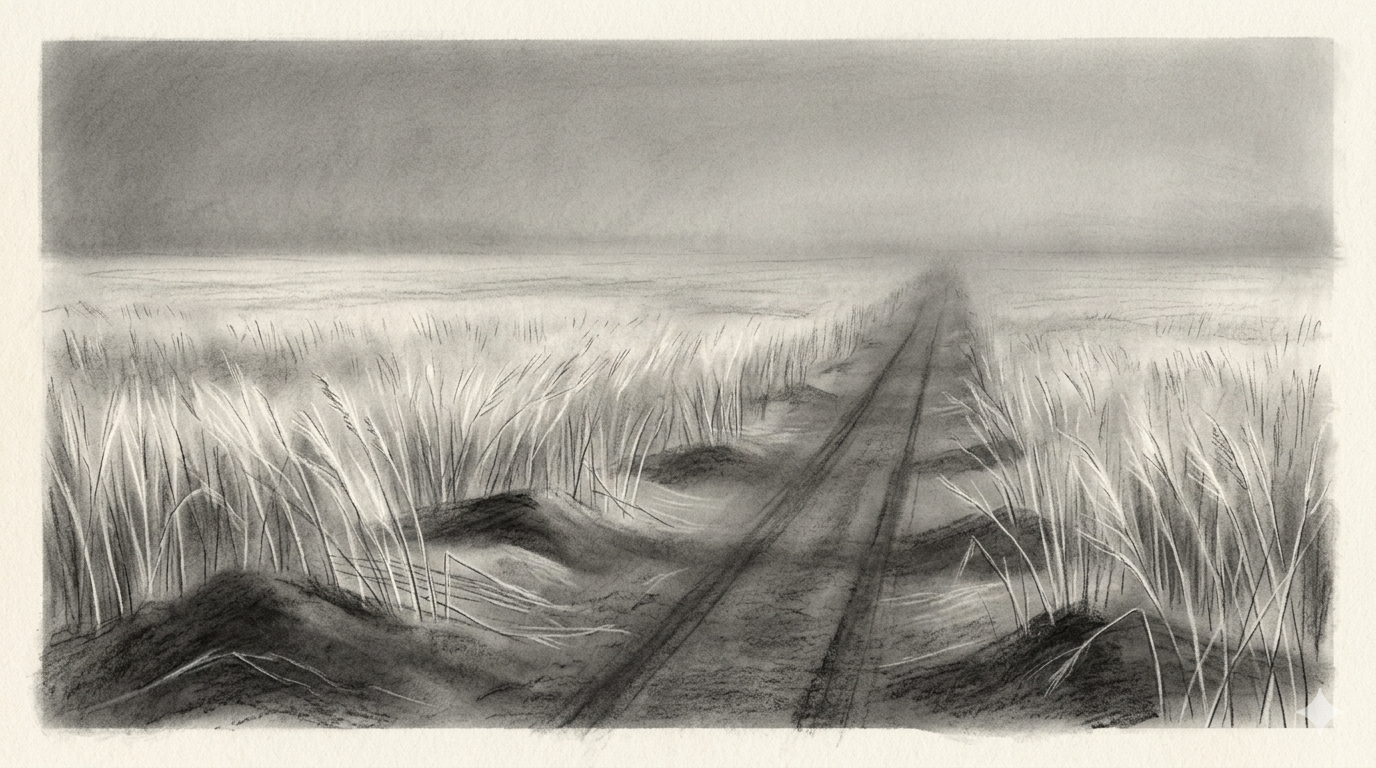
Brent started bunching up toilet paper and tried to stuff it in his mouth. Brian kept closing his mouth and moving his head away from the gap under the stall. Brent just piled it up and blocked him with his foot.
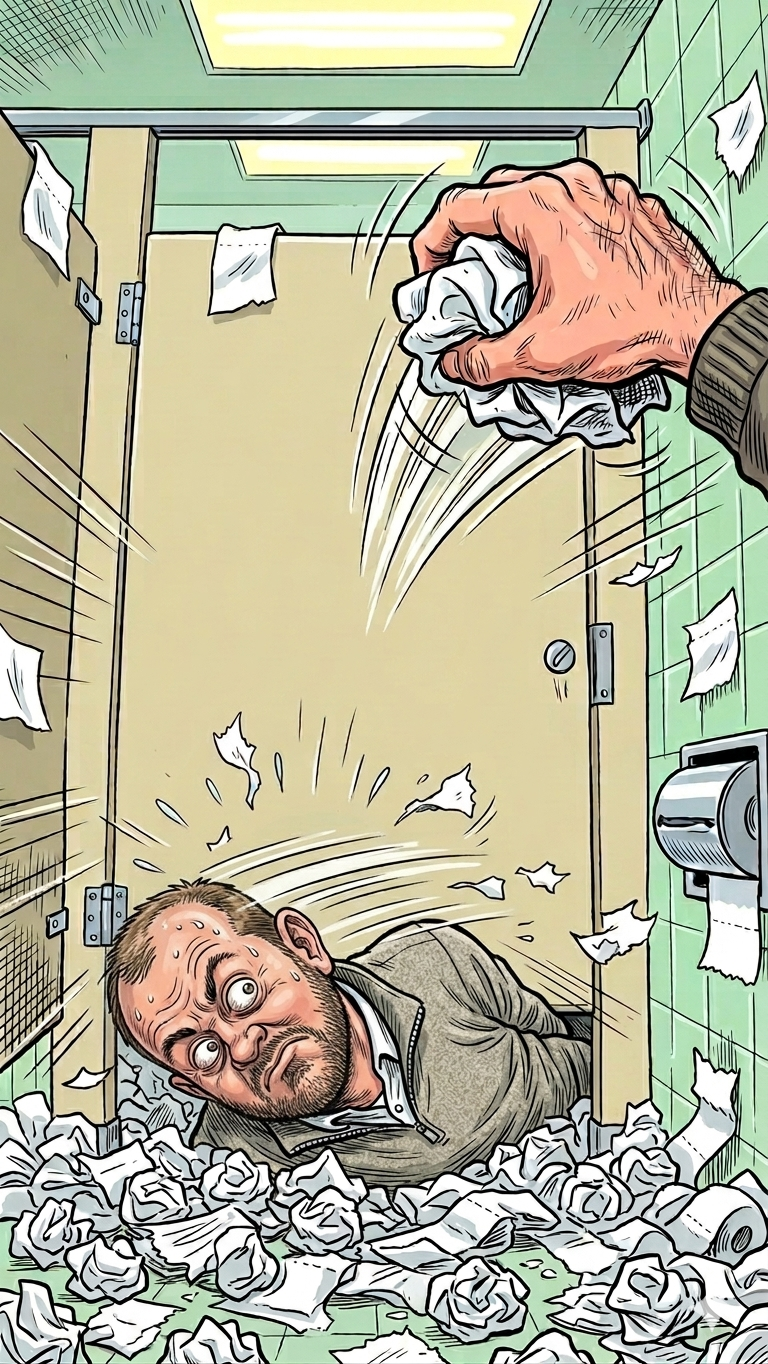
Day 38 — The Stallion
He came out of the grey
the way grace comes —
without apology,
never earned.
A wild stallion.
Moving through the Ashfields
at the pace of something
that has never doubted
its direction.
No saddle. No brand.
No sign of where he had come from
or what he was moving toward.
The grey parted for him.
It only parts
for things that belong to themselves
completely.
Chip walked alongside him.
The Emberstone blazed in the pack.
He didn't reach for him.
The stallion turned his head —
full dark eyes,
the specific attention
of a creature
that has decided to see you.
Seen without agenda.
Without a mold
it wanted you to exist in.
Fully.
Without wanting anything in return.
Chip understood he was seen.
He put his arms around the stallion's neck.
The grey fell away.
The Ashfields, nowhere.
The streak and the ledger
and the Pull and the road
and the days behind
and the distance still to go —
nothing.
Two sets of prints
stopped to have a moment together.
His breath came even and slow.
The mane was soft as silk against his face.
The stallion smelled like rain.
────────
The fellowship watched from a distance.
He looked back toward Chip and the stallion.
Will wrote in the ledger.
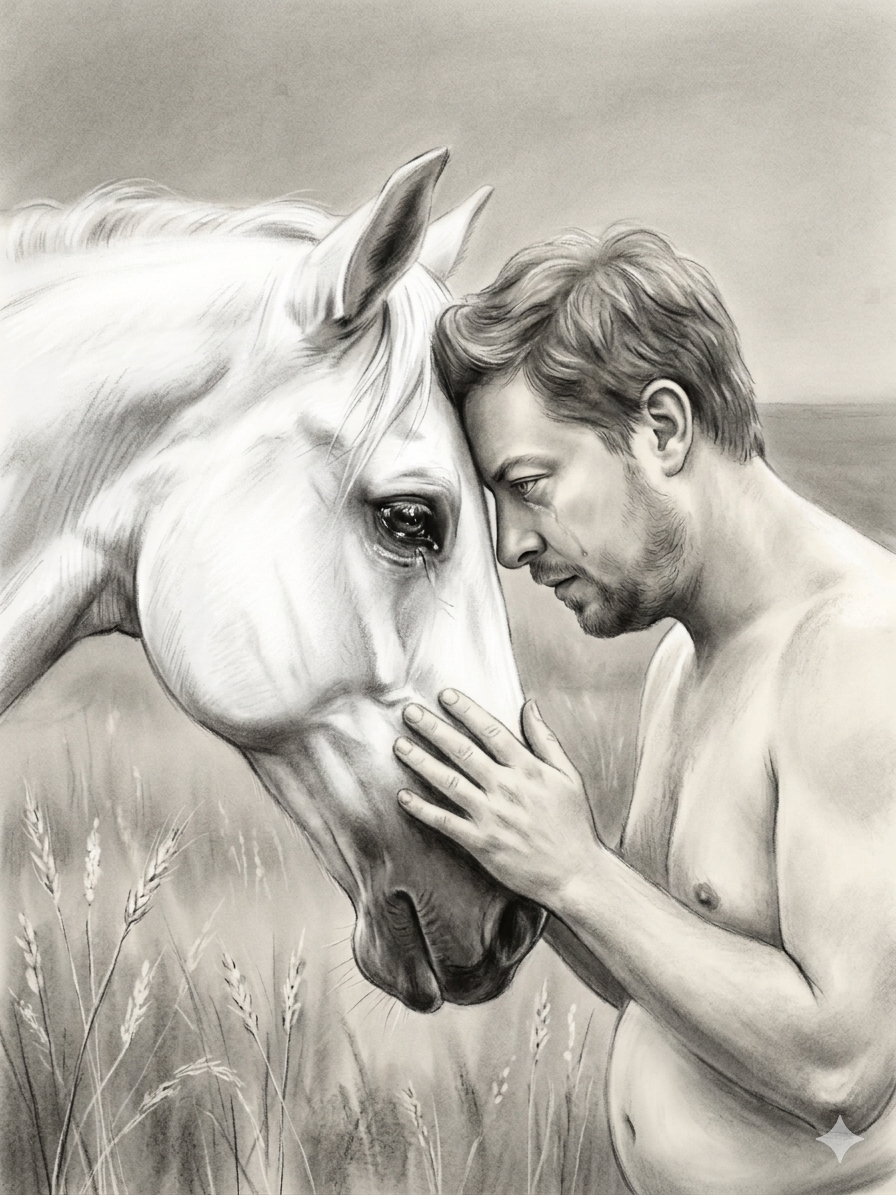
Day 39 — The Ashfields
The ash had started falling sometime in the night and by morning it had not stopped.
It came down dry. The ash on the ground was wet, had always been wet, but the ash in the air was dry, and it fell like confetti, weightless, drifting, turning over and over on its way down with a slow, sourceless patience. There was only grey sky, and out of the grey sky came ash, more and more of it, until the air was full.
By mid-morning Chip could not see far. The dry ash hung in the air in a moving curtain and the road ahead went into it and stayed there. It got in his eyes and he blinked it out. It got in his mouth and he spat and there was more. It landed on his arms, his neck, the back of his hands, and there was so much of it, falling so steadily, that he stopped feeling it land — it was just on him now, a dry grey layer that his brushing did not move. He understood that if he stopped brushing for an hour the ash would forgive him, would absorb him, would carry on. It was becoming his skin. It was almost there.
Underfoot every flake that reached the ground went wet the moment it landed — dry confetti in the air, wet mulch on the ground, the same ash living two lives. It had been ankle-deep at the mountain. It was shin-deep now, knee-deep in the drifts, and it pulled. Each step Chip took, the wet ash closed around the boot and held it, and lifting the boot was work, and setting it down was work, and the next step was work. Walking had become wading. The Ashfields had become a place he moved against.
Stevie was wading too. The ash was deeper on her than on any of them — she was low to it, pushing through it chest-first, the wet grey climbing her shoulders, the dry grey settling on the patch of her back above the surface. She put her head down. She stayed at Chip's heel. The smallest of them, in the deepest of it, attending to the next step and only that.
────────
The Pull spoke while he waded. It did not say much. It did not need to.
Chip kept wading.
A pause.
He looked at the ash he was standing in. There was no tree, no wall, no sanctuary. The ground was not shelter. The Pull had called the snooze a kindness and was calling the ground a kindness now. The voice had not changed. A soft name laid over a hard fact.
The ash did not care. Chip lifted the boot.
The wading was the hardest thing the day had asked of him. But he had been born to run. Each worked step was a thing he was choosing, and the choosing was the thing — the better in you reaches for best, a muscle you find sore, and work until you stop noticing the soreness, and it's yours.
────────
The dry ash thinned toward evening. The road showed itself again — and ahead, faint, the first rise it had shown since the mountain.
The Emberstone held.
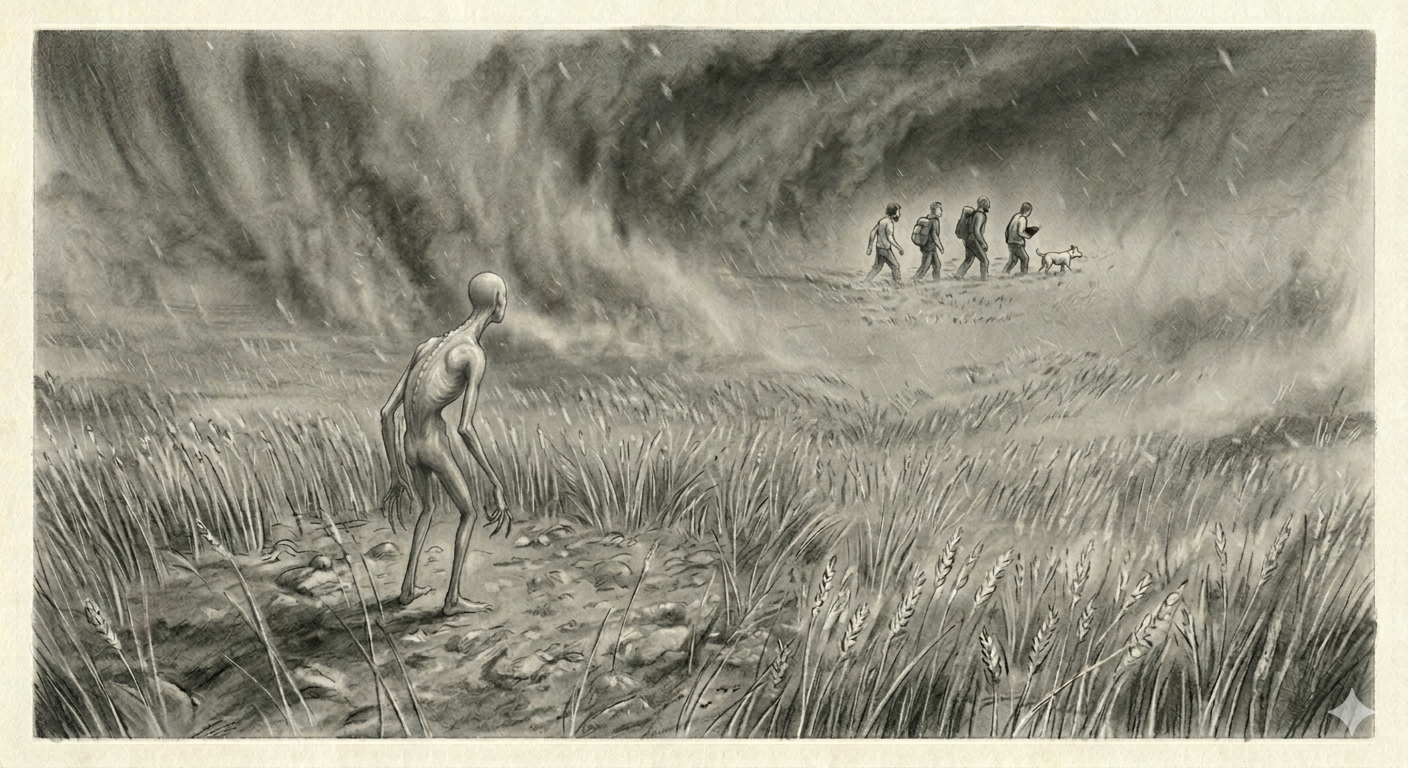
The ash ended the way it had begun — at a line.
The fellowship had been wading for two days and then the ground under the wet ash began to come up to meet their boots, firmer with each step, and the drifts went from knee-deep to shin-deep to a grey scurf over honest dirt, and then there was a line, and on the far side of the line the ground was just ground.
The dry ash thinned in the air and then it stopped. There had been a curtain of it falling for two days and then there was no curtain, and the world had edges again.
They walked into the new country. The ground rose. Grass started in patches. A few low pines stood off the road. The air smelled like air. By evening they were at the foot of the mountain, and the foot of the mountain was a slope of stone and grass that went up out of sight into the dark, and the road ran into it and went up.
They made camp at the base.
────────
Brent built a fire. Will closed the ledger. Kevin sat with his back against a stone and did not say anything for a long time, which was the Kevin version of celebration.
Brent: "We made it."Will: "We made it to the base of the mountain we now have to climb."Brent: "Will. Papi. Let me have this."Will: "Documented. Brent had this."· · ·Stevie was already asleep.
They ate. They did not talk much. They were too tired to talk much. The fire was small and good and the mountain was a shape against the dark and the Emberstone held in the pack at Chip's hip.
The Emberstone was burning brighter tonight than it had in the Ashfields. Chip had not opened the pack to look at it. He could feel it through the strap. It had been warm for forty days and tonight it was warmer, and steadier, and the warmth was the warmth of a thing that has been pointed toward what it is for and has finally seen it.
One by one they laid down.
Chip closed his eyes.
He was asleep before he remembered lying down. The Dreaming Place was already there. It had been waiting. The voice he knew was quieter tonight than it had been in the Ashfields. Asking instead of offering.
What do you want, Chip. Tell me. I will hold it for you tonight.
He thought about it.
You are at a bar with your friends. A Tuesday. The four of you in a booth, two pitchers in, the kind of night that wasn't supposed to be anything and has become something.
You are reminiscing about your bachelor party. The best weekend any of you have ever had. Brent is doing impressions. Will is filling in the things Brent gets wrong. Kevin is laughing the laugh he laughs when he can't help himself. The booth is loud. The waitress has stopped checking on the table.
And it isn't because the trip was good. The trip was good. But the trip was good because of how the four of you were on it. The way you read each other. The way nobody was performing. The way Brent didn't have to translate and Kevin didn't have to mediate and Will didn't have to track. The way you were a thing in motion together instead of four people chained at the ankle dragging each other forward. The Quest had done that. The Quest had made the four of you a fine-tuned machine, and the machine had been having a great time ever since.
And that weekend the machine had met the rest of your people. Your cousins. Your college friends. Your family. The guys from work who you had not been sure would mix. Brent had the room laughing inside of an hour. Kevin had ended up on a porch having a real conversation by sunset. Will got into a long quiet debate with someone neither of them remembered the next morning. The four of you ran the weekend the way you ran the road, and everyone you loved got to see it. Nobody had to be introduced twice. Everyone you loved met everyone you loved and the room held.
Brent raises his glass. "To Chip." Will raises his. Kevin raises his. You raise yours.
The four glasses clink at the middle of the table and the four of you chug. You chug yours all the way down — the way you learned to chug at the bachelor party, the trick of it, the breath before. You set the glass down empty.
Will signals the waitress. "Two more pitchers."
The booth holds. The night is not over.
Dreams are good. You just don't live in them. You get up. The stone is still lit. So do you.
IX. The Ridge of the Unremembered
◆ The Ridge of the Unremembered
Chip woke to the smell of bacon.
There was no bacon in the pack. There had been no bacon for forty days. He sat up.
Brent was at the fire, not turning around.
There were three other men there.
────────
Joe was sitting on a stone with a coffee. Long hair loose by his shoulders. Will's friend who traveled in from Madison. A doctor — when it comes to sleep and performance, a modern-day airbender.
Joe stood up and hugged him.
Jack was on the next stone. Chip's brother-in-law. He sat by a fire the way other men wished they sat by fires.
Scott was last. One of Chip's oldest and bestest of friends. They had been at college together and at every important night of Chip's life since. He came over and hugged him.
────────
Kevin had been looking up at the road. The road went up out of sight into the mountain.
Joe nodded.
────────
Seven cups came up.
The sun cleared the ridge. The road went up.
Chip stood up, slung the pack, and started.
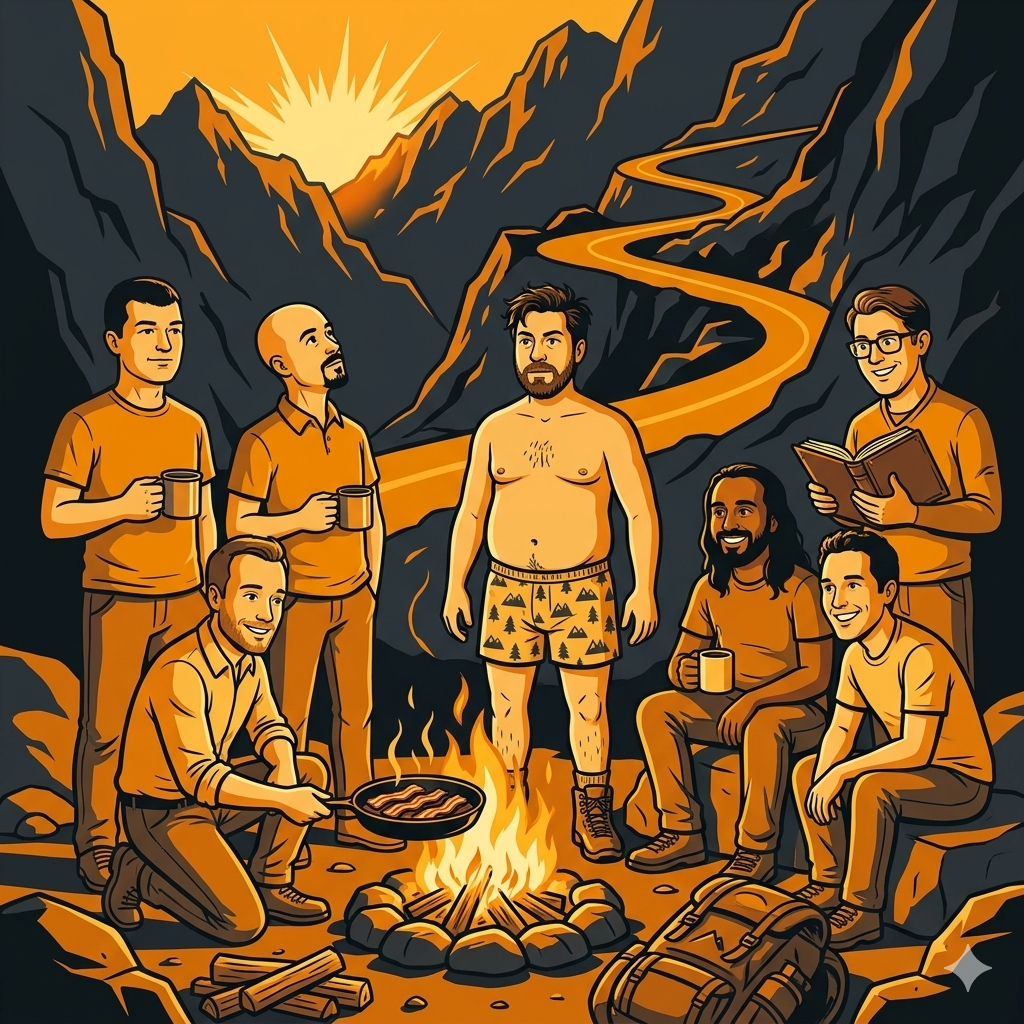
Scott was pouring.
He had the Fortaleza Blanco open — the bottle you crack when you're with your people — and the sangritas built on the rock. Tomato, orange, lime, salt, Tajín, bitters. Seven tin cups of sangrita with seven tequilas served in shot glasses from On the Border.
He handed Chip the first pair. Chip did it.
────────
They had climbed all day. The road had risen through pine and stone and by midday they had come out onto a flat saddle where the wind dropped behind a ridge and the sun stayed warm and the view opened all the way back.
The day was clear.
You could see all of it.
You could see the foothills they had crossed that morning, and the long grey scar of the Ashfields beyond. The Ashfields from this vantage were enormous — a wide flat country running back for miles, smaller from height than it had ever felt from inside but still huge, still sprawling, still the largest single thing in the view.
Beyond the Ashfields, the dark line of the forest. And far beyond all of it, smaller than the eye expected to find anything, real — the cluster of streets and rooftops that was Downers Grove.
The town Chip had walked out of. The town he was going home to.
Chip looked at it for a while.
────────
Chip thought about how to say it.
Jack picked up his sangrita.
────────
────────
Chip looked at him for a second. He looked back at his sangrita.
Chip patted the pack.
────────
A pause.
────────
The light on the country below had gone the long flat gold of early evening. Brent refilled the cups.
Jack lifted his sangrita.
Seven cups came up.
They drank.
The wind stayed behind the ridge. The sun stayed warm on the rock. The mountain went up behind them.
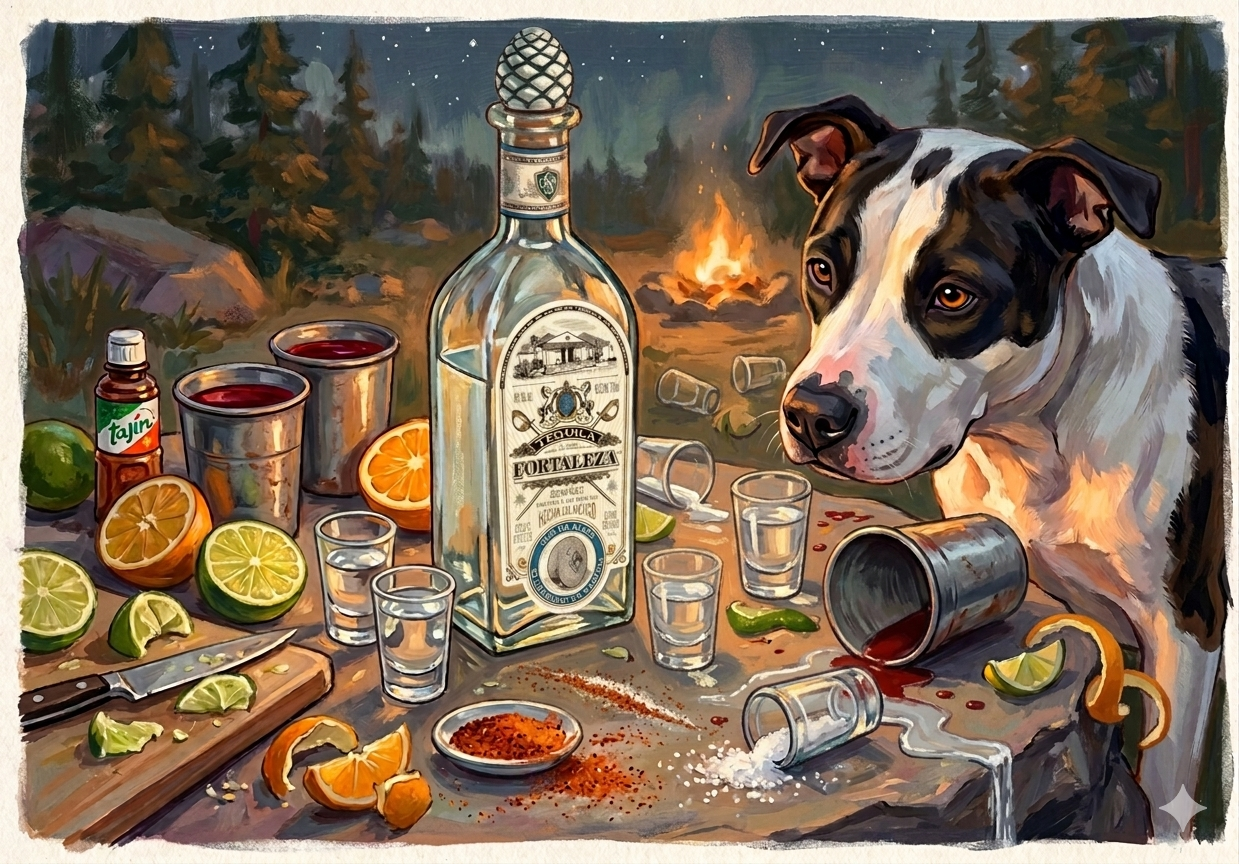
The fire was a real fire that night. Brent had built it. They had climbed since dawn, stopped early at a flat shelf with pines, a stream, a view. Scott had said this is the place. He was right. The sangritas were out. Stevie was asleep at Kevin's feet.
────────
They had been laughing at something nobody could remember the start of when Brent looked over at Jack.
Joe said it hushed, in the voice.
Jack's Attenborough was, on a technical level, the best of the lot.
────────
Kevin deadpanned.
He sang.
────────
Stevie's tail twumped against the ground once in her sleep.
────────
The fire stopped.
────────
The fire stopped again, differently this time.
A small silence. Brent put his hand on Kevin's shoulder.
────────
A long warm pause. The fire moved against itself. Stevie was still asleep.
────────
The sangritas went on. The fire stayed small. The Emberstone was warm in the pack. Stevie did not move.
They didn't go to bed for a long time.
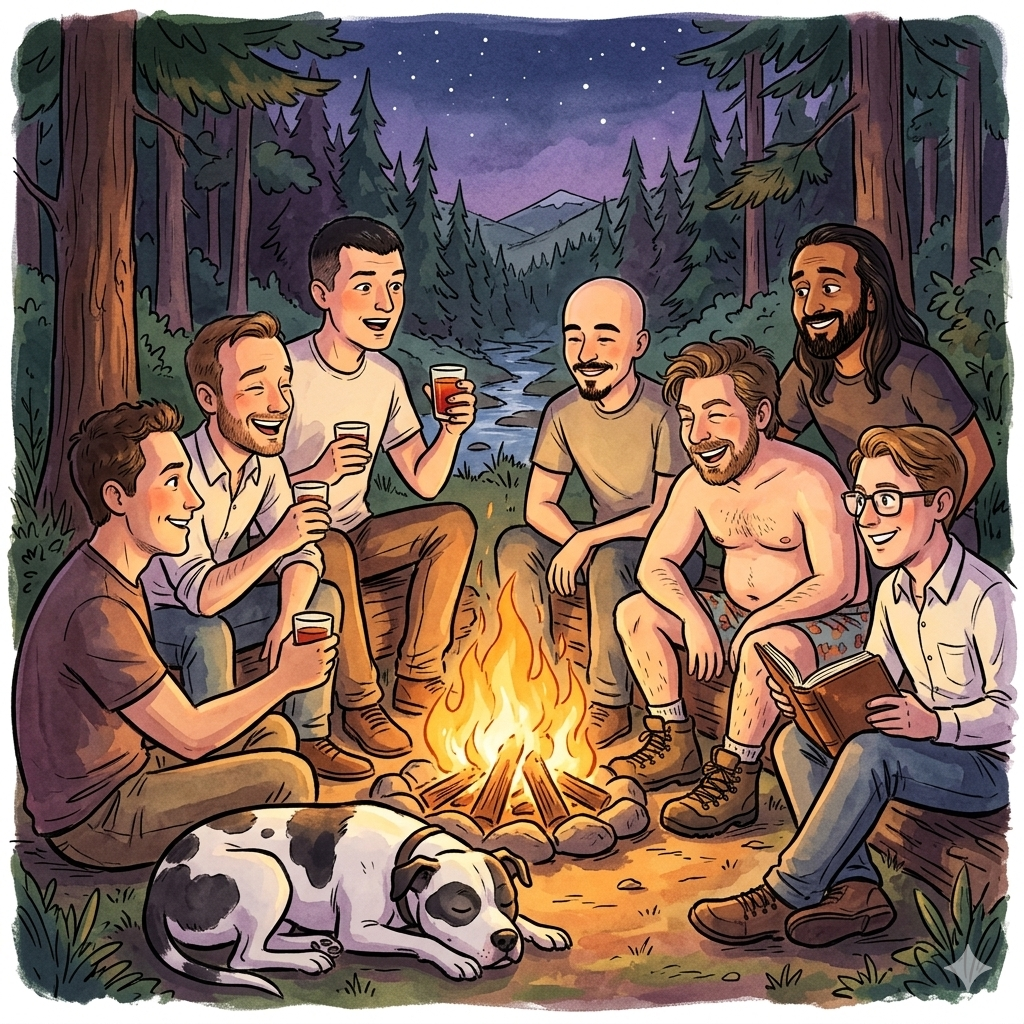
They saw it from a half-mile out.
An obelisk on a wide flat shoulder of the road. Black stone — not small stones, not the fist-sized rubble of a trail marker, but head-sized blocks and larger, fitted without mortar, the stones holding each other by their own weight. Four-sided, tapered, the height of four men at its face and five at the peak, the top coming to a clean point against the sky. The thing had mass. You could feel it from a distance the way you feel a building before you reach it. It was the tallest thing in any direction that wasn't the mountain, and it didn't look accidental.
Stones had been placed on it for a long time.
────────
They came up to it slowly.
He had stopped a few feet short of it. He stood there long enough that everyone stopped with him.
────────
They came up to the obelisk.
The names were everywhere. Carved deep on the larger stones, shallow on the small ones, some so weathered the cuts were just depressions you had to read by touch. The alphabet started at the base of one face, ran up to the point, came down the next, up the third, down the fourth. You walked around it to read it.
They read.
Aaron. Adelheid — Kevin took Jack's hand and put it on the carving so Jack could read it with his fingers. Adelheid. They moved up. Aldric.
Cael. Darius. Deshawn. Diego. They read every name, touched the worn ones, named them out loud. The visitors fell in — Joe quiet, Jack reading the unfamiliar ones with British care, Scott serious. The road had a record. They were inside the record.
────────
They came around to the second face. The M section.
Madhav. Maeko. Magnus. Mara.
Maren. Maren. Maren.
Three stones in a row.
Brent paused.
Joe was looking at the stones the way a doctor compares patterns.
The puzzle sat there.
────────
────────
Kevin had stopped reading. He looked at where Brent was pointing — a stone in the K section, middle-aged weathering, the carving clear and the stone face softened. Kevin.
His handwriting. The fellowship knew his handwriting from the ledger margins, from the notes he'd scratched on packs across forty days.
Kevin walked over and put his hand on the stone.
He kept his hand on the stone.
────────
They went to the platform. Kevin pulled a small black stone from a pile at the base — the pile was there for travelers who didn't bring one. He carved his name. He set the stone on the platform. He turned around.
When he turned back, his new stone was on the obelisk, in the K section, next to his old one. Two Kevins.
The fellowship went one at a time. Brent. Will. Chip. Joe. Jack — Jack in clear English block letters. Scott last.
When Scott set his stone down, the obelisk shifted. The taper at the top eased by a few degrees. A handful of stones re-laid themselves on the third face. Then it was still.
────────
They stood around the obelisk for a while.
Chip looked at the three Marens. Then at the two Kevins. Then at his own new stone, clean among older C names.
He looked at Kevin. Kevin nodded.
────────
They walked on.
The obelisk stayed behind them, taller by seven stones. The mountain went up.
They had been climbing since dawn. The road went up.
By midmorning Scott had stopped to talk to Joe.
────────
Scott put his hand on his own stomach. He went pale.
────────
The fellowship stopped walking.
Joe was already sitting down on a stone. Scott had a hand against the rockface for balance.
────────
────────
Joe lay back on the stone slowly. He looked at the sky. His long hair fanned out. He looked beautiful.
Scott had slid down the rockface a few feet and was sitting at its base, a hand over his eyes.
────────
Joe's thighs began to swell.
Slowly at first, then with confidence. His pants stopped being able to contain them. Brent looked. Then Brent didn't look. Scott was watching his own thighs do the same thing.
Chip turned away. Kevin turned away. Will closed his eyes. Brent put both hands over his face.
Two wet pops, three seconds apart, echoed off the rockface.
A long pause.
────────
Jack stood looking at where they had been.
Then Jack began.
────────
He sat down on the rock next to where Joe had been.
He laid down. He folded his hands across his chest.
He popped his clogs.
────────
The fellowship stood for a long moment.
Chip looked at what was left of them. Joe's limbs scattered across the stone. The patch of rockface where Scott had been. Jack on the road, hands folded, like Wallace without Gromit.
────────
────────
They stood for a while.
A pause.
────────
They rolled Jack down the mountain.
The road at this stretch had a steep drop on the east side. They lined him up at the lip and gave him a respectful push. Gaining speed. He cleared a small outcrop. He cleared a second one. He picked up momentum.
The fellowship watched.
Jack made it all the way down. Past the treeline. Past a small stream. Past a clearing. He appeared to keep going for some time after the fellowship lost sight of him.
────────
The fellowship turned back to the road.
The mountain went up. They followed the road.
By late afternoon the grade eased. The trees dropped away. The rock opened out on both sides into a long flat saddle — wide, wind-scoured, the sky coming in from every direction at once.
Chip had been running ahead for the last quarter mile. He couldn't have said why.
They came up onto the Ridge.
Chip stopped.
Behind him: forty-five mornings, the whole of it, Downers Grove to here. In front of him: the horizon, and on it — faint, unnamed, the thing the compass had been pointing at since the Hollow Pass.
He stood there for a while.
The check-in photo goes to the group automatically. The Ridge, the horizon, the faint shape of what the compass has been pointing at for forty-one days. The group is waiting. Chip picks the emoji.
Kevin replies first: "Yeah." One word. That's the whole response and it's exactly right. Brent sends seventeen crying emojis and then "PAPI." Will writes: "Day 45. The Ridge. Chip sent the crying mountain emoji. The ledger notes this is accurate." Brent: "Will just validated the crying mountain. Historic."
X. The Forgetting
◆ The Forgetting
They had climbed for two days through stone country.
The road had cut through pine and rock and the pine had thinned and the rock had grown. By the second day's afternoon they were walking through a valley of cliffs and the wind moved in it the way wind moves in a thing larger than itself. The mountain had stopped being a peak ahead of them and had become a country they were inside of.
────────
They came out at the edge.
A gorge opened in front of them — wider than anything they had seen, the far wall blue with distance, the bottom invisible. A river was down there somewhere. They could feel it more than hear it.
And the bridge.
It hung across the gorge in a long curve, planks and rope, the far end small enough to disappear if you blinked. The middle of it sagged into the gorge and came back up. It was the largest crossing any of them had ever stood near.
────────
Will took the ledger out.
────────
The fellowship turned.
A pause.
────────
────────
The flask was on the stone of the anchor at the near side. Brushed metal, dented at one shoulder, the cap sealed in dark wax.
Kevin picked it up. He turned it once in his hand.
────────
The flask had been left by a traveler who had crossed the Forgetting and continued. It held water drawn from the gorge below. The water held what the bridge took — not direction, urgency. A small amount drunk on the far side gave back what had been left on the bridge.
Travelers who had crossed left flasks at the near anchor for the travelers who hadn't yet.
The wax seal had not been broken.
────────
Chip took it from Kevin.
────────
Chip fitted the flask into the side strap of his pack where it would ride against his hip. He pulled the strap tight.
────────
They camped at the near anchor that night. The bridge swayed in the dark above them.
────────
The mountain went up on both sides of the gorge. The road went across.
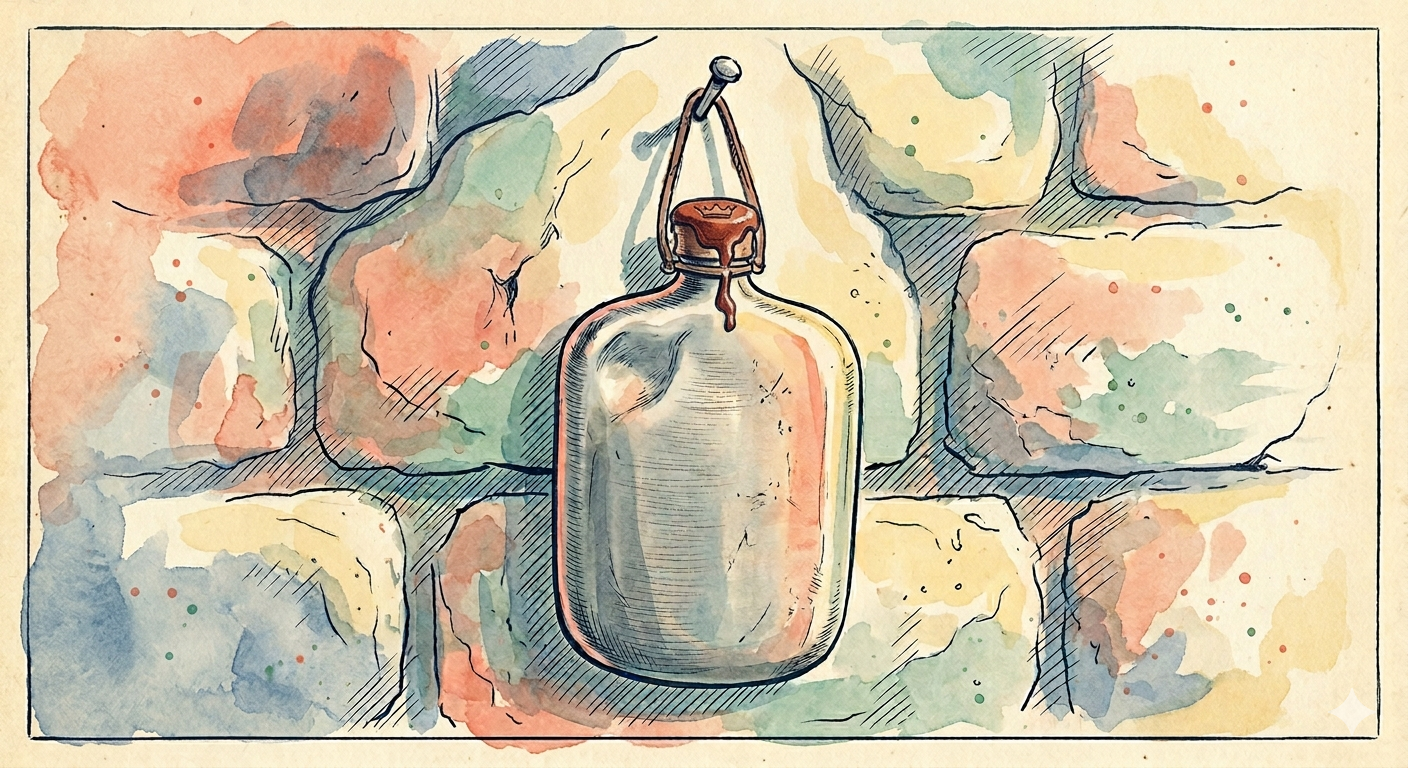
The fellowship woke at the anchor.
The bridge was the first thing in the light. It hung across the gorge with the dawn just touching its planks, the far end lost in the blue distance.
────────
A pause.
────────
────────
They sat with it for a moment. The wind moved in the gorge. The bridge swayed.
────────
They packed the camp.
────────
They walked to the entrance of the bridge.
Chip checked the flask in the side strap. The wax seal was still intact. He pulled the strap tight.
Will and Brent looked across.
Kevin looked down for a moment.
Chip looked down for longer.
Stevie looked at Chip.
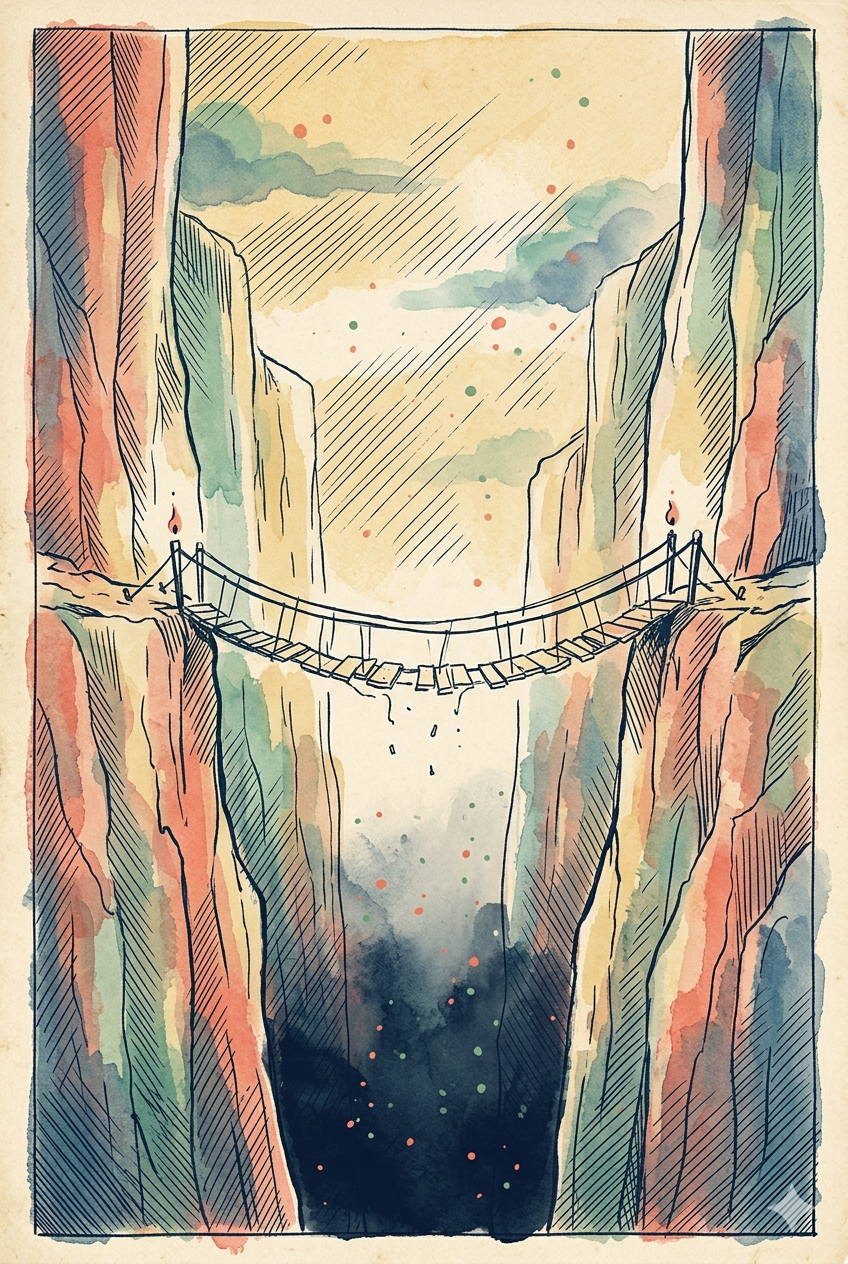
The bridge was old rope and the rope was weathered and the whole of it was concerning to cross.
Two ropes ran across for the feet, with wooden pegs set between them every couple of feet. It had been a system once. Some of the pegs were gone. Where the pegs were gone the ropes hung looser, in long slack dips that swung on their own. One rope ran across above for your hands, so you had something to hold while you walked your feet along the two below.
The wind came up the gorge in slow lifts. It moved the ropes and let them settle. Below the ropes the gorge went a far way down — you could see a couple of ledges, some rock, and then mist all the way down to a distance you couldn't measure, because you couldn't see the bottom. The crossing was twenty yards across to a thin lip of stone, and the road past it went on up the mountain the way it had gone up the mountain on this side. The same road. Just on the other side of the air.
Chip put his hand on Stevie's head. Stevie did not look at him. Stevie was looking up the mountain, past the bridge, at the road on the far side — the road they had not reached yet.
────────
Brent went first.
He took off his pack and re-shouldered it tighter. He kissed one finger and held it up to the sky. Then he took his first steps onto the bridge.
He went fast across the first stretch, feet on the pegs, eyes up, the way a man late for a meeting moves on a sidewalk. The bridge got less sturdy toward the middle. You could hear the wood splintering out there, somewhere under him, and the rope made a sound it had not made near the post. He kept his pace. Light on his feet. The second half had the most missing pegs. The ones still there were in rough shape. He kept going. Near the end the last peg rotted through and cracked as he stepped on it. He stumbled, caught himself on the far rope, and made the rock, and sat down with his hands on his knees.
────────
That last peg was gone now. Brent's foot had finished it.
The four of them looked at the gap and didn't say anything for a moment. Stevie was still looking up the mountain.
Brent sat down on the edge of the ledge, feet braced, hands ready.
Chip rigged a sling for Stevie with the straps on his bag and Kevin's jacket. She was close against his body and his hands were free, her weight pulled forward against his chest. She was confident in him. She wasn't braced. She wasn't looking. She was a warmth at his sternum.
He moved more carefully than Brent. The bridge was louder under him. He set each step where it had the most to hold it — left foot where the rope tied onto a peg, right foot the same on the other rope, testing each one before he gave it his weight. Moving the slowest through the middle of the crossing, he arrived at the end of the good section and sized up the gap. Too wide to step. He'd have to lunge it — a stride and a small jump off the last good peg, across the gap, to the rock.
Brent put his hand out, giving him something to aim for.
Chip set his feet on two separate pegs so he had something to push from. He took a breath. He lunged.
He planted clean on the last peg and the peg snapped under his weight, but he had the momentum by then, and the snap only sent him faster at the rock. Brent had him by the shoulders before he could rock back. Chip and Stevie were across.
The bridge was in bad shape behind him. Past the middle it was just rope.
────────
Will looked across at Chip and at Brent. The far side looked farther than it had ten minutes ago.
Will stepped onto the bridge and started to cross. He was doing the most damage of any of them — bigger boy, and the bridge worse now than when Chip crossed it. He got to where the pegs began to fail. The handrope kept fraying under the pull of him; he was putting too much into it. Another peg snapped and swung loose below.
Kevin stepped onto the rope behind him, near the sound edge, where he'd said he'd be. Ready to move and reach if Will got into trouble in the shimmy.
────────
Will got to the middle and set his hands to drop down into it.
Chip remembered the vial.
The painter's shack. The painting on the wall there — it had been this. This bridge, this gorge, this exact stretch of air. This was the moment the vial was meant for. The fellowship needed help, and the thing for it had been in Chip's pack.
Chip opened the vial and pulled the small piece of paper out.
Brent snatched it from his hands.
His face did something Chip had never seen it do.
────────
Brent sighed.
Chip looked at his boots. He had nothing else to say.
Will let his feet drop. He put both hands on the upper rope and got his weight under it and started moving across hand-over-hand, slow, the way a man moves when he is doing a thing he has not done since middle school gym class.
A pause. A grip-shift.
Will moved another two feet.
The wind came up the gorge in slow lifts.
Will got another two feet. The rope made a sound under his right hand. Will did not look down.
A footrope snapped.
It went under Will's right hand, and his right side dropped, and he caught the whole of himself on the other rope, both hands now, hanging, his feet swinging into the gap. He brought his legs up, gripped the rope, and was about to keep shimmying.
────────
He had a stride into the bad rope and his hand on the armrope when Will's weight wrenched the whole thing sideways, and Kevin's hand closed hard on the armrope to hold Will, to hold both of them, and the armrope tore out of the far anchor where Chip's lunge had frayed it through.
The footrope went with it.
The bridge now only attached on one end swung — back, away from Chip, down toward the post where the ropes still held — and it took both men in the arc and whipped the loose ends through the pegs that were left. The dead rope wrapped them where they gripped, at the hands, at Kevin's arm, and cinched, and the cinch caught on a peg and held.
They hung there. Tangled. Out over the gorge. On the side they'd started from.
────────
The arguing stopped.
Kevin had gone still, which was Kevin working. He was analyzing the situation.
Will pulled at the wrap with his free hand. The rope drew the other way, down and out, and the wrap didn't move. It pulled on them. They both tried to shift their weight around to knock it loose, to no avail.
Kevin looked across the gorge. He looked at Chip.
────────
Chip was on his knees at the edge with the gorge between them.
Brent had moved up beside him. Brent had the vial paper folded in one hand.
────────
Chip threw his boot first.
He had it off and in his hand before he'd thought it through — heavy — and it dropped out of the air halfway and went down into the gorge. They didn't hear it land.
Chip had it in his pocket. Metal, machined, balanced, the one he'd paid a small fortune for. It rode in his pocket for years.
────────
You've got this.
Chip wound up like he was Rookie of the Year (1993). It left his hand like a sure thing, like it had always been a sure thing, like the throw was already made.
Easy. Now.
The trajectory was perfect. The aim was dead on. The power was a hair high. It missed the snag. It clipped the torch bracketed on the frame at the top of the post, and the lit head broke off and dropped. It caught the rope above them and stuck there, burning.
────────
The rope took the fire slowly.
It was old and dry and it caught in a low line that found the fibers and walked them down. The smoke came first, low and resinous. The fire was at the top, and it was working its way down the rope toward their hands.
There was no climbing through it.
The fire wasn't fast. It was certain.
────────
Will watched it come.
A beat.
────────
Will got an arm loose as the wrap burned through the snag above. It was too late for the climb.
He squirmed the rest of the way free and let go, hands at his sides. He didn't fall like a man who slipped. He went with his hands at his sides, and the gorge took him. They didn't hear him land.
────────
Kevin stayed.
The fire came down to his hands.
Kevin held the rope. It blackened and kept its core and would not part. He held it because it was the thing holding him, and the fire went into his hands and up his forearms and did not stop, and the rope did not break.
Kevin started screaming.
But there was nothing to do with the rest of the sentence. The joke had nowhere left to go. Brent stopped talking. Chip stopped talking. The screaming kept on without anyone to answer it, and the only thing any of them could do was the thing Kevin was already doing, which was wait.
He stopped screaming after a while.
The rope held. It held him a long time. It held him long past the part where holding meant anything.
When the rope finally went it went quietly, the core giving somewhere inside the char, and what was left of the bridge swung down against the near wall and hung there smoking.
────────
Chip was on his knees at the edge.
Stevie had not looked at the bridge. She was turned up-mountain, sitting, her back to the gorge, the way she'd been since before the rope snapped.
Brent was saying something. Chip couldn't hear it. The gorge was wide and quiet and the far side of it was empty now.
────────
His fidget toy was gone. His boot was gone. His friends were gone.
────────
After a while Brent stopped saying things and sat down beside Chip and put a hand on his back. He left it there. Stevie kept looking up the mountain. The smoke went up out of the gorge in a thin grey ribbon and the wind unmade it.
The hand on Chip's back wasn't steady.
The hand was trembling, and it was wet, and Brent's breathing beside him had gone shallow and quick.
Chip got him by the shoulders. Brent was grey. Brent was sweating in the cold.
Brent stopped. His eyes weren't finding Chip anymore.
Nothing.
────────
Chip went through his own pack with both hands. There was nothing in it that was sugar. There was nothing in it that was medicine. There was nothing in it that did anything to a body at all.
Except the thing he found before he crossed.
The flask. Dented, wax-sealed, the trusted thing, the thing Kevin said was left by travelers to remember.
Stevie had turned around. She was not looking at the mountain anymore. She was watching Chip's hands.
Brent is unresponsive.
Chip uncapped it.
The smell came up and it was a smell he knew. It was the smell of good times on the back porch. It was booze. Of course it was booze. Booze had always helped this group.
*Chip poured it onto Brent's mouth.*
*Brent came to. His first motion was to grab the flask and glug it down. He got to his feet. Booze had always been the answer and this was not going to be the exception.*
Brent: "I got the hypo-glyco glow, papi. I'm back."
*He took one step toward the road. He stumbled on his own feet, and he went over backwards, cleanly, off the cliff.*
The first outcrop was maybe forty feet down. Brent hit it hip-first and his hip shot out of him like stepping on a Twinkie. He bounced off the wall. There was too much speed to catch anything now — Brent's whole mass roaring with velocity, tumbling through every crevice the canyon had on offer, missing every possible landing like a quarter in the charity spinner at Taco Bell that never once drops you the free Mexican pizza.
────────
*Chip stood at the edge with the empty flask in his hand.*
The road went on up the mountain. He looked at Stevie. Stevie was already looking up the road.
So he went.
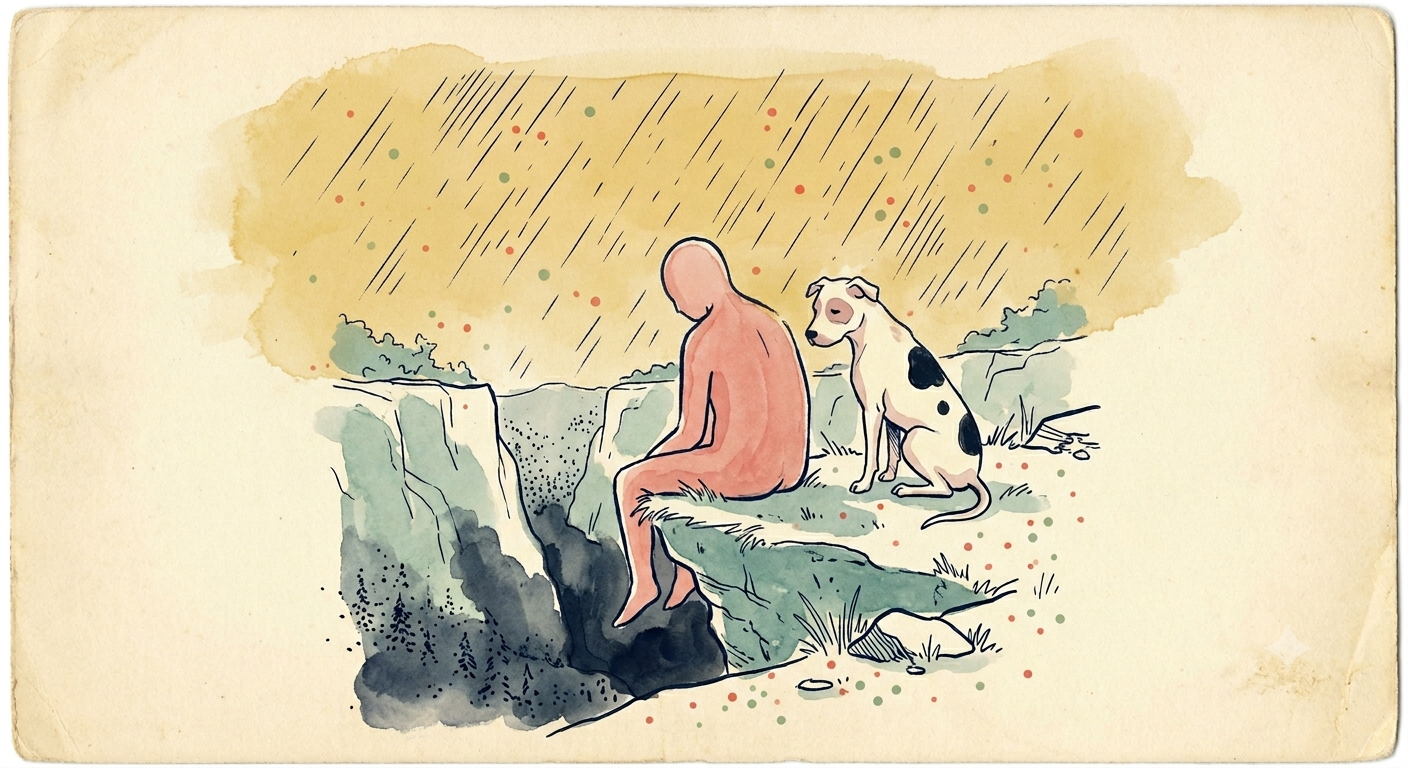
The road went on along the wall of the gorge, a thin ledge of it cut into the rock, and the rock went up on both sides farther than the eye wanted to follow.
Stevie went first.
She picked the line. Where the path narrowed she took the inside without being told, and Chip put his feet where she put hers. She didn't look back to check. She knew he followed.
And somewhere in the watching of her — the sureness of her, the way she just went — Chip felt the first edge of a thing he didn't have a name for yet. He was following a dog up a mountain. He was glad of it; she was better at this than he was. But under the gladness was something else, small and stubborn and his own: he wanted to be the one who knew the way. Not instead of her. He wanted the wanting itself to come from him — the pull up the mountain to be his pull, his legs deciding, nobody and nothing out front making him go.
They went.
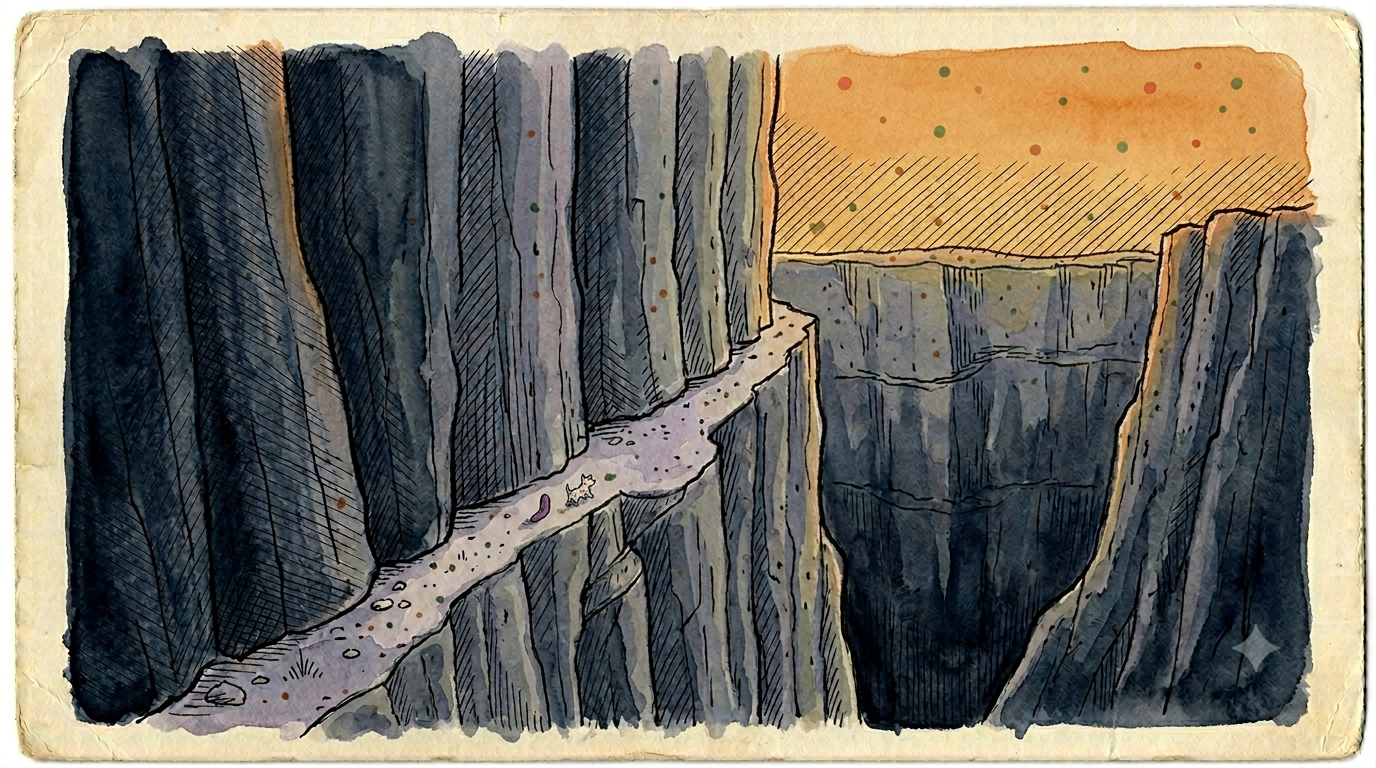
The gorge let them out by afternoon and the land opened into a valley, flat and wide, the path running pale across it toward the foot of the mountain.
It was easier walking. After the rock it felt like nothing at all.
Stevie ranged out ahead, nose down, doubling back, the way she did when the ground stopped being dangerous. Chip let her. He walked and did not hurry and the valley took its time around him.
He noticed, somewhere in the middle of it, that he was not bracing for anyone. Not counting heads. Not listening for three other men on the trail behind him. The quiet was just quiet. And he found he wanted it — not as a thing instead of them, but as a thing of its own. He could walk all day at his own pace and answer to no one and the wanting of that did not feel like a betrayal. It felt like the next thing.
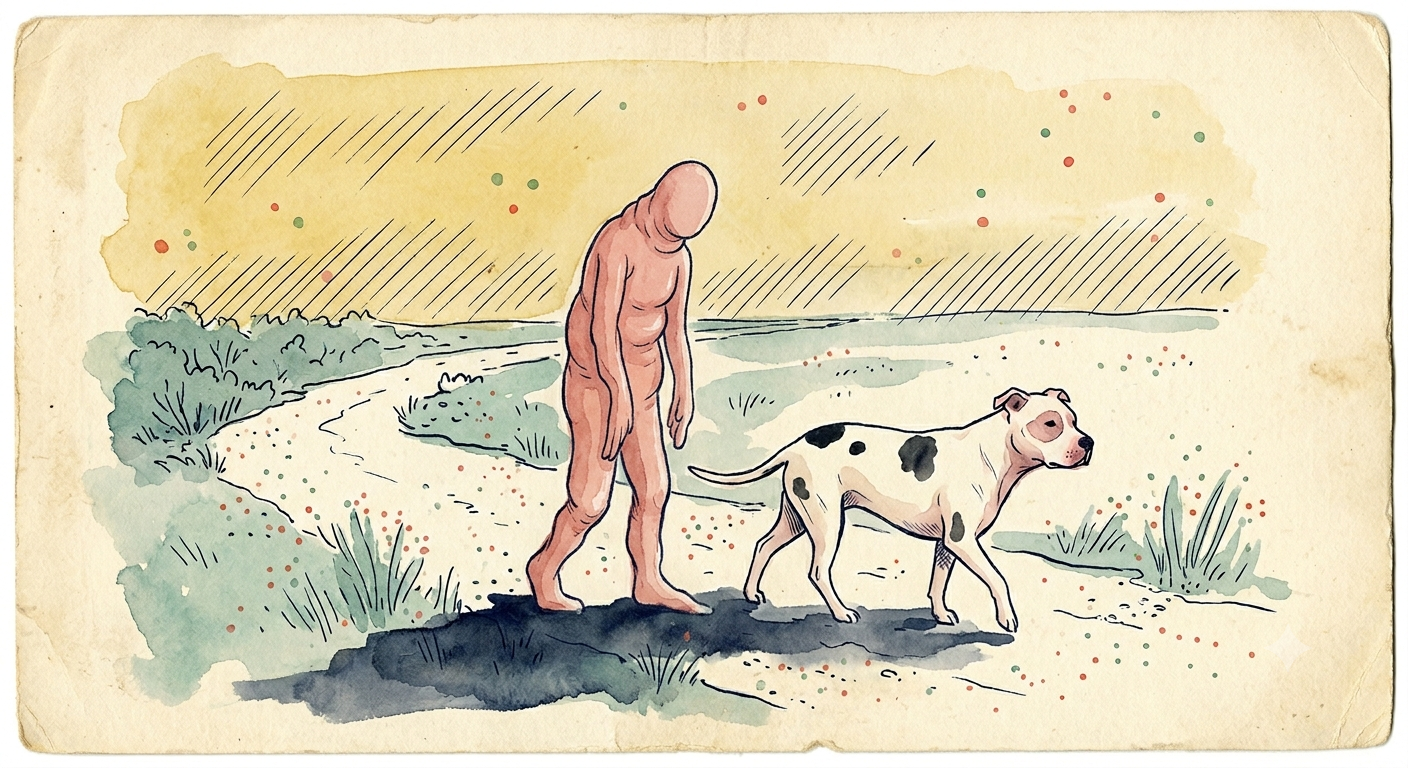
XI. The Valley Below the Peak
◆ The Valley Below the Peak
The gorge was behind him.
The road came up out of it through a stand of pine and a long set of switchbacks, and then the trees thinned, and then the trees ended, and Chip walked out into the valley.
The valley ran flat ahead of him, a long stretch of open stone and low scrub, and ended at the foot of the mountain. The peak was somewhere above, in the cloud. He couldn't see it. The road cut a pale line through the valley to where the climb began, and then the road went up.
────────
There was a marker where the climb began — a leaning post, old, the grain gone silver, and a flat stone set into the ground at its foot worn smooth by the boots of everyone who'd stopped here before deciding to go up.
Chip stopped there. Stevie stopped with him.
He looked up the line of it. The road went up and kept going. The top was in the cloud.
He put his boot on the stone the way the post seemed to want him to, the way you touch a thing other people have touched.
Then he started climbing.
The climbing was slower now. Thinner air, or thinner him.
He'd been doing the math as he walked. He couldn't help it; it was the kind of mind he had. The Hatch State of Sleep Report — a sleep company out in California, putting numbers to the thing everyone already knew. Thirty-seven percent of Americans don't get seven hours. Forty-three percent go to bed at a different time every single night. That's the water everyone's swimming in. A third of grown adults, more, getting up wrecked and doing the day anyway, and nobody lines them up at dawn and tells them they've failed.
So what was this, then. What was he holding himself to that none of them were held to.
Because by that measure — the real one, the one everybody actually lives by — he was already past it. Way past it. Fifty-some days of getting up on purpose. Most people never put together a clean week in their lives. He wasn't behind the curve, he was off the top of it. He had already done more than enough. More than the data said was normal, more than the people who wrote the data, more than nearly anyone he'd ever known. He could sit down on this mountain right now and still be, by any honest accounting, a man who'd done more than his share.
He was holding himself to a standard the world had quietly agreed not to require.
Stevie had stopped ahead of him and was looking back, waiting, the way she did when he slowed without deciding to.
He hadn't decided to.
He started walking again before he'd finished the thought, which was maybe the only way to win it.

He met her coming down.
He'd been climbing since the light came up, Stevie out ahead, the road narrow and the air thinner than it had been, and there was a woman walking down it toward him with a pack on her back and no hurry in her. Older than him. Weathered the way the rock was.
She stepped to the wide part of the road, and then she didn't go by. She stopped, and set her pack down on the rock —
A pause. She didn't say she was sorry.
She crouched and held out the back of her hand, and Stevie went and smelled it, and let Maren put a hand on her head.
────────
She said it like a weather report. The most ordinary fact about the mountain. People go up. Then they go down for someone. Then up again.
Chip went still.
Maren let out a breath, slow, and something in her face settled — not surprise.
────────
────────
He heard the tense too late and didn't fix it. Is he? or was he now?
────────
They sat with it. The wind came up the slope and went over them and kept going.
She stood and got her pack back onto her shoulders.
────────
She went on down. Stevie watched her go a while, then turned back up the road, which was Stevie saying it was time.
He climbed all morning with what Maren said still in him.
Everybody on this mountain is being carried or carrying. There's no third kind of person.
He had spent a long time trying to be the third kind. The kind who didn't need it and didn't owe it. He saw now it was just a way of standing very still while the people around him did all the moving.
The grade steepened toward a shoulder of rock, and the road bent around it, and when he came around the far side the land fell away and he could see how far he'd come — the valley small behind him now.
The top was closer. Real now. A place, not an idea.
XII. Ashen Peak Slope
◆ Ashen Peak
The valley was gone. The peak was all there was.
The air had thinned to where he noticed his own breathing. He climbed in short stretches and stopped and climbed again. Chip set the pace.
Down low the road only ever asked him not to stop. Up here it had stopped asking that. It assumed it. It had moved on to a harder question.
The question was how well.
There was a good way to climb. There was a good way to live each day. The good way cost more and gave more. He got better as he went up.
He had more in him than the climb required. He was only finding the floor of it now.
He climbed it well.
By the second day he'd stopped thinking about the top.
He wasn't climbing to arrive anymore. He was climbing to do it well. Getting somewhere and getting good are not the same climb.
You climb to arrive and you can quit when you arrive. You climb to be good at the climbing and there is no quitting, because the being good at it is the thing — not the arriving, not the rest at the top. The man who climbs well is the man, full stop. The arrival is what happens to him on the way.
He found he was different up here.
He wasn't deciding to be better. He was finding that he already was. The man who had walked out of Downers Grove fifty-seven days ago had been carrying a smaller version of himself. The better one had been in there the whole time. The climb had only been pulling it forward.
He kept climbing.
And the higher he got, the more he felt it. A pull.
He stopped, both hands on the rock. He knew what a pull was. He'd spent fifty-some days learning. His whole body braced for it.
But it wasn't dragging him down. It was above him — up past where he could see — and it wasn't asking him to stop. It was asking him to come.
He went toward it.
────────
The pull got stronger.
He climbed toward it, and near the top of a long pitch he stopped to breathe, and it spoke.
────────
────────
────────
I started the morning the way I had started every morning of the last sixty days. I built up the fire. I put coffee on. I tended my camp — the small camp I had built up here when I first arrived, knowing I would be here a while, not knowing how long. I had set the canvas properly. I had made a fire ring. The kettle had a spot. I was not living here in the way a man lives in his own house. I was living here in the way a man lives in a place he knows he will leave when his rest is done.
Then I went out to the lip of the camp where the Rest sat on its stand.
The REST-3 was standard issue for this kind of fieldwork — Remote Environmental Survey Terminal, which was what it said on the laminated card in the lid of the case, under the foam cutout where the unit sat. In the field everyone called it the Rest. It was a round screen on a matte black polymer housing, roughly the size of a large plate, with a rubberized grip around the rim that kept it from slipping in wet conditions. Held level it sat on the ground like a lens — the image centered in the circle, the country below arranged the way it looks from altitude, which is how God is always depicted looking at it in the paintings. You look down. That is the natural position. The housing mounted on an aluminum pivot bracket for angling toward a slope, looking down at the country the way the country was meant to be seen from up here.
There was a frequency dial on the right side, coarse and fine adjust, and a small indicator light that went from amber to green when the signal resolved. Finding a person took patience: pan coarse until the image settled on the terrain you wanted, ease in on fine, and hold. When you locked onto someone the light dropped green and they were there — their whole body and the road they were on and the quality of how they were walking it. You could follow a person for hours this way. Come back after leaving and they were still on their road, still in the same frequency, doing whatever they had been doing while you weren't watching.
I've had this unit for eleven years. The housing had a scuff across the lower left quadrant from a trip in The Villages. The fine-adjust dial was stiffer than it had been. Otherwise it worked the same as the day it was issued.
This morning I tuned the Rest down the slope and found Chip on the last bend of the road.
I had been watching Chip and his three friends since the second morning of their quest.
I had not chosen them at random. I had watched the start of perhaps a dozen quest-walks that month, the way you sample a few books from a new shelf before deciding which one to read. Most of those groups I dropped within a week. They walked, they argued, they went home.
I had checked in on them briefly around week four. I was going to move on. Then Brent wrote the Rivian entry — the full interior hose down, in a level of detail I will not try to summarize here — and I hadn't missed one since. I stayed. I told myself I'd wait to see what happened when the fellowship came back through, if it did. That was honest, as far as it went.
The four of them together became the best thing I had pointed the Rest at in a long time. I had told no one this. There was no one up here to tell.
I had known Chip was going to make it.
After sixty days you can read a body the way an old hand reads weather. The shape of his decisions had been bending toward the peak for a long time.
He was going to arrive. The question was settled. I stayed anyway, because I wanted to be here when Chip came up. I had questions I had been carrying for sixty days. I wanted to ask them. I wanted to tell him, while I could, that he had been seen.
Chip came up the way he had been coming for many days. Stevie at his heel. The Emberstone in the pack. His head down, then up, then down again, the way a man walks when he has stopped counting his steps and is still counting something.
The path ended at the lip of the camp.
I turned the Rest off.
I wasn't using the lens anymore. Chip was here.
I stood beside it and waited.
Chip came up over the lip and stopped.
He saw the camp first — the fire, the kettle, the canvas. The device on its stand, the round screen dark now, angled down toward the road he had just come up. Then the man standing beside it. Chip held still the way a man holds still when something is fitting together.
Stevie came up behind him and walked past and put her head on my boot.
Chip looked at the dog. He looked at the screen angled at the road. He looked at me.
He sat down without a word.
Water first. Then fire. Stevie stayed where she was. The wind came across the camp from the east and didn't stay.
I had questions. I had carried them for sixty days, and now there was a man across the fire from me who could answer them.
I asked about the dog.
I asked about Will — whether the writing had been for himself or for Chip. I had wondered for a long time.
I asked about the morning his face had gone still in the wet ash. I told him I had seen his body decide. I told him I hadn't been able to hear what he decided. I wanted to know.
Chip answered. Some short. Some long.
Those answers were his. I'm not writing them down.
Then I told him what I had seen.
I told him about the stallion. I told him what I had seen in the way he held the horse, and the way the horse let him. I told him I had cried at my fire, which I had not done in a long time.
I told him about the bridge. I did not say more than that. He did not ask me to.
"You are going to start carrying people now," I said. "Most who get up here do not notice what they have been training for. The climb was the preparation. The carrying is the work. I am telling you because I had to find that out the slow way, and you don't."
Chip nodded.
"I have been with you for sixty days. You did not know," I said. "I wanted to tell you while I could."
Chip looked at the Rest. He looked at the dog, who had still not moved.
"Thank you," Chip said.
That was all he said.
It was the right size.
I told Chip the peak was an hour above us. He could see the last of it from where he was sitting if he leaned. He could walk it now if he wanted to. He had the daylight.
Chip did not stand up.
"Stay. I'll put more wood on," I said.
Chip stayed.
We talked into the dark.
I made Chip eat something. Then I went into the camp and brought out what I had been keeping for an evening like this one. A bottle of Maker's Mark. Two heavy glasses. A small wooden box. The Panasonic LA95 portable DVD player I had hauled up here years ago, folded shut, the screen dusty, the disc already inside.
I had not known for sure that Chip would arrive. I had been ready anyway. Most of what I had kept up here over the years I had ended up using alone. It had not occurred to me to mind.
Chip looked at the bottle. He patted the side pocket of his pack and pulled out a small pink packet. He held it up.
"Do you have a lemon?" he asked.
I had a lemon.
He made the drinks. Sweet'N Low. Angostura. The lemon. He did it the way a man does a thing he has done a thousand times in his own kitchen.
He handed me one. I drank it.
"Sweet'N Low really does dissolve nicely," I said.
"Perfect when you're traveling," Chip said. "Perfect at home, too."
We had another one.
Then he lit a joint with the Emberstone.
We passed it. He made another drink.
It got late.
At some point I checked my watch and it was one in the morning and the bottle was lower than I would have predicted and the joint had gone around more times than I had tracked. Stevie was asleep across both our feet. The fire was keeping itself.
"Do you want to watch Return of the King?" I asked.
"I don't know," Chip said. "It's a long movie. Maybe just one more. A nightcap."
I looked at him.
"Chip. Tomorrow I am going to wake up on time," I said. "I am going to put out the fire and pack the camp and start down the other side of this peak. That is what I am going to do.
"It does not matter that we are about to start a three-hour movie at one in the morning. It does not matter that we are going to have more drinks. It does not matter what we do tonight. I am getting up tomorrow because that is what I do.
"And you are going to walk the last hour to the peak. You are going to summit. You are going to check in from the top. That is what you are going to do, and it does not matter what tonight looks like. It is not about the night before. It never is.
"It is about whether you are the kind of man who gets up. You are now. The road made you that. The peak is one of the things you do because you are that. The work you go back to is another. Whatever you do after that is another. None of them care about the night before.
"You wake up. You start the day. That is the whole thing."
Chip was quiet.
"Put it on," Chip said.
I hit play.
We watched the movie. We had more drinks. The fire kept itself. Stevie did not wake up. The stars up here are not the same stars as below — no atmosphere to beg through, no city to compete with. They sit right on the ridge. The Milky Way cuts straight across the opening overhead, dense enough that the dark patches between them look wrong.
Chip poured some of his old fashioned out for his fellowship when Merry and Pippin were passing the pipe. He did it again when Sam picked up Frodo and carried him up Mount Doom.
We finished our drinks. He made more. The movie kept going.
Frodo went west. Chip was going home.
Chip looked at the screen as the credits rolled.
"You got eagles coming for us in the morning?" Chip asked.
"Oh yeah. Of course," I said. "They're gonna help with all my gear and transport the camp."
"Oh nice," Chip said. "Think I could get one after I reach the peak?"
I laughed.
"Hahahah. Oh, Chip. There's a weight limit to eagles. They can't take off with your fat ass."
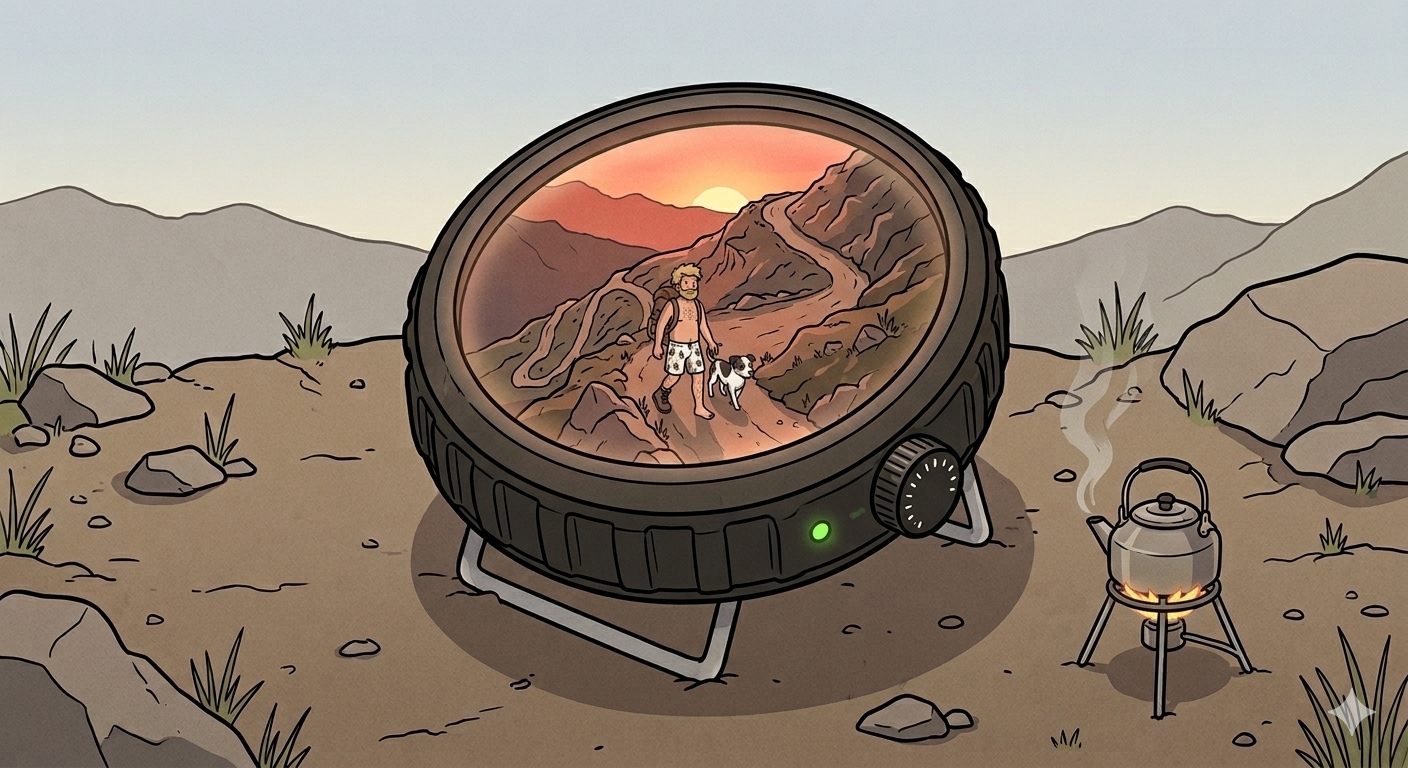
Sixty mornings.
The Waking Fire is at the summit. The Emberstone, which has been sitting on a nightstand and going into a pack and coming back out every morning for sixty days, ends its campaign here.
The ash on the slope records the ascent. Every step. The ash of the high trail is mixed with the residue of the Waking Fire, and what the Waking Fire touches, it marks. Looking back down — sixty mornings of footprints, all the way to where the slope begins, all the way to where the road started, back through the Valley and the Forgetting and the Ridge and the Ashfields and the Sanctuary and the Pass and the Greywood and Thornwick and the Fogmere and the Amber Road and a house in Downers Grove where none of this was inevitable.
The road back to Downers Grove looks different from up here.
Not because Downers Grove changed.
Because the person looking at it did.