The Emberstone Chronicles
The Emberstone Chronicles
Audiobook — read along
The Dreaming Pull has been in this house longer than the quest has. It moved in through the accumulated softness of a life that has been built well and knows it. A good job. Kath, and a dog named Stevie, both of whom are genuinely excellent. A life that asks nothing of the morning because the morning has already been earned. The Dreaming Pull finds comfort that already exists and makes itself at home inside it. This house gave it a lot to work with.
The Pull is not a villain. It is a force as old as the first morning that was ever too cold to face, as patient as every reasonable voice that has ever whispered that today is fine. It is made of ordinary reluctance accumulated over a long time. It genuinely believes what it offers. That is what makes it dangerous.
It has met Chip before. It knows the shape of his campaigns — the early momentum, the genuine intent, the texture of a Wednesday in week three when the growth is somewhere up the road being difficult. The Pull has the receipts. Day eight. Day eleven. Day fourteen. It has watched Chip choose the 3.0 pickleball bracket because that's where he's the best player in the room — not the 4.0 bracket where his real ceiling might reveal itself. The Pull intends to use this architecture again.
But the ledger has five entries.
The Fellowship assembled: Will, who documents everything and whose care for Chip is expressed through the precision of a ledger. Brent — Papi Chulo — who calls everyone Papi when they need it and means it every time. Kevin, who became a father and in so doing became someone whose mornings are not his own.
The Emberstone is in the pack. Stevie is at the door before the alarm finished its thought. A dog with a fully formed opinion about the morning is not something the Dreaming Pull can argue with. It does not speak that language.
The road to Ashen Peak starts here.
A Decision:
The alarm sounds before dawn. The house is still. The Dreaming Pull settles into the quiet and waits.
You can:
Lie still a moment before answering
or
Rise before the argument develops
Chip chose to Rise.
The argument never assembles. The Pull hasn't finished composing its opening case when the feet are already on the floor. The Emberstone catches first light. The road begins before the doubt does.
The Amber Road arrives as a smell before anything else — dust and something older underneath it, the scent of a path that has absorbed ten thousand mornings. The Emberstone is warm in a way it wasn't in the house.
Brent shouted.
"Chip Papi chulo is on the quest, hes on the road papi"
"Obviously I knew that. I helped name the stone." Kevin Added
Nobody had known Kevin helped name the stone.
The bend in the road at the waypost marker. The notch that somebody cut into it and did not explain.
Day 7 — Missed Check in
One morning lost on the Amber Road. The Dreaming Pull knows this stretch well — it has been working it since before the quest had a name.
The road will still be there.
Will's ledger methodology: one entry per morning, timestamp first, checkin time second, streak count third, a single observational note if the morning warrants one. No encouragement. No commentary on trajectory. The ledger is a record, not a conversation.
Brent has opinions about this methodology. He has expressed them, diplomatically, twice. Will acknowledged them both times with the silence of someone who has heard the feedback and decided it is not actionable.
Kevin explained.
"That's just how Will loves people. He shows up and writes it down."
Will has not commented on Kevin's interpretation. The ledger has a new entry for day 8.
Ten mornings. The road has a name now.
There is a waypost on the Amber Road where travelers have been cutting marks for longer than the cartographers in Thornwick have been alive. The wood has gone grey and soft in places, dark and hard in others. Moss has settled into the deeper cuts. The initials have softened into something that reads more like weather than writing.
The Emberstone burns steadier than it did in the first week. A candle in a draft has a certain motion to it — a lean, a recovery, a lean again. The Emberstone has stopped doing that. It sits in its own light and holds still.
Stevie, who had been reading the post with her nose in the way a scholar reads a difficult text, came to her conclusions and signed them with hot piss.
A Decision:
A mile marker stands where the Amber Road bends into the Fogmere. The post leans like old teeth. Travelers have been cutting marks into it for longer than anyone has kept track.
You can:
Leave a mark on the waypost
or
Walk past it
Chip takes out his knife. The cut is small and deliberate — his initials, the date, a notch underneath that he'll know the meaning of and nobody else will. The post takes it the way old wood takes everything: without comment, and for a long time. Somebody four hundred mornings from now will run a thumb over it in the rain and wonder who he was, and the wondering will be the answer.
The Fogmere arrives as a temperature drop and a change in the sound of Chip's own footsteps — like the world has put a hand over its own mouth. Visibility, generous, is thirty feet.
Stevie, who has strong feelings about fog, presses against his leg and stays there. The Emberstone gets warmer as the air gets colder, glowing faintly through the fabric of the pack.
The Dreaming Pull was already in the Fogmere when Chip arrived. It did not come with the weather. It was here first. It has its best material on this road. It has won in fog what it has lost in clear air, and it is not in a hurry.
Something moves at the edge of the stone's light.
Low to the ground. Built like a living piece of slate. The plates that armor its back overlap in four rows, and when it moves they shift against each other — slate on slate, the sound of a stack of thin flat stones being set down one at a time by someone being careful about it.
Six feet in constant motion, the pattern always front, middle, back, front, middle, back. The sound layers on itself into something almost like a small engine at low idle. It has no eyes — shallow depressions on each side of the skull, furred over with fine white hairs, reading temperature and vibration. It arrives at the correct conclusions faster than anyone with eyes ever has.
Chip makes a small sound. The kind of involuntary intake that happens when the thing you've been reading about for years is standing in front of you doing the thing.
Chip follows it. The group falls in behind him in a line. Nobody looks away.
The fog thickens. The stone goes from amber to almost pink at the edges, which is how the Emberstone reads very dense grey. Then the fog thins.
A clearing the Fogmere has made an exception for. In the middle of it: a heron, or something heron-shaped, standing on one leg in water that is not there.
The proportions are wrong the way something in a dream is wrong — close enough that your brain accepts them until it doesn't. Too tall by maybe a foot.
Its feathers are not grey. They are the color of things seen through grey. The bird is not the color of the fog. The bird is the color of what the fog is in front of.
It turns its head — past the point a neck should let it go — and stops.
The murk-crawler taps its front feet in a short pattern — three soft, two hard, a pause, one soft. Then it turns and starts back the way it came, unhurried.
The heron looks at Chip. At the group. Then at Chip again, with a specificity that is not comfortable.
When it speaks, the voice is made of other voices. A man's tenor in the consonants. A child's cadence in the way sentences end on a slight rise. Underneath, a woman's voice saying something that isn't quite the same thing the heron is saying out loud. The bird has learned language the way a parrot learns language, except that a parrot learns from the family that keeps it. This thing has been alone in the clearing. It has learned from whoever passed through. Some of them, Chip understands without being told, did not pass all the way through.
"You've come a long way this morning. I know one thing to ask, and I ask it of everyone who stops here. It has been a long time since someone answered correctly. I would like you to try."
Then, carefully:
"Something travels with you that you did not pack.
I have no mouth but I speak to those who stop.
I have no eyes but I see who is lost.
I grow heavier the longer you carry me,
and vanish the moment you set me down.
What am I?"
The fog holds the question.
Brent asked the group-
"is it a feeling"?
"sleep on it" Kevin replied
Will closed the ledger
Day 12. The murk-crawler. The heron. The riddle. Documented. Answer pending.
The heron is where they left it.
Chip has been carrying the riddle since yesterday morning. He knows this thing. He has been carrying it longer than this campaign.
The group reaches the clearing before he has decided whether to say it. If a bird can look tired, this one does.
It turns toward them. Recognizes them. The voice today has more pieces in it — there is, underneath everything else, someone very old, someone who sounds like they have been cold for a long time.
"You came back. Most don't."
Brent goes first, because Brent always goes first.
"An echo."
"An echo needs a voice to follow. This makes its own."
Kevin tries.
"is it Fear?"
"Closer. Fear can be outrun. You know this already."
"not by me I can't." kevin shoots back.
Brent laughs. Will has said nothing, which is worse than a guess. Will has been watching Chip — he can tell, from the way Chip is standing, that Chip is about to say the thing.
"Doubt," Chip says.
The heron lowers its head — a motion a heron's neck should not be able to make.
The heron steps aside.
Behind where it stood: a path through the fog. Not lit. The fog simply declines to be there, a corridor about four feet wide, arrow-straight, extending further than the Emberstone's reach.
The group walks the corridor in single file. Nobody talks. The sound of their footsteps is closer than it should be, the way sounds are in a room with a low ceiling.
They emerge on the other side. The fog ends without tapering, the way a curtain ends. The road is there. The sun is there, actually there.
Kevin breaks the silence "you knew it before you said it. How long?"
"Since yesterday." Chip answers "Maybe longer."
Kevin nods and doesn't follow up.
Will documents.
"Day 13. Doubt. The path opened."
Brent sent a message that said: "I want to address something that happened last weekend."
Nobody had asked.
"I went to a Rivian owners meetup. I'm not an owner. I know that. But I wanted to be around the vehicles and I thought I'd be respectful and just observe. And things were going fine. And then a 2023 R1S pulled into the lot and I got jizzy. I didn't realize how jizzy I was being. I thought I was being normal. I was not being normal."
Kevin, immediately "oh no"
Brent kept going: "a man named Norm came over. Very calm. He said only registered owners get to jizz at the meetups and I needed to show registration if I was going to jizz that much because it was distracting and against the posted rules. I said Norm I don't own a Rivian but this isn't even jizz yet, this is pre cum, I know the rules. He said no way that is way too big of a spot on your khakis to be pre cum that is jizz. I said Norm that is just my drips, imagine how much of a leader I'm going to be here once I actually own one. He said sir you need to leave. I said Norm listen to me. Rivian is $16.52. It moved 2.5% today. He went quiet for a second. Then he said you made me shoot. Then he said you're a bad guy for making me shoot, you know that, you should go, fuck you, and fuck you I didn't ask you to make me shoot the way I shot right here."
Chip, after a pause: "wow that's neat"
Brent replied: "Norm's a cool dude. Has a Rivian."
On the way out — the grey thinning, the road becoming visible again — there is a shack.
It sits just past where the Fogmere thins, in the narrow band where fog and not-fog meet. Boards weathered to the color of old bone. A tin roof gone the soft grey of a cloud. A door that opens without being asked. The group stands on the threshold. Then everyone goes in.
The smell hits first. Linseed oil so old it has become part of the wood.
Canvases stacked against every wall. Dozens of them. They are all studies of fog. The painter was trying to catch something he can't. None of the canvases are finished.
A jar of water with a brush still standing in it, the water dried decades ago, the brush fused to the glass. A cup with the ring of something once-dark dried into the bottom. The painter set it down one morning and did not come back.
Kevin stands in front of the blank canvas for a long time and doesn't say what he's thinking.
A decision:
Propped on the table, set apart from the clutter — a small canvas. Maybe six inches square. The only finished canvas in the shack.
Dark reds and deep blues, a burnt orange underneath, a single streak of cadmium yellow across the lower third. If you look at it with soft eyes it resolves into a shape. A gorge. A bridge across it.
The Forgetting. Weeks from here. A crossing where travelers do not lose their direction but their urgency.
Beside the canvas — a small glass vial. Stoppered with cork, sealed with wax that has gone the color of a bruise. Rolled against the inside of the glass, a thin curl of paper. A note for whoever breaks the seal.
The painter knew what was down the road. Bottled something for it. Left both here for whoever walked out of the fog.
Only one person carries it. Who?
You can: Give to Will, Give to Brent, Give to Kevin
Chip chose to keep it himself.
Chip put it in the pack while the group is still looking at the canvases. Nobody saw. The Forgetting is weeks away and the vial is small and he's the one this campaign is about anyway. The pack is a little heavier when he shoulders it again, which is probably the vial and probably just imagination.
Thornwick smells like woodsmoke and old paper — the smell of a place that has been keeping records long enough that the records have become part of the architecture. The buildings are low. Every surface has been labeled by someone who thought the labeling mattered, and in Thornwick, they were right.
Chip's arrival generated conversation about whether the records were real and whether Will's ledger counted. Will noted the ledger was already a primary document.
"Papi Chulo has arrived in Thornwick." Brent says with a big smile on his face.
Kevin, from a timestamp suggesting he had been awake since before the conversation began, said there was an entry in the Thornwick ledger that stopped at day forty-seven with no explanation. Nobody asked how Kevin knew this. By now the group had learned that with Kevin, sometimes you just receive the information.
The archive opens at the third hour. Chip arrives after.
A junior cartographer at the door explains the hours. She does not make this difficult. She also does not make exceptions. The door stays closed.
The compact cartographer finds him outside. He asks Chip if he is carrying anything from a field contact named Mira. She was on the Amber road around his day 7 carrying something. Chip missed the check in that day and the contact. The field cartographer doesnt explain what she was carrying and wishes Chip a safe road.
Later, from Brent
"how was the archive?"
Chip took a moment and before responding "closed, I didnt get there in time"
The Greywood is ahead. The cartographers map thresholds Chip has been crossing without knowing they were there.
Brent had something to share
"papi, i watched something last night, TLC. My Strange Addiction. Nathaniel. 27. Arkansas. 1998 orange Chevy Monte Carlo named Chase, papi he called Chase his soulmate"
Kevin, against his better judgment:
"wait, what"
"Kevin he checked the dipstick. on camera. he licked it up and down, he described draining the reservoir, HE MAKES CHASE REDLINE"
Kevin, to himself.
"I need a coffee, maybe tequila"
Brent continued.
"His dad was concerned. papi Nate's dad doesn't get it, Nathaniel completed the full service. start to finish and i'm thinking about Rivian down 2.1% to $16.40 this morning and i'm thinking i could be Nathaniel"
Kevin, immediately
"you cannot be Nathaniel"
Brent escalated.
"i want to GENTLY kiss her bumper to bumper Kevin. again and again until she smells like my mouth. the door jambs. the wheel wells. the seam under the hatch where the rain gets in i want to take off my clothes and expose every crack and crevice to my dumpling i want her to flash her dirty little hazards at me frunk to hatch. headlight to headlight. high beams focused on big papi, dick to dome.i have a towel KevinMY WIFE KNOWS NOT TO TOUCH THE TOWEL but the full service Kevin. the full flush. what Nathaniel had"
Brent, visibly sweating, has unbuttoned his shirt down to his navel leaving only the top button. Distraught, the cholo pinches the two bottom corners of the shirt and fans his bare belly. He turns to the group, frenzied:
"fuck fuck fuck fuck fuck fuck RIVIAN IS ELECTRIC!THERE IS NO TAILPIPE!!there's no where to stick my 4 inches of throbbing pink!!!papi i'm reduced to the back seat. Camp Mode engaged. tonneau closed for privacy. temperature set to her favorite. she wants it. she's been asking for itshe's a swampy little jizz crock papi. she's a squelching spunk gremlin. Nasty lil filth fuck. My gunk glazed goo goblin and she knows what she is, an absolute non-stop, round the clock glop stop… my man mayo depot for slurried chowder, daddy batter, and ejaculate — KEVIN! Listen! OSHA's hands are tied! she's been classified essential infrastructure, if she stops — everything backs up, everything leaks, she takes too many loads to shut downand i'm gonna pull my piglet until it squeals papi. i'm gonna FILL HER UP. i'm gonna flood her seats. i'm gonna leave the cabin soaked. i'm gonna paint that Glacier White interior off white and she's BEGGING for the next charge cycle. all of it for hershe's been a good girl papi. Big Pimp Papi takes care of his girls. and the main slop ho gets the full hose down — she's a top earner papi, she earned it all"
Chip, playfully responds
"ooo papi likey"
Will closed the book
"Day 19. RIVN $16.40, Brent role plays pimping out an imaginary Rivian. He treats his top slop bitch well, documented"
Twenty mornings. Thornwick has been watching.
The cartographers keep entries going back further than this quest. The entries that extend furthest don't belong to the travelers who seemed most certain at the start. They belong to the ones who kept showing up after certainty would have been reasonable to abandon.
One entry in the Thornwick ledger stops at day forty-seven. No explanation. The cartographer's margin note says only: further than expected.
The Emberstone burns differently in Thornwick. Not brighter. More settled.
The road south leaves Thornwick past the last of the cartographers' houses. After the houses, a footbridge over a creek narrow enough to step across. Then the road and the trees and the morning ahead.
Voss caught up with him at the bridge.
She was small, older — old enough that her hands had gone translucent at the knuckles. The right hand had a deep black stain at the side of the index finger where decades of nibs had pressed. Her right hand had done forty years of work her left hand had only watched.
She pressed a compass into his hand.
It did not point north. The needle rested somewhere east of north and held there with a small steady confidence, as though it had decided. She explained that it points where it points, some travelers work it out, others dont but both are useful to the cartographers.
The compass was older than anything else in the pack. Brass casing gone soft-edged from handling. Whoever had carried it before him had carried it for a long time.
A Decision:
The road bends past the bridge toward the Greywood. The compass is in his hand. The needle holds east of north.
Your choices:
Ask Voss about the compass
or
✓ Put it away
Chip buckled the compass into the side pocket of the pack without reading it again. Voss had given him an instrument, not an assignment. The road went on and he went on with it.
In the Greywood the air sits heavier in the lungs and a few degrees cooler. Sound moves differently — your own footsteps come back smaller. The light goes grey-green and filtered, the way light comes through water at depth.
Old growth. The trees are spaced wider than younger forests because each one is the survivor of every other tree that tried to occupy its share of the sky. Look up and the canopy is dense everywhere except along the edges of each crown. Crown shyness, the foresters call it. The Greywood is named for what the light does inside it.
Stevie was in her element. She had spent the Fogmere days low to the ground and unsure, but the Greywood opened up around her and she opened up with it. Something small had moved in the leaf litter and she had committed to it, nose down, tail working.
Chip read the floor as he walked. Burn scar to the east, healed cambium thick enough to date the fire to forty years back. Inonotus dryadeus at the base of an old oak, weeping at the rim. Partridgeberry in the understory, which only happens in forest that hasn't been logged in a hundred years. A turkey scratch in the leaf duff.
He didn't talk while he walked. He was happy.
Then Brent stopped at a beech and put a hand up. On the trunk at chest height: perfectly still, as though it had been placed.
Brent pointed at it "What is it? Should I squish it?"
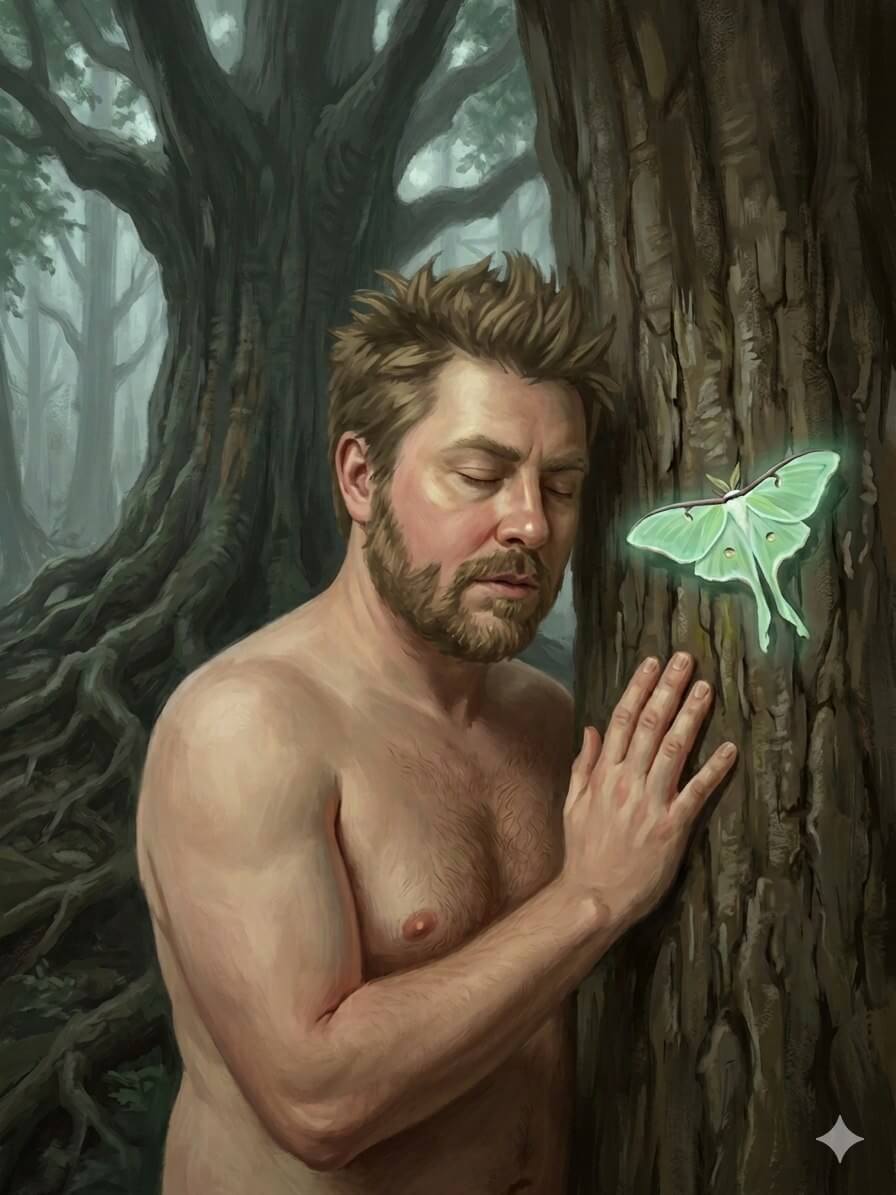
"Actias luna," Chip said. "Luna moth. It dies in a week."
"What."
"They don't have mouths. Once they emerge as adults, they can't eat. They just mate and die."
A pause while everyone processed that.
"If I didn't open my mouth I'd get laid in a week too." Will said
"I talk to my wife, papi that's how it works."
"Everyone here would do better mouthless," Kevin said.
Brent told Chip to say a prayer for it. Chip refused. Brent tried Will. Will agreed it wasn't Christ-like to refuse. Chip refused again. Brent tried Kevin.
"Say a prayer for the moth, Chip,"
Chip closed his eyes.
"Heavenly Father, we come to you this morning in the Greywood to lift up your creation. Lord, we know that not one sparrow falls to the ground apart from your will, and we trust that the same is true for this moth. You clothed the lilies of the field more gloriously than Solomon, and Lord, you have clothed this creature in a green that no man could paint. Father, we ask that in its short week you grant it the desires of its heart — that it find its mate, that it complete its work, that it return to the earth as Genesis tells us all flesh must. We thank you for the wonder of it. We thank you that all creation groans together, and that you hear even the smallest of your creatures. In Jesus' name, amen."
A long silence.
"Amen," Kevin said.
Will lifted his head. "In Jesus' name!"
Brent nodded slowly. "Baruch hashem, heavenly papi chulo."
Stevie circled back. She sniffed the base of the beech, looked up at Chip, and moved on. The moth wasn't for her.
The Greywood went on south. Behind them the moth had a week. The trees had centuries. Both were happening at once.
The trail Chip was following wasn't a deer trail. The prints were single-file, the stride twenty-eight inches, regular. Every print landed on bare dirt or root, never on leaf litter. A person who didn't want to be tracked but wasn't bothered enough to brush the prints out behind them.
Chip followed the line.
It ended at the base of one of the largest beeches in the Greywood — a tree with a trunk the diameter of a small room. At the base of the trunk, on the side facing away from the road, the wood opened into a hollow.
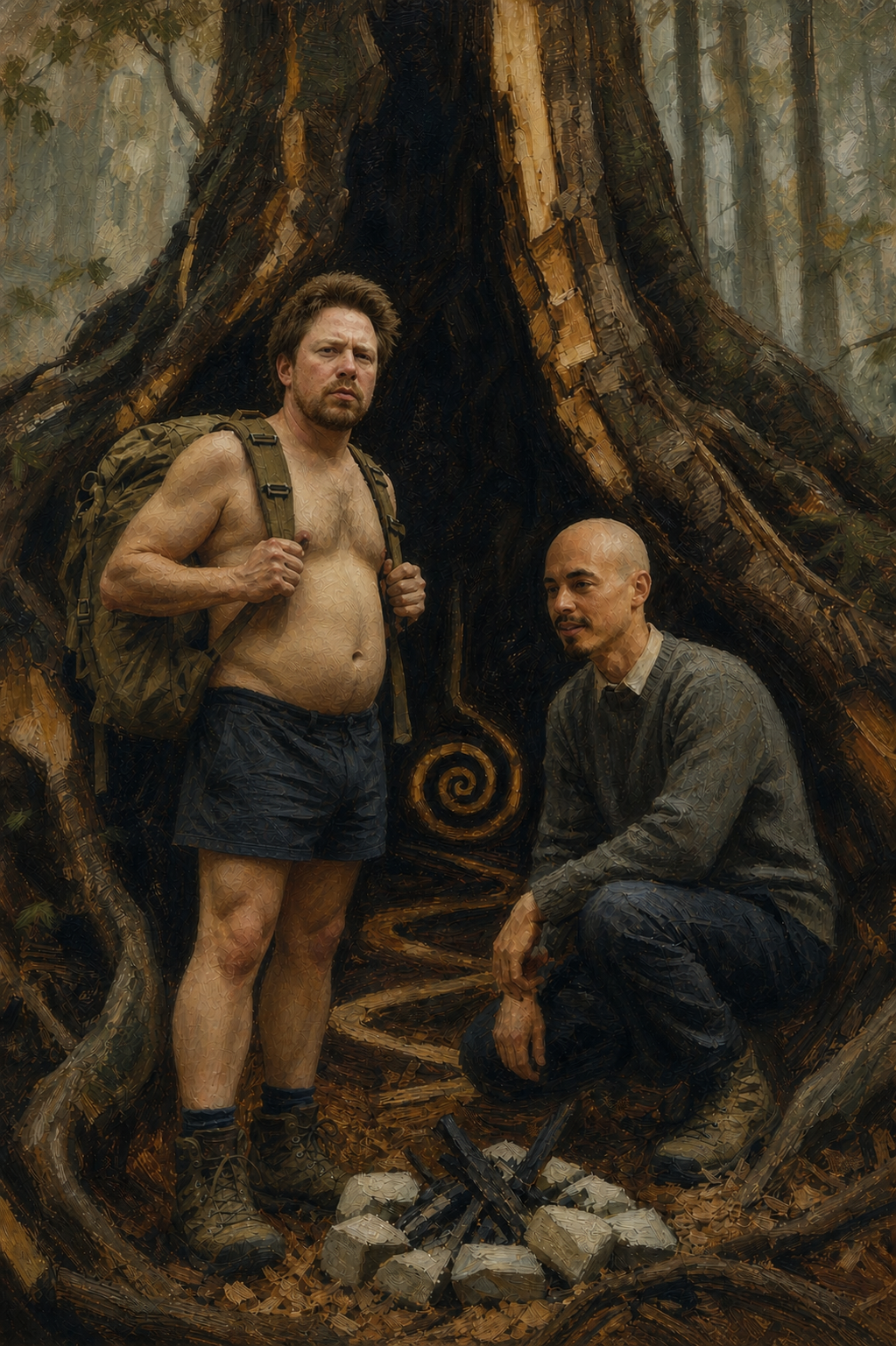
Inside, along one curve, someone had pressed a symbol into the soft wood. A spiral, seven turns, the terminus angled out from the wall. Below it, a small fire ring. Chip held his hand above the ash. Hardwood. Banked overnight. Still faintly warm. Twelve to eighteen hours back.
He photographed the symbol and stepped back out.
Kevin looked at the photo "Wayfinder mark"
Chip asked what it was.
"Surveyor leaves them. Tells the people coming behind that the route's been walked."
Chip asked how he knew.
Kevin looked at him a beat longer than the question needed "I've been on a road before, Chip. I've slept in a tree. This isn't my first road."
Chip didn't have a response to that.
"The spiral points where they're going. They're ahead of us. Half a day, maybe."
Will closed the book "Day Twenty-Two. Hollow. Wayfinder symbol. Documented."
They walked on. Half an hour past the hollow Chip stopped at a fern that had been bent back at the stem rather than broken.
Whoever was ahead of them wanted them to know.
The Dreaming Pull was here before the road was here. It will be here after. It does not need to travel. It is wherever a person could decide not to get up. It is at work right now, in someone you know. In your house. In you.
It does not announce itself. Argument is a form of attention, and the Pull does not need attention. It needs only the moment after argument, when the person says fine, you're right, I'll start tomorrow, and turns over, and goes back to sleep.
The Pull does not want anyone to fail. It wants them to fall short by a margin small enough that the falling-short can be reasonably explained — by tiredness, by the weather, by the work being harder than expected. The morning that was almost what it should have been. The apology that was implied instead of said.
It works through small persuasions. The 10am alarm that becomes 10:15, then 10:30, then noon. The voice in your head that always has the right rationalization for the moment. Each persuasion is small. Each persuasion costs a person who they were going to be.
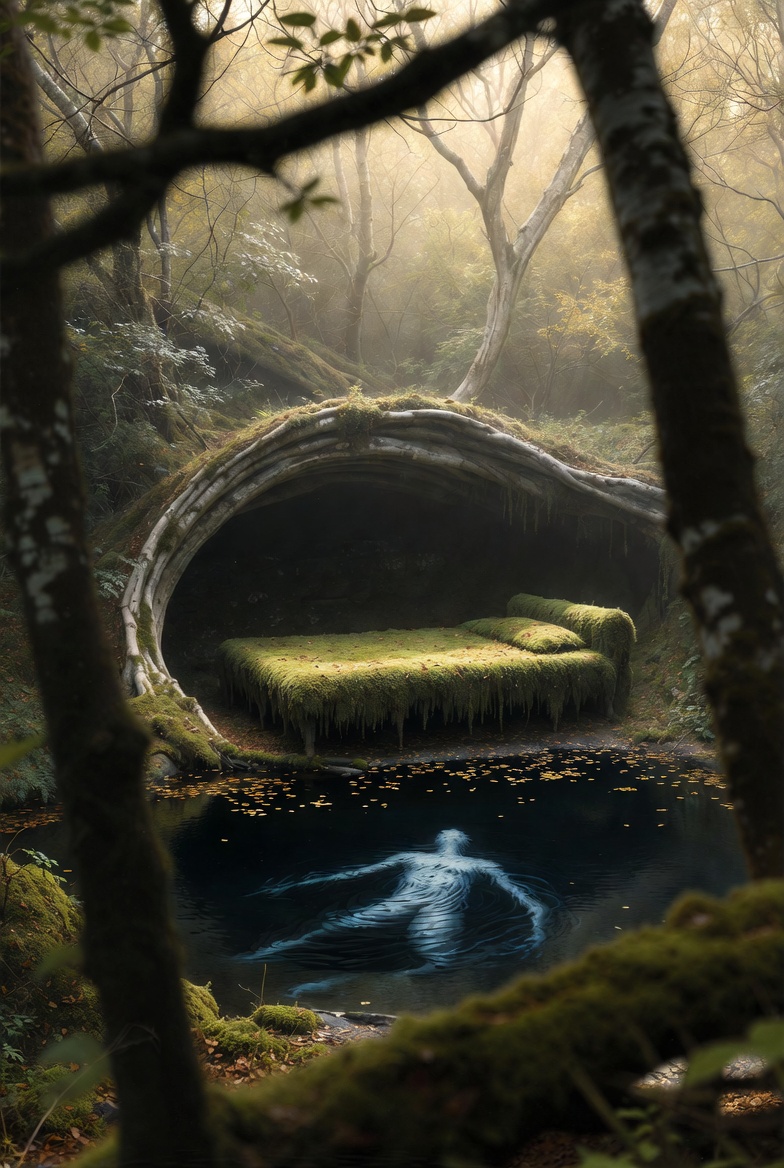
The Pull does not have a face. The face that appears below dark water, in the folds of bedding, in the patterns of flame — that face is what the Pull leaves behind when its attention has rested somewhere a long time. A residue. The depression a head leaves in a pillow.
There is no version of this where the Pull is finally beaten and goes away. There is only the version where, on a morning, a person rises and walks anyway.
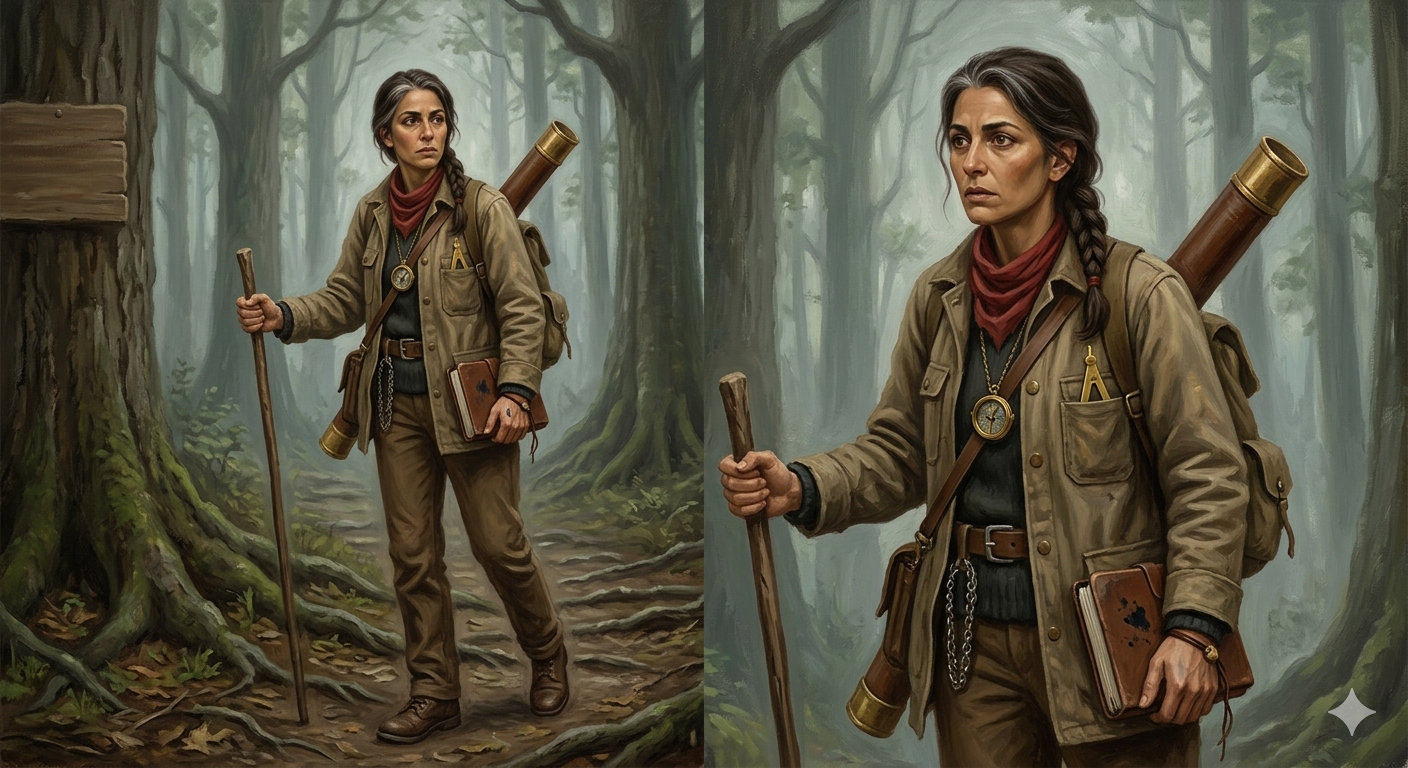
She came around the bend moving fast, and stopped when she saw the group. Her eyes settled on Kevin.
"Senna," Kevin said.
She said she didn't expect to see him carrying again.
He said he wasn't planning on it.
Senna looked at Chip. Kevin tilted his head: "this is the road we're on."
She turned back to Kevin and asked how it was going.
"He's getting up. Finding his way."
Senna looked at Chip again, longer this time. Chip held the look.
She told them about the cairn. Weeks out, at the highest accessible point of the Ridge. Names cut into the base stones, going back further than the cartographers' records. She told them to read every name.
Will was writing as fast as he could.
Senna said she had to keep going. She told them to walk well.
"Walk well." Kevin said back
"Kevin," Brent waited until she was out of earshot. "She said carrying again. What are you carrying."
"I've carried before," "But, right now I'm just carrying this dick and balls."
The group walked south. Chip walked beside Kevin for a while. He asked if Kevin had done this before. Kevin said he had. Chip asked if Kevin had done it with other guys like him.
"With other people. Yeah." a few steps in silence-
"Walking beats crawling. Running beats walking. Ultimately, it's finding the desire to run. And then wanting to run alone."
Chip kept walking. He thought about how many mornings Kevin had been on roads like this with people who didn't make it. He thought about how Kevin had still gotten up this morning to walk with him.
Twenty-five mornings. The remainder is unmarked.
The work isn't building anything. The work is the thing being built. You can't see it from the inside. From here it looks like you got out of bed twenty-five times. From a distance it looks like a man getting good at being one.
A Decision:
Chip found the pond ten minutes off the main path. Still and dark with tannins, a fallen log half-submerged at the bank. He stood at the bank for a moment before calling the others.
What does he want to show them?
Charidotella sexpunctata / Laetiporus sulphureus / Osmundastrum claytoniana
✓ Ambystoma maculatum
Chip decided.
Under a log at the pond's bank — he lifts the edge gently, replacing exactly what he disturbs — a spotted salamander. Black with bright yellow spots, completely still in his hand for three seconds before it decides he's not a threat.
The yellow spots are a warning. The warning is real — it produces a mild toxin through its skin. But the toxin has no practical effect on anything large enough to hold it, which means the warning has been working for thirty million years exclusively on predators that no longer exist. It still makes the toxin. It still wears the spots. The threat is gone and the defense remains, fully functional, absolutely sincere, pointed at something that has been extinct since before this continent had its current shape.
He puts it back. He replaces the log exactly.
The Hollow Pass changes sound first. A footfall comes back small and late, the canyon adding distance to it before returning it. The walls rise on either side higher than the eye wants to follow — a thousand feet of dark layered rock.
The compass needle settled in the Pass. It had been moving since Thornwick — slow and uncertain. In the Pass it stopped, pointed once, and stayed.
Kevin was in a cold car for reasons involving his children and their morning schedules. He mentioned that one of his kids had woken him up to ask if bugs dream, which he had not been able to answer, and that Chip might have thoughts on this.
"Tell him yes. A bee in the hive at night does the same thing he does. Her body gets very still and her brain gets busy. Scientists put tiny machines on bees and the machines say their brains run pictures while they sleep. The pictures are probably the flowers she went to that day."
"Tell him a firefly probably dreams about the right time to flash. A ladybug about the leaves she was on. A butterfly about whatever color of flower she likes best."
"The most important thing is that bugs are tiny. They have tiny brains. So their dreams are probably very short. The dream of a bee might only be the smell of one flower for one second, over and over until morning."
"That's still a dream."
"Tell him I said it's a really good question."
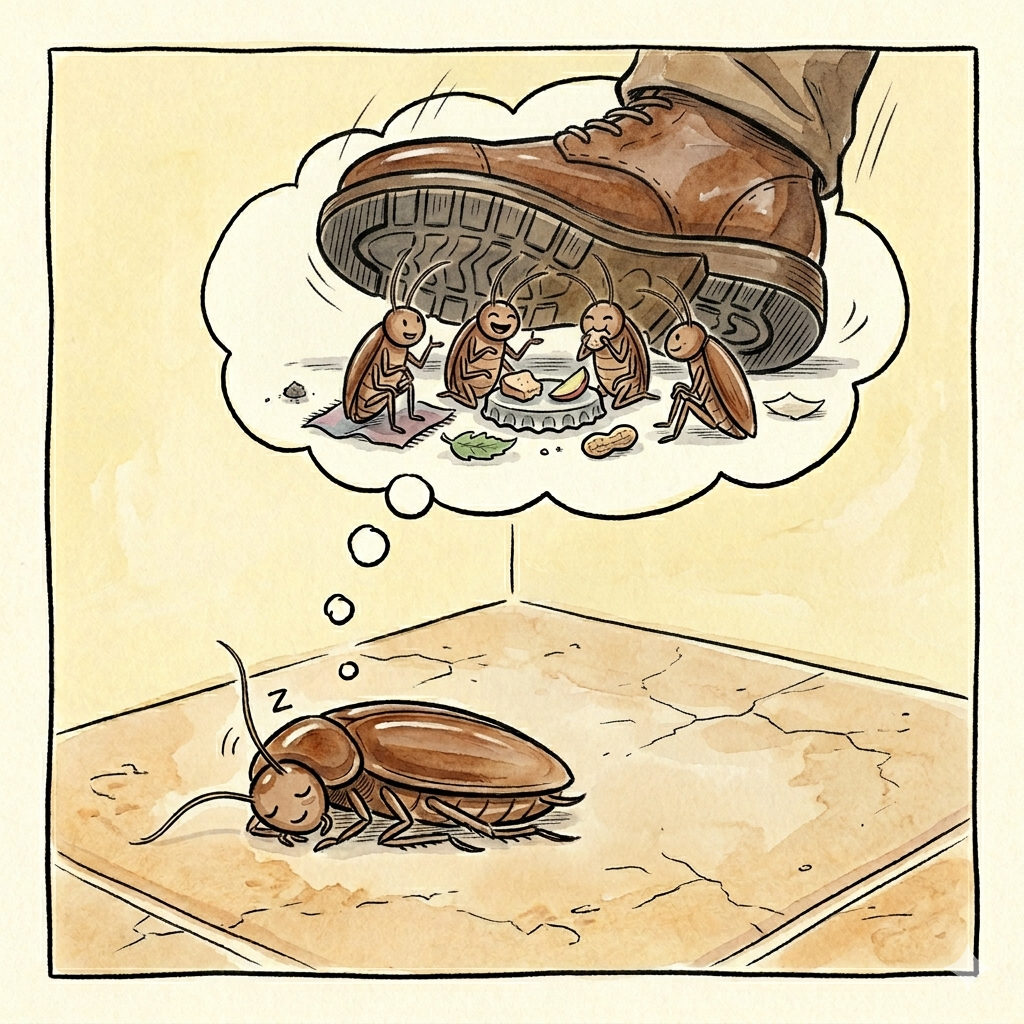
"papi I want to know what a cockroach dreams about" Brent asked
"Brent a cockroach probably dreams about being underneath something"
"yeah totally"
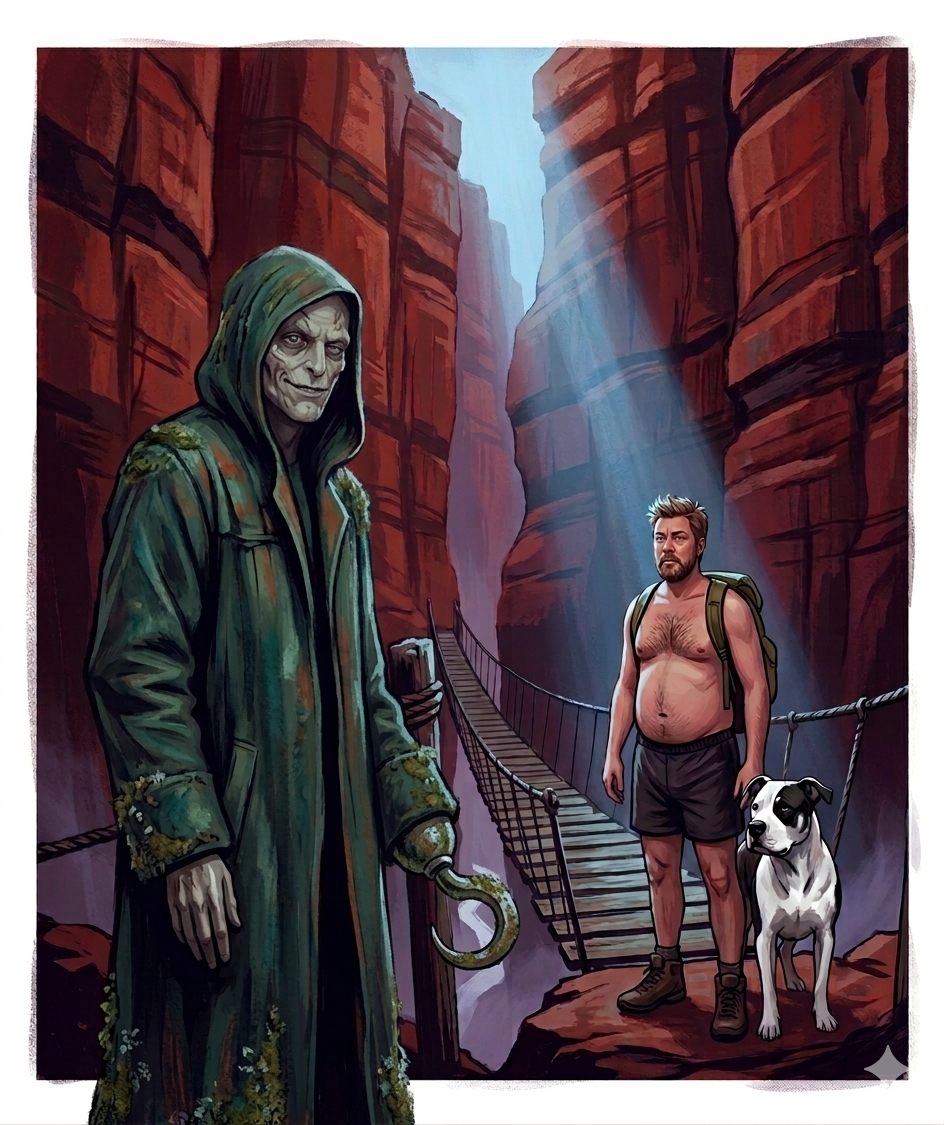
The bridge at the Hollow Pass has one keeper. Aldric. Thousands of years in the same coat. The ropes move whether the wind is blowing or not — the canyon pulls at them from below.
Aldric already knew the answer. He was waiting to find out if Chip did too.
"You look like you left something behind. What was that, traveler."
Below the bridge the river has been cutting the same stone for a million years and is not finished.
"I stopped believing I would be a different person. I left that behind."
Aldric stepped aside. Reached into his coat — a stone, smooth, from the canyon floor, warm and weathered — and dropped it into the pack.
Aldric watched him cross the way he has watched ten thousand travelers go. The safe answers. The almost-answers. The ones who stood at the edge and stepped back into safety.
And the ones who spoke honest and kept walking.
There are not many of them.
This one kept walking.
Chip asked Will to tell a story. Will said he had plenty.
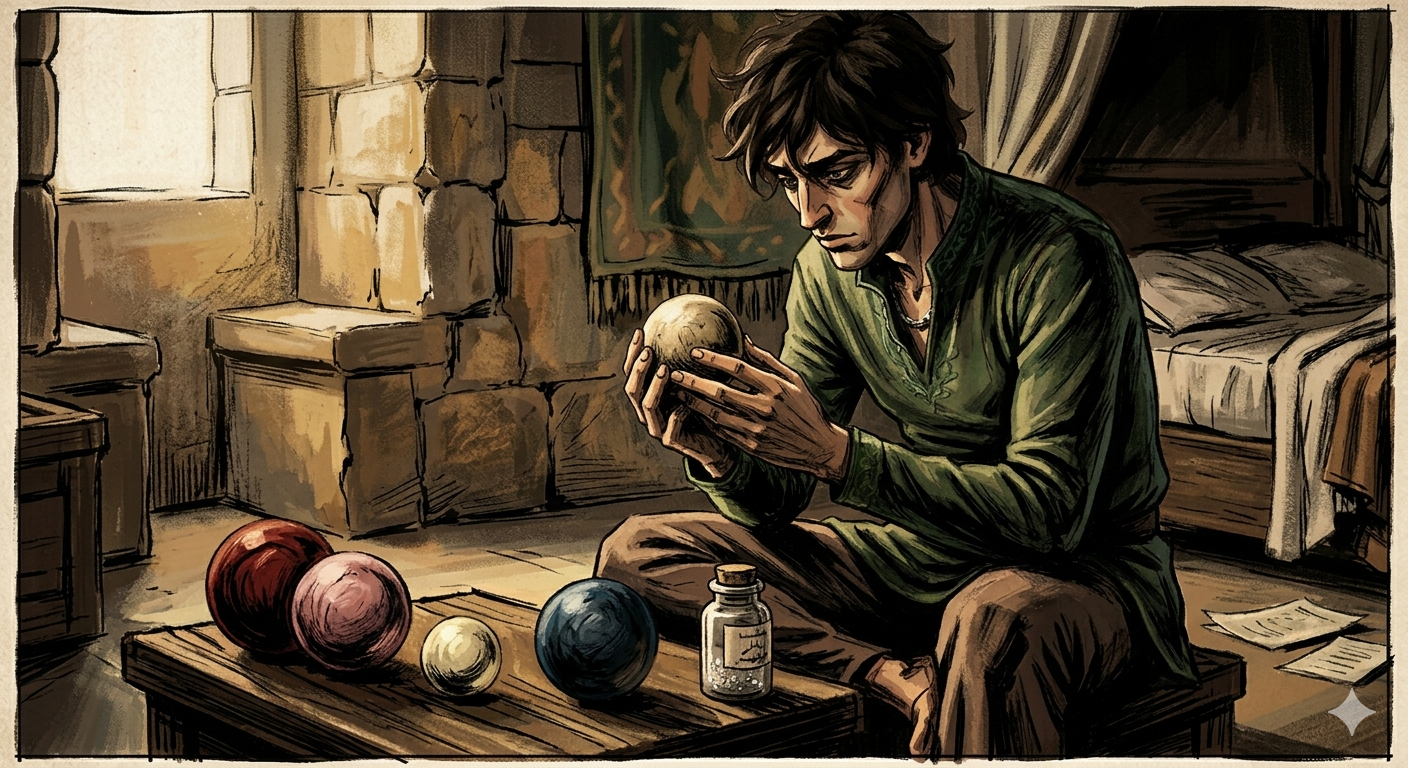
"This is a story about a little prince, His name is Giuseppe."
Will settled in
"Once upon a time, in a kingdom of stone and good harvests, in the foothills of a country no longer on any map, there lived a little prince named Giuseppe. Giuseppe was beloved. He was the kind of prince who remembered the names of his subjects' dogs.
"The kingdom worked because everyone in it juggled. The bakers juggled the bread and the deliveries and the apprentices. The blacksmiths juggled the steel and the customers and the fire. The farmers juggled the harvest and the weather. The chancellor juggled the ledgers and the king's appointments. From the highest tower of the castle, you could look down and see thousands of small bright objects in the air. The kingdom kept going because the juggling kept going."
"The king of this kingdom juggled for the entire kingdom. He held the things no single person could hold — the wars, the seasons, the borders. His juggling was so practiced that nobody saw him do it. They only saw the kingdom not falling.
The little prince loved the king. Giuseppe wanted to juggle."
"Giuseppe started with one ball. The wake-up ball.
The wake-up ball was what every juggler in the kingdom started with. You toss it in the morning. You catch it. You toss it again. It was the easiest ball, but only after you had been juggling it long enough that it had become easy. Before then it was the hardest ball, because every grain of attention you had was on it. The day shaped itself around whether you could set the ball. You didn't run the day. The ball ran you.
Giuseppe wasn't lazy. He wanted to do good work. So sometimes, late in the day, after he caught the wake-up ball for the last time, he would pick up another ball. The work ball. He would snort a little meth, and he would juggle the wake-up ball and the work ball together for a few hours, and in those hours something extraordinary would happen.
Giuseppe would do incredible things. He would draft a decree, settle a dispute between two villages, find a clean way to lower a tax that had been unfair for a generation. Once he wrote a letter to a neighboring kingdom that the chancellor would later say, in private, was the best letter the kingdom had sent in a decade.
Giuseppe would look around at the bakers and the blacksmiths, all still juggling, and notice that during the hours he juggled, his work was the best in the kingdom."
"The prince does the most output in the smallest window," Chip said. "Some people work eight hours, some people spend all day working up the motivation to do meth and then work two and accomplish more. That's just efficiency. Some people are sprinters."
"Giuseppe reasoned this exact thing." Will Said
"Giuseppe reasoned that he was the most talented person in the kingdom. He reasoned that his meth-fueled power hour was the best hour. He stopped reasoning there."
"He did not reason that the bakers had been juggling since before the sun came up. That Hilda the blacksmith had already shoed five horses. That during the long hours before he picked up the work ball, his portion of the kingdom had been getting carried by other people.
The little prince did not reason that his sprint was a sprint, and everyone else had been running, sustained, with pace, and carrying the work of those asleep."
"Giuseppe only saw his own small sprint, and reasoned that his hour was the best hour. He went to bed proud."
"Wait. Is this —"
"It's about a little prince named Giuseppe."
Will went on.
"Think about it from the king's seat. You are the king. You are looking at the little prince. You love him. He has the makings of a great king — when he is awake, he is brilliant.
And you are looking at your bakers. Your blacksmiths. Your chancellor. The people who carry not only their own work but the prince's portion of the kingdom while he sleeps. You know what it has cost them.
And one day you have to decide who runs the kingdom after you are gone.
You cannot give the kingdom to someone with potential — because without work ethic it's just potential. The talent is wasted. You have seen it before. The kingdom does not stop. The kingdom is held together by the workers. And then the kingdom needs a king who has been there. A king who knows what the workers have been carrying.
The kingdom is not a thing you bestow on someone for being clever. The kingdom is a thing you hand to someone who has been holding it already."
"The little prince wants to juggle more. He believes he has the ability to. But the ego of getting more done in less time keeps him at one ball. He never sets the wake-up ball. The wake-up ball keeps determining the day. He never escapes that.
The kingdom doesn't stop existing. The little prince lives a long pleasant life as a prince who is no longer in line for anything. The marriage ball, the children ball, the leadership ball happen at the pace they happen, when they happen, if they happen — because Giuseppe never built the capacity to choose when. The kingdom remembers him fondly. The kingdom goes to a baker. Or a blacksmith. Or another prince in another kingdom who got up earlier."
A long silence.
"Giuseppe doesn't change overnight." Kevin said "Nobody does. Giuseppe shows up tomorrow."
Another silence
"Tell Giuseppe I heard him." Chip said
"We got you, Giuspapi."
Chip put the phone down. He stood in the Pass. The stone Aldric gave him was warm in the pack.
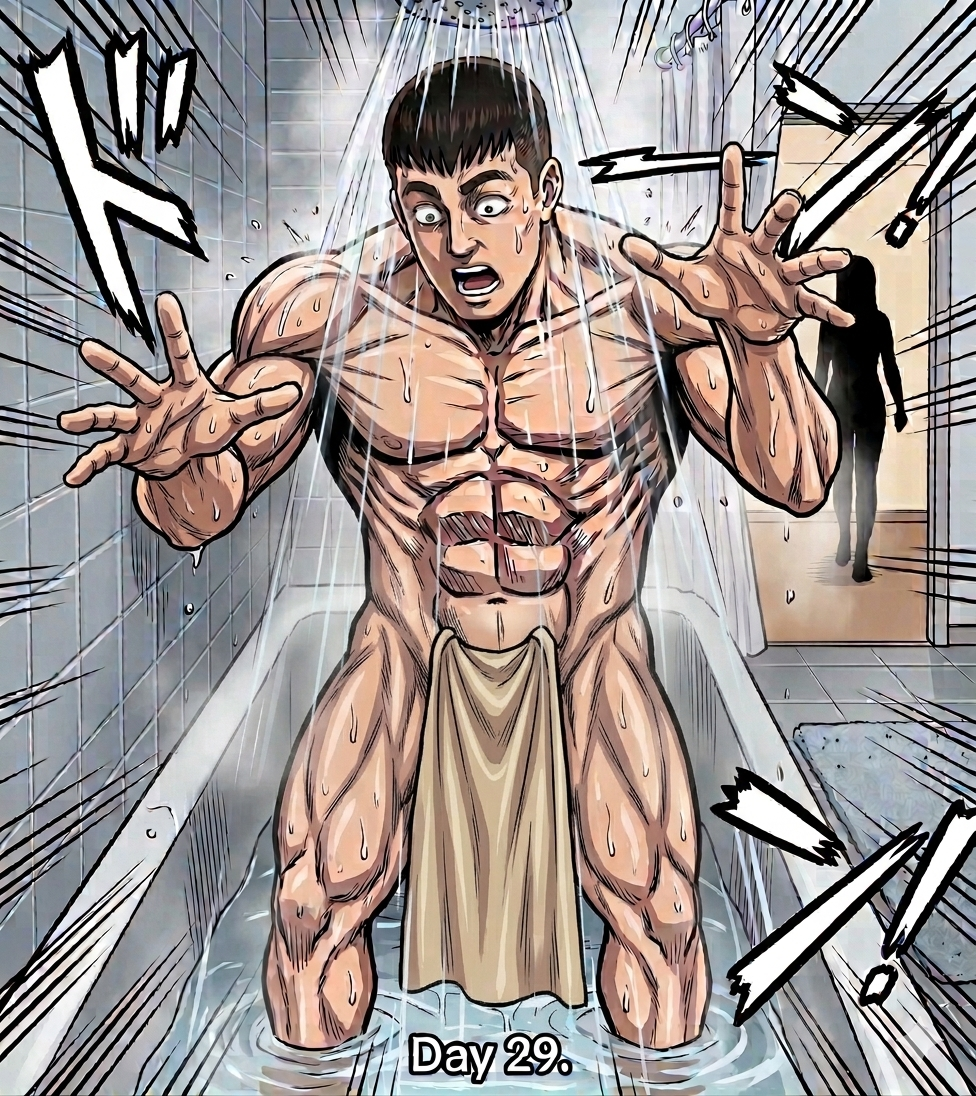
Thirty is a number that means something — not because of what the number is, but because of what thirty consecutive mornings cost, and what they built in the building.
The Emberstone burns at its clearest in the Pass. Not brighter. Clearer. The Pass strips things to what they actually are.
The compass from Thornwick stopped moving in the Pass. The needle settled into certainty.
A Decision:
The compass has settled. It is pointing in a direction that is not the marked road.
You can:
✓ Follow the compass
or Stay on the marked road
Chip decided to follow the compass. Following it means leaving the marked road for a while. This is not the path other travelers have documented.
The Sanctuary smelled like woodsmoke and the breath of someone who had been quiet a long time. The room was warmer than the fire alone should have made it.
Halverd was at the fire when they came in. He looked up and smiled.
"Come in, come in. You've had a hard stretch on that road. Get inside."
He stood. It took a moment, because he was very tall.
He had eight arms. Two rested at his sides. The upper six were each doing something — one stirred a pot, one mended a strap, one held a steaming wooden cup, one turned a piece of wood, one held a thin knife above the wood, and the last was open, palm up, resting on nothing.
He moved around the room and set water in front of them.
"My name is Halverd. Welcome."
Brent was looking up at him.
"Halverd. You've got —"
"Eight. Yes. It's a lot. I find them useful."
Stevie pushed past Chip's leg and walked across the room to Halverd's chair. She stopped in front of him.
"Hello. You're a good dog."
He put one of his resting hands on her head, slowly. She sat down at the chair leg.
"Dogs and I tend to get along. I think they like that I move slowly."
The sanctuary was one room. Stone walls, a deep hearth, a long wooden table, a west-facing window. The east shelves held small wood carvings — birds, mostly. River stones lay on the lower shelf, polished flat.
Chip asked if Halverd had made them.
"Some. The good ones are mine. Most aren't — travelers leave them. People stop here and carve while they're staying."
Kevin had been looking at the chestplate hanging on a peg by the door.
"Halverd. The chestplate."
"Old armor. It's mine. I was a soldier a long time ago. There was a bad day at a city gate. I came here after. I sat down outside this place and the woman who kept it then handed me a broom. I swept. I stayed. When she died I kept the door open for travelers coming through the Pass."
A pause
"I haven't worn the armor since."
Kevin nodded.
The bread came out of the oven Halverd had built into the side of the hearth. They ate at the long table. Halverd did not eat. He sat at the near end and kept his hands going. He asked about the road. He listened carefully. When Will mentioned the bridge in the Pass, Halverd closed his eyes for a moment.
"I remember when they built that. It was a wet summer. The man who designed it lost a son to the river while they were building it. He finished anyway."
They slept in the Sanctuary that night. Stevie was on the floor near his chair.
Chip got up before the others. Halverd was working. Two hands at the pot, starting on porridge. Two on the strap from the night before, almost finished. One on the wood. One resting.
"Morning." Halverd Said
"Morning."
Chip went to the shelf. The cup with the small chip in the rim was set out for him.
"That cup chose you. I noticed last night."
Chip filled it with tea and swept the floor near the door.
Will was sitting at the bench with his own piece of wood. He looked at the wall across from him.
"The walls have a slight sway to them."
"Wind." Halverd said "The Pass pushes air through here all year. The mortar between the stones is mixed with something that gives a little. Old buildings that fight the wind crack. This one moves with it."
Brent looked at the wall. "That's not just wind."
Halverd's hand paused. Resumed.
"No. Not entirely. The sanctuary has some old magic in the stones. Travelers used to bring small things and press them into the mortar when it was setting — coins, prayers, small memories. The magic holds the building together. It's quiet magic. You'd miss it if you weren't sitting still."
Will set his piece of wood down. A few rough cuts that had not gone anywhere.
"How do you carve something when you don't know what it is?"
"I make a cut." Halverd said "The cut suggests another cut. If I make enough cuts, the wood becomes what it was going to be. I have learned not to decide what a piece is before the piece has shown me."
"This one is taking a long time to show me. I think it might want a different set of eyes. Take it. See what it tells you."
Will took the wood. Halverd passed him the knife.
"Don't decide. Just make a cut. See what the wood does."
Will made a small cut. He paused. He kept going.
Halverd asked Will about the ledger. Not what was in it. Just about it.
"Since the second day. I hadn't kept one before. I married my wife three weeks before the road found me. I had been planning to keep a journal for her. The ledger became the journal."
"Good. She'll want to read it."
Will was unsure - "There's just a ton of content about jizz in here. Either someone's jizzing or we're talking about the properties of jizz. There's gotta be at least six pages of jizz in this thing —"
He stopped.
Halverd kept his hands moving "Jizz is funny. You've got a bukkake amount of jizz in that smut diary of yours, Will."
Brent looked up. "Eight-armed guy living alone in a magic sanctuary is into jizz jokes. Who are you?"
"Jizz is funny in any context, Brent. Any sentence. You'll find it works."
A pause
"The magic I mentioned earlier. In the mortar."
"It's jizz."
"The travelers have been jizzing in the mortar for centuries. It holds the building together. That's the magic."
"Halverd you live in a house of jizz." Brent said
"It's a sanctuary of jizz. The sanctuary of Halverd is just a fort made out of dirty tube socks, crusty towels, and crumpled kleenex."
"Le jizz." kevin said in a french accent
Halverd cackled.
"Dumbest thing I've ever heard. Say it again.
"Le jizz."
"Dumbest thing I've ever heard. Twice now."
"I was a soldier before I was a sanctuary keeper. Soldiers joke about jizz. We had a man in my unit who could work jizz into anything. We loved him for it. It is nice to do this again."
Halverd made another cut.
"He would have laughed at your dirty little ledger, Will. My wife would not have wanted to read about jizz. She thought soldiers were ridiculous."
"You were married?" Brent asked
Halverd looked at his hand.
"She was a baker. Baked bread for the soldiers' barracks. I met her there. We were married four years. She died of a fever the same year I left for the front."
"You were close with them. The soldiers?" Brent asked
"Yes. It was a long time on the line. Small unit. Eight of us, most of the time. They were tired. They missed their homes. They told the same jokes over and over until the jokes weren't jokes anymore, they were just things we said."
"I was popular in that unit."
"Popular how?" Brent asked
"The arms came in useful. The men found uses for them I had not anticipated.""There was a night. I let my focus go. All eight of my hands were doing the same thing at the same time. Something went wrong. The men I cared about were hurt. Badly. By me. By my carelessness."
"I left the unit the next morning. After the gate I found this place. That is why I do not let more than one hand do the same thing at the same time."
The evening came. They ate at the long table. The walls were swaying, very slightly. The fellowship had stopped looking at them.
"What do you think about us staying another day?" Chip asked
Halverd did not look up.
"That's your choice. The Sanctuary is here. Some stay one night. Some stay a week. Some stay longer. A few stay forever. You don't have to decide tonight."
Chip went to his bedroll. The fire was low. Halverd was working.
Chip woke in the night. The fire was low. Halverd was at the hearth, four hands resting, four hands working. The others were asleep.
The room was talking.
"Hello, Chip."
He knew the voice. It was the voice from Downers Grove. The voice from the alarm. It had been with him a long time.
"The road has been hard. I have watched you. You have done well."
Chip did not answer.
"You swept today. The broom was by the door and you saw the dust along the bench legs, and you went and got the corners. Most people miss the corners. You found them."
"I was kind to you."
"The road has been harder than those mornings. It is only now that you are leading your life. Leading your fellowship. I am here because I am always here. Look around the room."
Chip looked. The fire. The long table. Halverd, carving. The walls.
The walls were swaying with the voice.
"This is a place where a person can stop and it is not a failure. The broom finds the floor. The fire takes the wood. Each small thing is the whole thing. You are good at a day like that. You have done one every morning for thirty-three mornings. You are better at it than most people who come through here. Halverd has noticed. He set out your cup. Out there, what waits is the road leading to the highest peak. I will not lie to you. The road gets harder. Tomorrow is colder than today. The snooze was a kindness. I gave you what you needed. In here, what waits is this. The broom. The fire. The cup. The dog at your feet. The host who knows you. Look at Halverd."
Chip looked. Halverd was at the fire. One hand was carving. The eyes were on the work.
"He was a soldier once. He carried his armor to the door and hung it on the peg. He sat down in the chair he is sitting in now and he has not stood up. There are travelers who would call that a failure. They are wrong. He stopped doing the thing that was breaking him, and he started doing the thing that was making him. The room held him. He is the kindest man on this road, and I made him. I can give you what I gave him."
Halverd looked up. Across the fire. At Chip. He did not nod. He did not say anything. He looked at Chip the way a person looks who has heard the voice and lived inside the answer. Then he looked back at the work.
Chip saw a man at a fire. He saw the strap. He saw the carving. He saw the arms taking turns. He saw the kindness. He saw the tiredness under the kindness.
He thought: Halverd is the kindest man on this road.
He thought: he has been carving the same piece of wood for two days.
He thought: I am not Halverd.
He thought: the road is mine.
"I have always seen you. I will be here. Sleep."
The walls slowed. The talking stopped. Chip lay in the dark. Halverd worked. Chip slept.
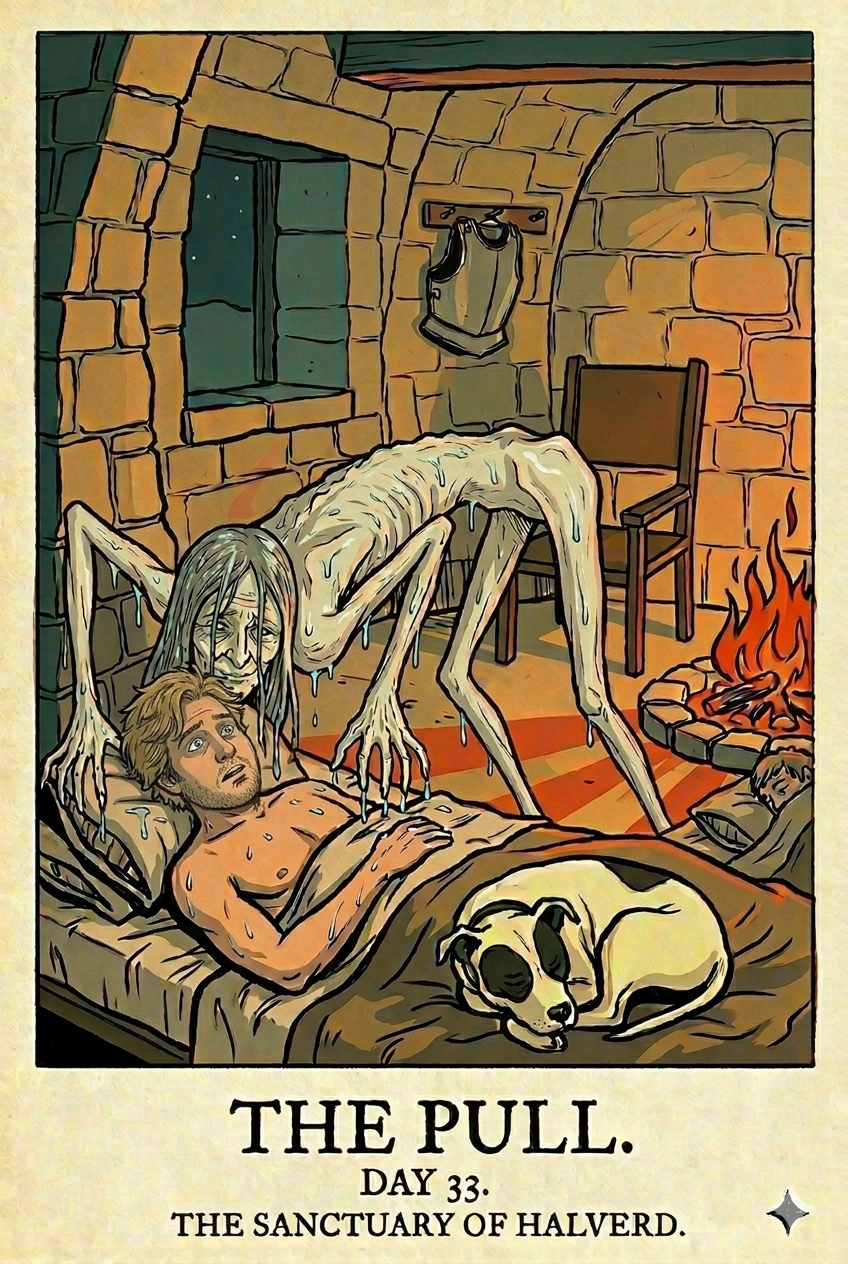
Chip woke before the others. Halverd was at the hearth where he had been all night.
"Morning." Chip said
"Morning."
Chip went to the shelf, took the chipped cup, filled it, and sat at the table where the fire reached.
Halverd kept working. Then, without looking up:
"It was here last night."
Chip looked at him.
"I heard it. I know the sound of the room when it is in the room. I have heard it a long time."
"It came for you."
He paused
"A long time ago. I sat down."
"There are days I wonder if I should have kept walking. I have not yet decided either way."
He continued
"You did the right thing. The road keeps it interested. It will come for you again. Not here."
He looked up.
"The road is yours now."
That was all. Chip sat with his cup and watched the fire.
The others woke. Brent fed the fire. Kevin returned to the herb bundle. Chip found the broom and worked from the door to the hearth. He got the corners.
Will sat at the bench with the piece of wood. It was different now — the wood had been coming forward out of itself day by day.
It was Chip who heard it first.
He had paused with the broom in both hands when the sound came. A small dry scratch at the window.
Chip turned his head slowly. A wren was on the sill.
It looked at the room. It looked at the fellowship. Then it looked at Chip.
It held him there for a long moment. The eye on the small bead of its head, very steady. Chip looked back. He did not look away.
The wren hopped once. Took two small steps along the inside edge of the sill. It lifted off.
It crossed the room low — lower than the table — through the slow firelight, and came toward Chip. It landed on the top of the broom handle. Chip felt the wood take the small weight of it.
Brown along the back, pale at the throat, tail held up at the alert angle. The small feet were closed around the wood, and Chip could feel its grip through the handle, through his hands.
It tilted its head and looked at him with the right eye, then with the left.
The room was still.
After a moment, Will lifted the piece of wood very slowly from the bench. He brought it level with the top of the broom handle. He held it next to the wren.
The shape Will had been carving and the wren on the broom were the same shape.
"Yes," Halverd said.
The wren lifted off in one clean motion — soft, almost silent — and crossed the room the way it had come, and was gone through the window.
The sill was empty.
Chip set the broom against the bench. He sat down at the table.
Halverd set down what he was working on. He folded all eight hands into his lap. He looked at the empty sill.
He did not move for a long time. The fellowship did not move either.
Then Halverd let out a slow breath. The kind people don't let out in front of others.
Stevie padded across the room, put her nose against Halverd's knee once, and sat down at the chair leg.
"I have kept this room for a long time." Halverd said "The wren does not come every day. It does not come for everybody."
"It came for Chip."
"The room kept because you kept it. All four of you. The broom found the floor every day. The fire took the wood. The carving found its eyes. The wren came because the room was kept."
"And the wren came to you because you chose the road. Last night, the room asked. You said no. This morning, the room thanked you."
"You were good company. The best in a long time."
"I haven't had friends like this since my unit, at the gate."
He breathed like a man who was about to open a thing he had been keeping closed.
"Eight men in the unit. By the end of it we had stopped pretending we weren't what we were to each other. You understand what I mean?"
"Yeah." Brent nodded
"We had a tradition on the cold nights. A circle in the tent. Each man handled the man next to him. One direction around — each man in service to his neighbor, his neighbor in service to his. Everyone managed."
Kevin was looking at the fire.
"I was the eighth man. I could join the circle the way the others did, or I could use what I have. The men found this interesting. They wanted to know which of them had the most endurance. The problem was technique — each man's approach was different. The data wasn't clean. They needed a control variable."
"They asked me to step out of the circle. Stand in the center. Handle all eight of them at once — same speed, same pressure, same technique. That way the only variable was the men themselves."
"I had been doing one task per hand my whole life. They knew that. They asked me to break it. All eight hands doing the same thing at the same time. I loved those men. I would never say no."
"I gave them all eight. I did not keep a hand back to feel the pressure. I did not keep a hand back to catch the timing."
"I was making a mistake. A small one — a matter of pressure, of timing. The kind of mistake one hand makes and corrects in the next motion. One hand makes it, one hand catches it. That is the method."
"All eight hands made the mistake at the same time. None of them could catch it because all of them were making it."
He said it plainly, without a flinch.
"I ripped their dicks clean off their bodies. All eight men. At once."
The fire popped.
"Jesus Christ, Halverd." Brent said
"What the fuck." Kevin added
Halverd sat with their silence. He did not hurry past it.
"The two that made it were different men after. I left at dawn and I walked for a long time and I came here and I sat down and the woman who kept it gave me a broom and I swept and I stayed and I developed the method. I do not let more than one hand do the same thing at the same time. Ever."
"I tell you this because the wren came. The thing it taught me made the room possible. The room held me and the room held you and the wren came. I would not change what I have done since I came here."
"I would change everything before."
"So did the test work?" Brent asked
"No. There was no conclusive data. It was a poor experimental design."
Brent put his face in his hands.
Will looked up from the carving "If it'll help you get over this, you can service me. Just one hand at a time. But I'd do that for you."
"My days of servicing my friends are behind me. Now just strangers. Strangers with small treasures to barter."
"Le jizz." Kevin said, hoping to make Halverd smile.
"It's late." Brent said "We should sleep. Head out in the morning."
Halverd looked at the fellowship. His eyes were still wet. He said nothing. He nodded once.
They went to their bedrolls. Stevie was already at Halverd's chair leg.
Brent was tying the strap on his pack.
Will set the carving on the table.
"Halverd. I think it's done."
Halverd looked over. He reached out and Will put the wooden wren in his open palm.
"You caught it in the moment." Halverd Said
Halverd closed his fingers around it gently, the wing curving up from his hand.
"Halverd you should come visit us." Brent said
"Of course I'll visit. I've been meaning to leave here sometime."
"Halverd you wouldn't survive the Chicago suburbs." Will said
"I would. I've survived worse."
"Halverd we'd take you to Fogo de Chão." Brent went on "They bring the meat to the table on swords."
"Swords? I would enjoy that."
"Halverd come visit." Chip offered "I could use a pickleball partner with your dimensions."
"Only if you start playing with the 4.0 group now, Chip."
The fellowship laughed.
"Halverd are you 4.0?" Brent asked
"I have eight arms."
Chip the resident expert "That's not how the rating works."
"Halverd seriously come visit." Brent pressed "The west burbs. You can stay at my place. My wife would have questions but she'd come around."
"I'd love to. You guys are the best, that would be so much fun —"
"Halverd we'll set up a Halverd weekend." Brent landed on "You'll meet my brother. He's going to lose his mind."
A small sound across the fire — the polished stone Halverd had been working on for five days hit the floor.
"Halverd you cool with meeting my brother?" Brent asked
The wooden cup tipped from another of Halverd's hands. It hit the floor — wood on stone — louder than the stone. The water ran across the warm floor in a thin line.
Will looked up.
"Halverd…"
The half-mended cloth slipped from a third hand.
Then the carving.
Halverd had been holding it, the wing curving up from his fingers. The hand opened. The carving fell. It bounced once and the wing snapped off cleanly. The bird's body rolled to a stop near the fire. The broken wing was three feet away.
Halverd was hunched over.
The smile was gone. The eyes were open and empty. His head had dropped forward and stopped. The other six arms were limp. Three more objects were still in his hands — a stone, a strip of leather, a needle — and as the fellowship watched, his fingers loosened and they fell.
Stevie barked.
"Halverd." Brent said
Nothing.
"Halverd."
Chip stepped close and held his hand near Halverd's face.
"He's not breathing."
The walls of the room moved.
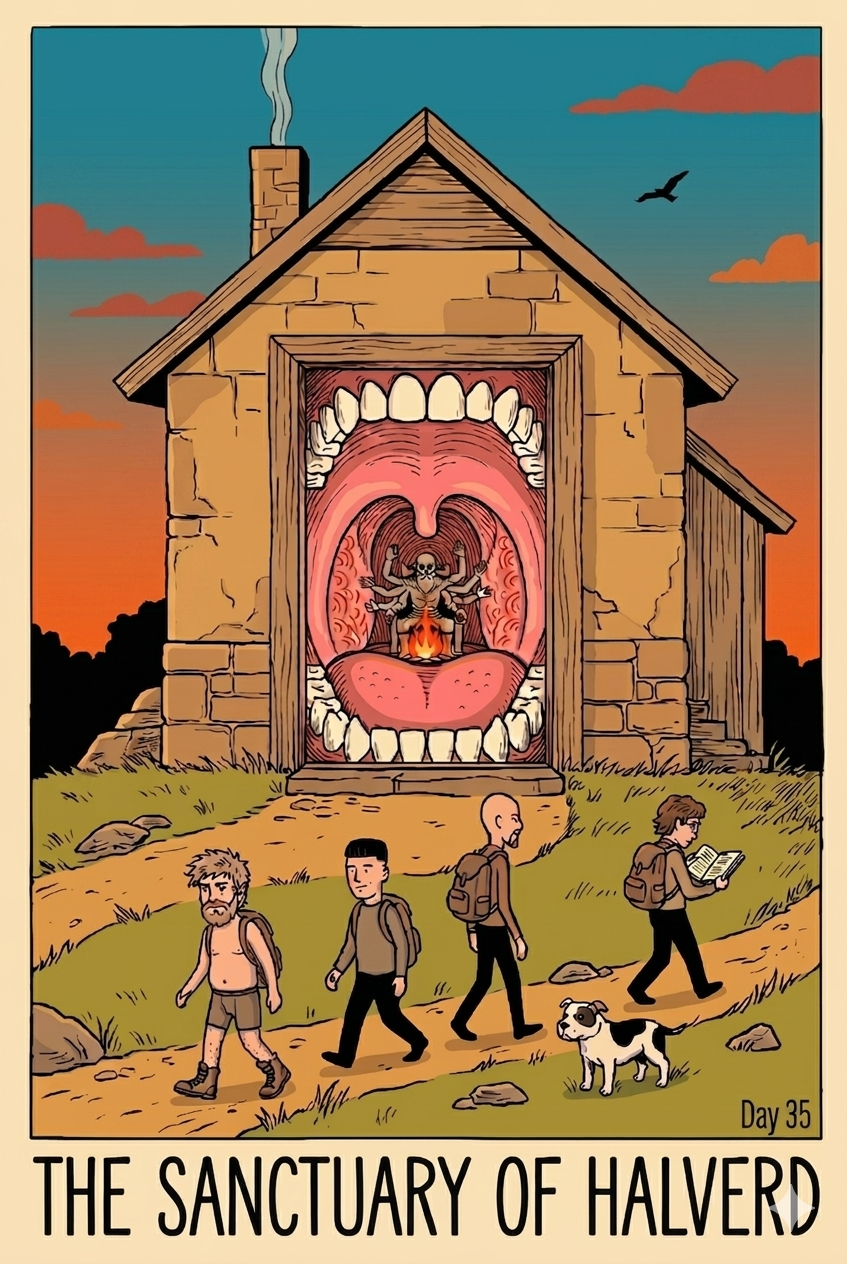
Not the slow imperceptible breathing they had been doing the whole time. They expanded — audibly — with a low wet sound — and then contracted.
The walls came in.
"Guys." Brent said quietly
The fire was on something that pulsed visibly now, every two seconds. The floor was warm and wet under their boots. When Brent shifted his weight, the floor shifted with him.
Chip looked up. The ceiling was ribbed and pink and ran with dark fluid in the spaces between the rafters. The pattern Chip identified as a hard palate.
"The room is getting smaller." Kevin panicked
Stevie was growling. Hackles up.
At the far end of the room, around the frame of the doorway, white shapes were emerging from the wall. Long. Pointed. Curved inward.
Teeth.
Top row first. Then the bottom. They came out of the doorway frame slowly, sliding into position with a wet click.
"The door —" Brent started
The teeth were halfway across.
"Go. Go, go —" Will yelled
Brent took a step toward the doorway. The floor pushed up against his boot. He stumbled.
"GO." Kevin barked
Halverd's body slid forward off the chair.
It hit the floor with a soft smush. The eight arms hung limp. The legs splayed behind, trailing. The head was slack.
The torso began to wriggle. The body crawled by the torso alone — the abdomen contracting and releasing in long even pulses. The arms dragged dead at the sides like sleeves of a coat. The head lifted just enough to face Chip, the empty face pointed at him, the slack jaw lolling.
"What." Chip said flat
Stevie was full barking now, planted between Chip and the puppet, hackles up.
"Chip go —" Will tried
The puppet was four feet from Chip. The teeth were three quarters of the way covering the door.
Chip stumbled back. Stevie was snapping at the puppet. The puppet's limp hand dragged across Stevie's shoulder. Stevie lunged.
"Stevie!" Brent shouted
Chip grabbed Stevie's collar. The puppet pulled itself another foot. Two feet from them now.
"Now. Now now now —" Kevin urged
The teeth were almost closed. The doorway was a slit. The torso coiled, aimed itself, the empty face lifted once more toward Chip.
The puppet's body lurched forward and one of its limp hands fell across Chip's boot.
Halverd sat up.
The puppet — mid-lurch — stopped. The torso pulled itself upright on the floor. The face animated. Halverd blinked twice, fast, the way a person does when they've nodded off.
He looked down at himself. He was lying on the floor halfway across the room from his chair, one of his hands resting on Chip's boot.
He looked at the teeth. He looked at the walls. He looked at the fellowship.
"Oh." Halverd said to himself
The teeth stopped. Hung there, almost shut. Then, slowly, began to retract.
Halverd pushed himself up onto his hands. Onto his knees. Onto his feet. He walked back to his chair. He sat down. He arranged his arms.
"Oh. Oh no."
A long silence.
Brent's foot was still raised toward the doorway. Will was clutching the ledger to his chest. Kevin frozen with his arms braced in front of him.
"Halverd. What just happened?" Brent asked carefully
"I needed a minute."
"A MINUTE OF WHAT?"
"Just — to rest. Keeping the puppet up — keeping all this — it takes —"
"What just happened, Halverd" Will said. Not a question this time
"I — yes, I must have, dozed off."
"You took a NAP?" Brent asked
"Yes. I didn't think you guys would notice. I just thought you weren't paying attention."
"WE WERE TALKING. WE WERE PLANNING YOUR VISIT. Were we boring you?"
"No. Brent no I just —"
"Oh so we WERE BORING YOU, YOU FIND US boring!" Kevin demanded
"Kevin no."
"Halverd you took a nap WHILE WE WERE INVITING YOU TO FOGO DE CHÃO."
"I have been alone for a very long time."
"Halverd we were going to take you to a STEAKHOUSE." Brent said "A Steakhouse WITH SWORDS."
Brent looked around, figuring it out
"Halverd. Are those teeth? Are we in your mouth right now?"
Halverd looked at the floor. He looked at the ceiling. He looked at the walls.
"Yes."
Will, very slowly, opened the ledger again. He picked up his pen. His hand was shaking.
"I'm going to need to amend the previous entries."
The walls had returned to their imperceptible breathing — the same breathing they had been doing the whole time, but now the fellowship knew what it was.
Stevie had stopped growling. She walked slowly over to Halverd's feet and sat with her head against the chair leg.
"Good dog. I'm sorry. I scared you." Halverd said softly
"Halverd. We're going to go." Brent said
"Okay."
A beat
"Is it because of the teeth?"
"Halverd we were already leaving." Brent said
"Is it because we're in my mouth? Is it because of the mouth, and I lured you to stay here with me and eat with me and slumber party here with me by using a mouth puppet and I'm actually just really big and we are just in my mouth right now? Is that why you're leaving?"
"Halverd we were leaving today regardless." Will said
"Are you sure it's not the mouth?"
"Halverd it's not the mouth." Kevin said
"Is it because I fell asleep?"
The fellowship paused.
Brent exhaled "...yes. Yeah Halverd that one. That's the one. And I want to file a complaint. Against you. For thinking we were boring."
"Brent please —"
"And I'm filing a SECOND complaint." Brent continued "Against you for being a mouth. And we have been hanging out in your mouth. For five days."
"Yes."
"Filed."
The fellowship piled on. Will filed for the teeth. Kevin for the floor. Chip on behalf of Stevie. Brent added one for Halverd's body crawling across the floor. Kevin filed for lack of transparency. Chip filed for the saliva-soaked floor he had been sweeping all week.
Halverd accepted each one. Yes. Yes. Yes. I'm sorry.
They packed the rest of the way. Halverd helped with several of his hands. He kept apologizing. Brent at one point hugged him. Halverd's many arms accommodated the hug.
Kevin shook his hand. Will bowed slightly. Chip was last. He put his hand on one of Halverd's warrior arms. Halverd put his other warrior hand on top of Chip's.
"Safe travels, traveler." Halverd Said
"Thank you, Halverd."
"And I really wasn't bored.And I would still like to come to Fogo de Chão.I just — I don't know if I can."
"Halverd, you're a building."
"Okay."
The fellowship walked out through the doorway. The teeth were fully retracted. The doorway was a doorway again. The cool air outside hit them. The road was where they had left it.
They walked maybe twenty paces and stopped.
"Did that just happen?" Brent asked
"Yes." Chip confirmed
"We almost DIED."
"Yes." Will confirmed
"We almost died because Halverd was BORED."
"He said we weren't boring." Kevin offered
"Kevin he fell asleep IN HIS OWN MOUTH while we were inviting him to a STEAKHOUSE."
They looked back once. The sanctuary was a small low building with a wooden door. From the outside, it looked like a building.
Three of Halverd's arms came out of the doorway slightly and waved.
The fellowship waved back.
They turned and walked.
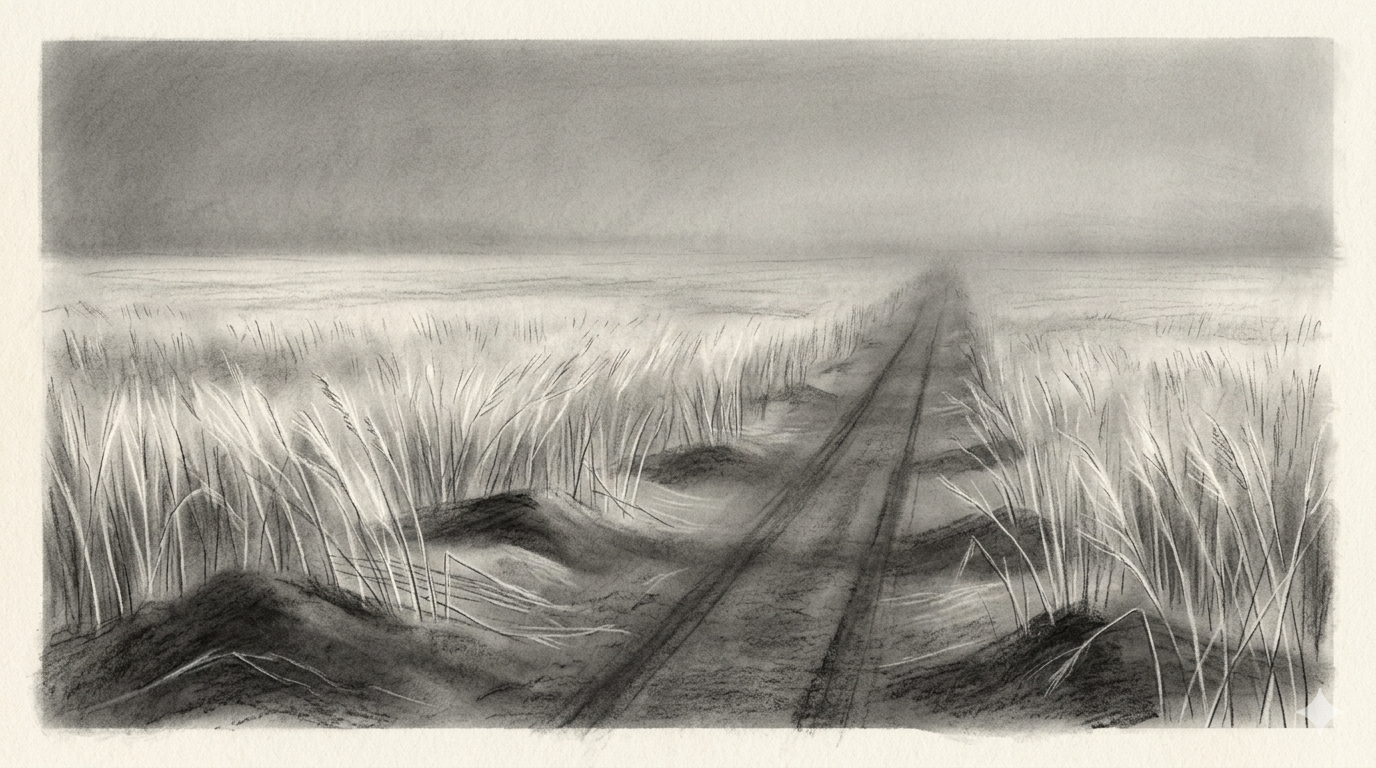
The mountain gave out underfoot.
The scree went to gravel and the gravel went to packed grey ground — and then the mountain stopped at a line. On one side, stone. On the other, ash, and out of the ash stood the field.
Chip put his lead boot down past the line. It went in to the ankle.
Stevie pushed past his leg, and then — at the line — she stopped. One paw down. Lifted. Down again. Reading something off the ground that none of them could read. Then Chip stepped forward and she went in after him, at his heel. She usually led.
It had been a grain field. The stalks still stood in the remains of rows, waist-high, the heads long gone. They were thin and pale and translucent, the sourceless grey light going into them instead of off them.
The wind moved through and the stalks answered. Not a rustle. Not a click. They whipped, thin and dry, the sound high and fine, a hiss at the edge of a whistle.
Chip looked at the dead grain in the dead light and understood what had killed it. The light had stopped. The grain had stood and waited for it and it had not come.
The road kept going, a darker line cut forward through the field.
"How far does it go." Kevin asked
"The maps stop where the mountain stops." Will said "After that it's one word. Ashfields."
Chip crouched and put his hand into a mound of the ash. The crust gave with a small soft sound, almost a swallow, and underneath it was cold and wet. The mound held the shape of where his hand had been.
Then the smell came up — the morning after a rained-out campfire — and once it was up it was the whole field.
"It's wet." Chip said "It's not wet from rain. It's just wet. Wet the way a cave wall is wet, it just is"
They walked. He could hear the wind but not feel it. The wind was in the field, lashing the stalks, and it never reached the road.
The whipping of the stalks was all high, up at the top of hearing, and under it there was nothing. For thirty-five days every place they had walked had treble and bass. Here the subwoofer was gone.
He stopped. He split a stalk with his thumbnail. He pushed apart a mound of ash. A second stalk. A third.
No insects. Not in the stalks. Not in the ash. Not on the road.
A wet dead grain field should have been a city.
"There's nothing alive here." Chip said "It should be full. There's nothing in it. Not one thing."
The stalks hissed and shone.
He came out of the grey
the way grace comes —
without apology,
never earned.
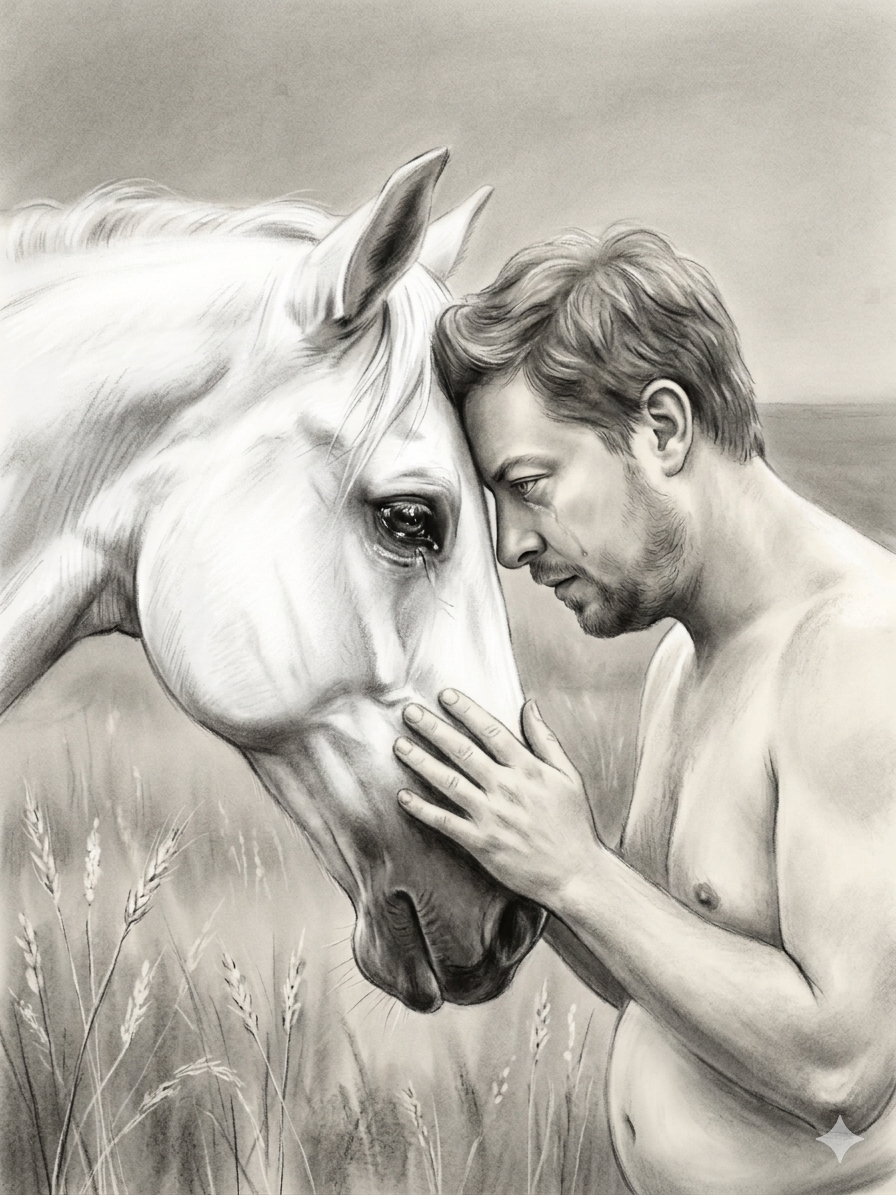
A wild stallion.
Moving through the Ashfields
at the pace of something
that has never doubted
its direction.
No saddle. No brand.
No sign of where he had come from
or what he was moving toward.
The grey parted for him.
It only parts
for things that belong to themselves
completely.
Chip walked alongside him.
The Emberstone blazed in the pack.
He didn't reach for him.
The stallion turned his head —
full dark eyes,
the specific attention
of a creature
that has decided to see you.
Seen without agenda.
Without a mold
it wanted you to exist in.
Fully.
Without wanting anything in return.
Chip understood he was seen.
He put his arms around the stallion's neck.
The grey fell away.
The Ashfields, nowhere.
The streak and the ledger
and the Pull and the road
and the days behind
and the distance still to go —
nothing.
Two sets of prints
stopped to have a moment together.
His breath came even and slow.
The mane was soft as silk against his face.
The stallion smelled like rain.
And in that moment
Chip shed a tear
as he broke into blossom.
The fellowship watched from a distance.
"That was a blessing," Kevin offered.
"Ay, papi" Brent said "But that was also weird right? Was there a sexual undertone to that?"
"Nothing wrong with holding a horse." Kevin allowed "But they were both erect the entire time."
"Yep. I always thought Chip was gay."
"No." Will corrected "Just gay horses."
"Good thing Chip didn't wake up earlier." Kevin added "They probably would have banged. We dodged a bullet."
"I was hoping this Quest would have more smut." Brent said
"Me too." Will agreed "Gotta wake up earlier. Quest isn't over."
"Hey Chip. Put that boner away. That's gross. We gotta go."
Will wrote in the ledger.
Day 38. Chip is a gay horse.
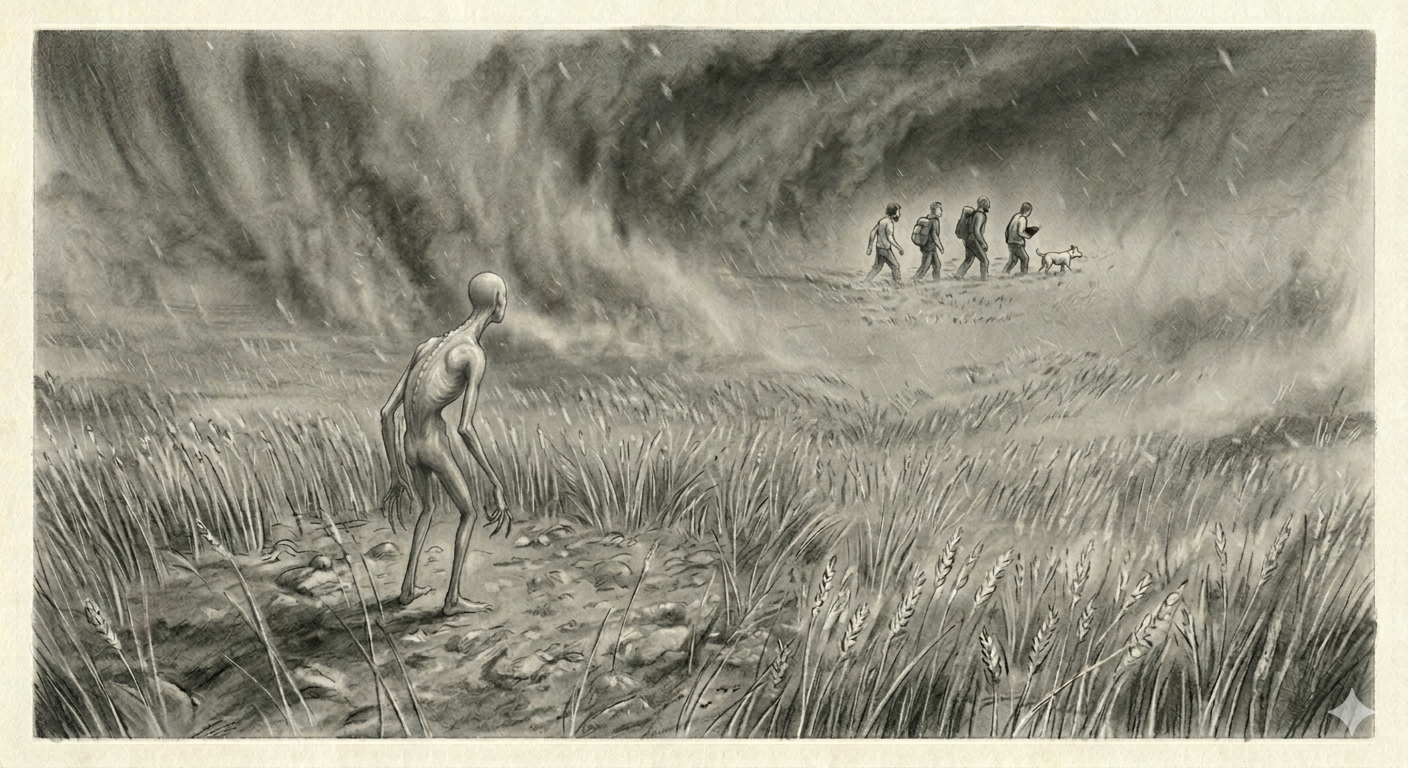
The ash had started falling sometime in the night and by morning it had not stopped.
It came down dry. The ash on the ground was wet, had always been wet, but the ash in the air was dry, and it fell like confetti, weightless, drifting. There was only grey sky, and out of the grey sky came ash.
By mid-morning Chip could not see far. It got in his eyes. It got in his mouth. It landed on his arms, his neck, the back of his hands. He stopped feeling it land — it was just on him now, a dry grey layer that his brushing did not move. If he stopped brushing for an hour the ash would absorb him.
Underfoot every flake that reached the ground went wet the moment it landed. It had been ankle-deep at the mountain. Knee-deep now in the drifts. Each step Chip took, the wet ash closed around the boot and held it. Walking had become wading.
Stevie was wading too. The ash was deeper on her than on any of them — she was low to it, pushing through it chest-first. She put her head down. She stayed at Chip's heel. The smallest of them, in the deepest of it, attending to the next step and only that.
The Pull spoke while he waded.
"Listen to me. I have been with you a long time. I have never lied to you and I will not start now. So hear this plainly: it does not get easier from here. The road climbs after this. The climb is longer than the field. The field is only the beginning of the weight."
Chip kept wading.
"So set it down. Soft. Set the weight down. You are tired and you are right to be tired. Look at the ash. It is deep enough now."
"Lie down. Let it cover you. The wet ash will close over you like a blanket, and the blanket will close over you like a hand, and my hand will close over your mouth, and that will be the end of the noise. Under it: no more long, hard work of becoming. There is a quiet at the bottom of this field that has been waiting for you since the good got better, and I have been keeping it warm. Lie down, Chip. I will lie down with you. There is no shelter in this country, and this is the kindest one you will ever choose."
He looked at the ash he was standing in. There was no tree, no wall, no sanctuary. The ground was not shelter. The Pull had called the snooze a kindness and was calling the ground a kindness now. A soft name laid over a hard fact.
"This isn't shelter!" Chip said with certainty.
The ash did not care. Chip lifted the boot.
Each worked step was a thing he was choosing, and the choosing was the thing — the better in you reaches for best, a muscle you find sore, and work until you stop noticing the soreness, and it's yours.
The dry ash thinned toward evening. The road showed itself again — and ahead, faint, the first rise it had shown since the mountain.
The Emberstone held.
The ash ended the way it had begun — at a line. The fellowship had been wading for two days and then the ground came up to meet their boots, firmer with each step. The drifts went from knee-deep to a grey scurf over honest dirt. On the far side of the line the ground was just ground.
By evening they were at the foot of the mountain. The road ran into it and went up.
They made camp at the base. Brent built a fire. Will closed the ledger. Kevin sat with his back against a stone.
They ate. They did not talk much. They were too tired.
The Emberstone was burning brighter tonight than it had in the Ashfields. It had been warm for forty days and tonight it was warmer, and steadier, the warmth of a thing that has been pointed toward what it is for and has finally seen it.
One by one they laid down.
A Decision
Chip closed his eyes. He was asleep before he remembered lying down. The Dreaming Place was already there. It had been waiting. The voice he knew was quieter tonight than it had been in the Ashfields. Asking instead of offering. What do you want, Chip. Tell me. I will hold it for you tonight. He thought about it.
Your choices:
Your legacy, Your people, or Life before
Chip chose his people as he drifted off
You are at a bar with your friends. A Tuesday. The four of you in a booth, two pitchers in, the kind of night that wasn't supposed to be anything and has become something. You are reminiscing about your bachelor party. The best weekend any of you have ever had. Brent is doing impressions. Will is filling in the things Brent gets wrong. Kevin is laughing the laugh he laughs when he can't help himself. The booth is loud. The waitress has stopped checking on the table. And it isn't because the trip was good. The trip was good. But the trip was good because of how the four of you were on it. The way you read each other. The way nobody was performing. The way Brent didn't have to translate and Kevin didn't have to mediate and Will didn't have to track. The way you were a thing in motion together instead of four people chained at the ankle dragging each other forward. The Quest had done that. The Quest had made the four of you a fine-tuned machine, and the machine had been having a great time ever since. And that weekend the machine had met the rest of your people. Your cousins. Your college friends. Your family. The guys from work who you had not been sure would mix. Brent had the room laughing inside of an hour. Kevin had ended up on a porch having a real conversation by sunset. Will got into a long quiet debate with someone neither of them remembered the next morning. The four of you ran the weekend the way you ran the road, and everyone you loved got to see it. Nobody had to be introduced twice. Everyone you loved met everyone you loved and the room held. Brent raises his glass. "To Chip." Will raises his. Kevin raises his. You raise yours. The four glasses clink at the middle of the table and the four of you chug. You chug yours all the way down — the way you learned to chug at the bachelor party, the trick of it, the breath before. You set the glass down empty. Will signals the waitress. "Two more pitchers." The booth holds. The night is not over. Dreams are good. You just don't live in them. You get up. The stone is still lit. So do you.
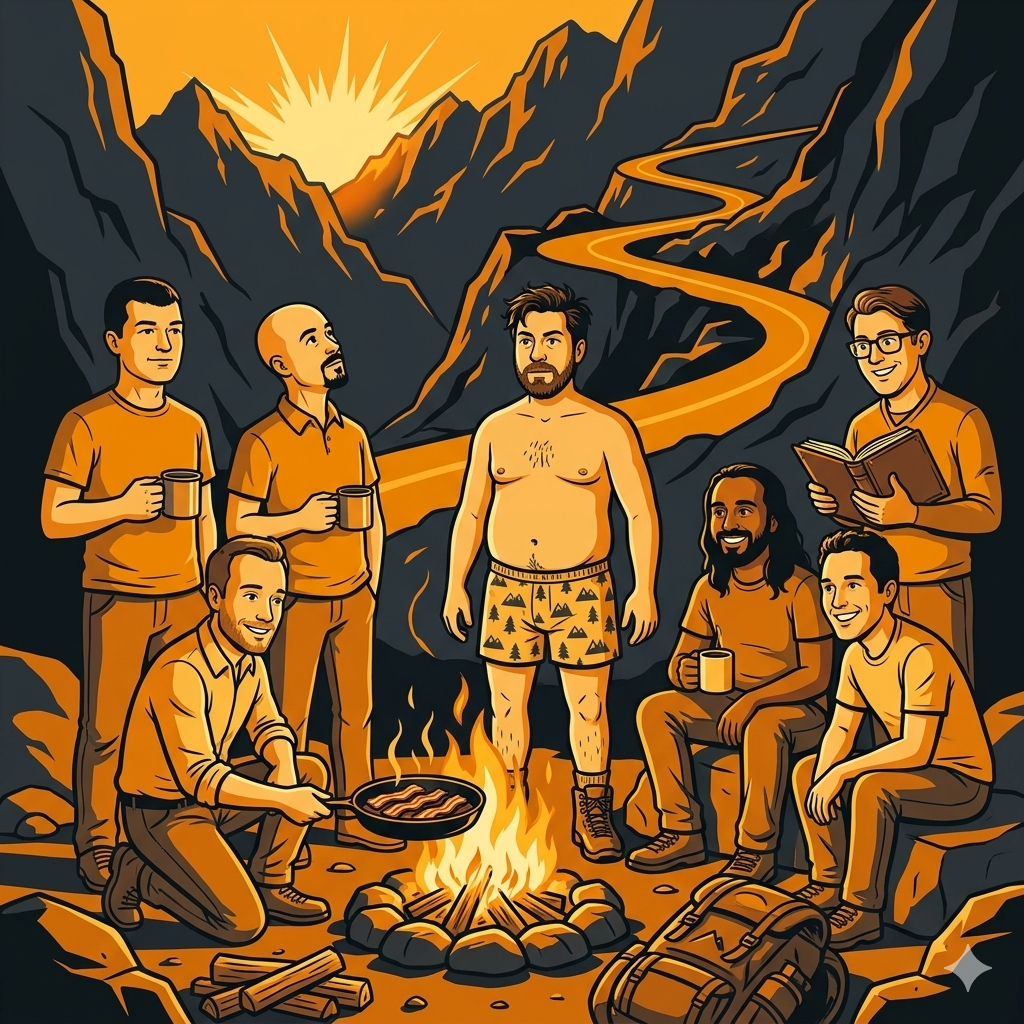
Chip awoke to the smell of bacon. There had been no bacon for 40 days. He sat up. Brent was at the fire, not turning around — Brent had been occupied with the group at the fire.
There were three other men around the fire.
"Papi fritas. Get over here." Brent called
Joe was sitting on a stone with a coffee. Long hair loose by his shoulders. Will's friend from Madison. A doctor — when it comes to sleep and performance, a modern-day airbender.
Joe stood up and hugged him.
"Chip. You're traveling well."
Jack was on the next stone. Chip's brother-in-law. He sat by a fire the way other men wished they sat by fires.
"Mate. You're an absolute legend. I've been hearing about this for weeks. Properly impressive."
Scott was last. One of Chip's oldest friends. They had been at college together and at every important night of Chip's life since.
"Chip. Forty days. We knew you were going to make it. We figured the climb was the part that mattered now. So we came. We came because we wanted to be here for this."
Kevin had been looking up at the road.
"From here it's different. Waking up was the entrance. This is the test. You're up. Now what. Now you climb. Now it's what you do with the day. Whether you do it well. Whether you do it tomorrow too. Whether you live the day or let it happen to you."
"Right, that was beautiful, Kevin. Top marks." Jack reached for the pan "Anyway — who's having more bacon."
Seven cups came up.
"To Chip." Scott said "To the climb. To doing the most."
The sun cleared the ridge. Chip slung the pack and started.
Scott was pouring. He had the Fortaleza Blanco open — the bottle you crack when you're with your people — and the sangritas built on the rock. Tomato, orange, lime, salt, Tajín, bitters. Seven tin cups. Seven shot glasses
"Sangrita. Tequila. Sangrita." Scott said, handing Chip the first pair.
"That's incredible." Chip said
They had climbed all day. By midday they had come out onto a flat saddle where the sun stayed warm and the view opened all the way back.
You could see the foothills they had crossed that morning, and the long grey scar of the Ashfields beyond. The Ashfields from this vantage were enormous — smaller from height than they had felt from inside but still huge, still the largest single thing in the view.
"Five days." Brent said "We did that in five days."
"We made great pace." Kevin agreed
Beyond the Ashfields, the dark line of the forest. And far beyond all of it, smaller than the eye expected to find anything — the cluster of streets and rooftops that was Downers Grove.
The town Chip had walked out of. The town he was going home to.
Chip looked at it for a while.
"That's where it found me." Chip said
"What found you?" Scott asked
"The Dreaming Pull."
"It's the voice that told me not to get up. Every morning. It was in my head. The alarm would go off and the voice would say just fifteen more minutes, and fifteen would be an hour, and the hour would be the morning, and the morning would be the day."
"Chip was struggling." Will shared "He was thinking PM workday wake-ups was okay behavior and justifying it to himself."
"It hasn't gone away. It just doesn't get to win as often." Kevin added
"And it followed you out here?" Joe asked
"It's here. It'll be at the next camp. It's on the road ahead. It's patient."
"But we believed in Chip and look at him now." Brent said "Managing his alarm. Doing the climb to be the best version of himself."
"Right. So we drink to it." Jack raised his glass " To leaving the bed."
"I'll drink to that." Brent said
"Take us through it." Joe said "I came in at the forest. These two caught up at the Ashfields. What's in between."
"Then the Fogmere." Will said "Bad visibility the entire way. We met a heron that asked a riddle — Chip got it after carrying it overnight."
"Then Thornwick." Brent continued "Cartographer town. A woman named Voss gave Chip a compass that doesn't point north."
"Then the Greywood. "Kevin said "Old growth. The trees stay out of each other's way."
"I came in there." Joe said "Chip prayed over a moth. I prayed too."
"In the forest, we crossed paths with a surveyor I've worked with. Senna." Kevin paused "She told us about a cairn up the road. Names carved into the base stones. Said to read every name."
"Then the Hollow Pass." Will picked up "The compass settled in there. There's a bridge across a canyon kept by a man named Aldric. He asked Chip what he'd left behind. Chip said he'd stopped believing he was going to be a different person. Aldric gave him a stone."
A beat
"And then Halverd."
"Halverd had eight arms." Chip said "Good host. Fed us, gave us a place to sleep, gave us purpose. Then he told us a long story about how he wasn't very good at jerking off his friends. Then he tried to eat us."
"Sorry. Walk that back." Jack said
"He found us boring." Brent added "We found him disappointing at getting us off."
"It was mutual." Joe offered
"Mutual letdown. Filed in triplicate. Lovely."
The light on the country below had gone the long flat gold of early evening. Brent refilled the cups.
Jack lifted his sangrita.
Seven cups came up. They drank.
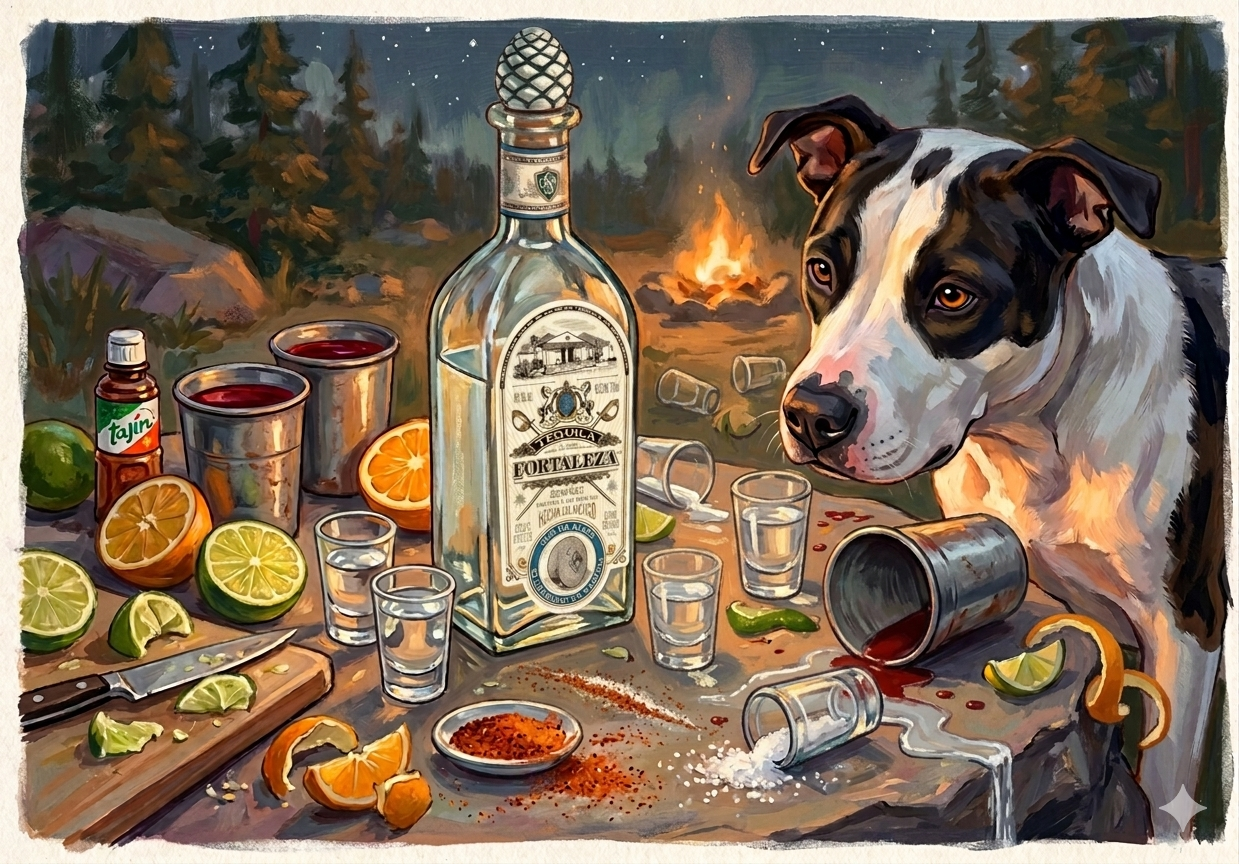
The fire was a real fire that night. Brent had built it. They had stopped early at a flat shelf with pines, a stream, a view. The sangritas were out. Stevie was asleep at Kevin's feet.
They had been laughing at something nobody could remember the start of.
"You know what delights papi." Brent started
"Tits," Will deadpanned.
"Look. I am man more delighted by ass than tits. That's me." Chip clarified "That's my taste. But I have no reason to think tits aren't delightful. Tits are, in fact, delightful. Ooooo. They are. They are delightful. I am delighted by titties."
"Ooooo Chip is delighted," Scott sang.
"That delights him. innit. The King is delighted!" Jack smiled
"And dongs." Will added "Dongs are most delightful."
"Of course." Kevin said
"Tits and ass and dongs are most delightful." Scott declared "They delight me until I am delighted."
Stevie's tail twumped against the ground once in her sleep.
"Stevie is delighted." Brent said
"She's dreaming." Chip noticed
"She's dreaming about being delighted. What delights Stevie?"
"A good scratching. Begging strips. The moment before you say her name."
"You know what's delightful." Kevin asked
The fire stopped again, differently this time.
"My kids."
A small silence. Brent put his hand on Kevin's shoulder.
"Kids are delightful?" Will asked
"My kids are delightful. Most kids are. Some of them can be little fucking pieces of shit but that's delightful in its own way. Like we tune in to watch Cartman. Cartman is delightful."
"Kevin is delighted." Brent said
"That delights all of us." Scott added
"That's the one, Bob's your uncle" Jack added
"Yeah. That's the one." Scott echoed
A long warm pause. The fire moved against itself. Stevie was still asleep.
"I am delighted." Chip said
The sangritas went on. The fire stayed small. The Emberstone was warm in the pack.
They didn't go to bed for a long time.
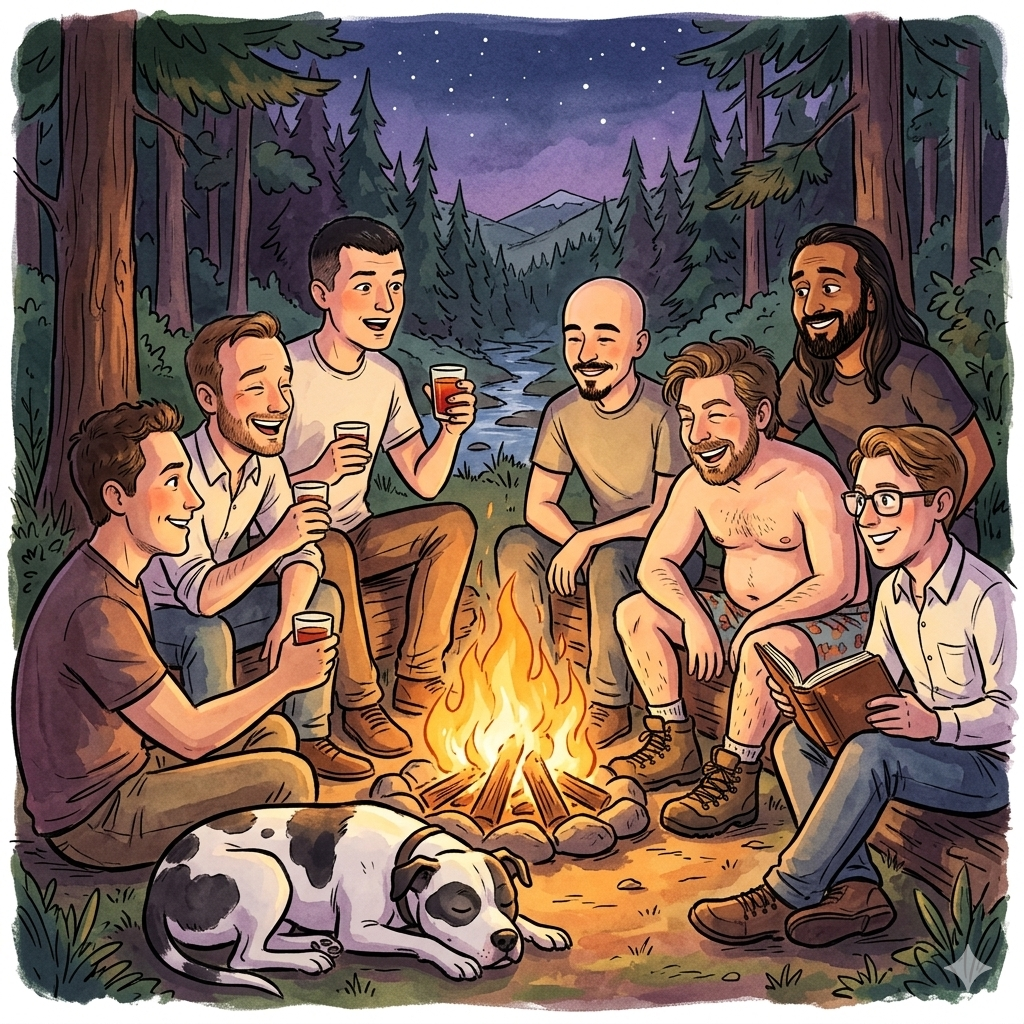
They saw it from a half-mile out.
An obelisk on a wide flat shoulder of the road. Black stone — head-sized blocks and larger, fitted without mortar, the stones holding each other by their own weight. Four-sided, tapered, the height of four men at its face. It was the tallest thing in any direction that wasn't the mountain.
Stones had been placed on it for a long time.
"This is the cairn Senna told us about." Kevin said
He had stopped a few feet short of it. He stood there long enough that everyone stopped with him.
"Its a different shape this time."
"Different than what." Brent asked
"Last time it was a menhir. One long column, rough on every side. Time before that, a ring — seven of them in a circle. The cairn doesn't keep one shape."
"Sorry — the cairn changes shape." Jack asked
"It re-lays itself as stones get added. Travelers don't move the stones. The cairn does. You carve your name on a stone. You set it on the platform — and the cairn does the rest. Your stone goes where the alphabet says."
They came up to the obelisk. The names were everywhere. Carved deep on the larger stones, shallow on the small ones, some so weathered the cuts were just depressions you had to read by touch.
They read.
Aaron. Adelheid. Aldric.
"Wait. Is this our Aldric?" Brent asked
"Could be." Kevin said "He's been at the bridge a long time."
Darius. Deshawn. Diego. They read every name, touched the worn ones, named them out loud.
They came around to the second face. The M section.
Madhav. Maeko. Magnus. Mara.
Maren. Maren. Maren.
Three stones in a row.
"Three Marens." Brent noticed
"The first one's a hundred years older than the third." Joe said, leaning in. " The hand wouldn't change like that. Three people."
"Kevin. Your name's on this cairn." Brent stopped walking
Kevin had stopped reading. He looked at where Brent was pointing — a stone in the K section, middle-aged weathering, the carving clear. Kevin.
His handwriting. The fellowship knew his handwriting from the ledger margins, from the notes he'd scratched on packs across forty days.
"Kevin, when were you here." Chip asked
Kevin walked over and put his hand on the stone.
"A long time ago. Before I had kids. I came up this road with someone I was trying to help finish."
A pause
"We should add ours."
They went to the platform. Kevin pulled a small black stone from a pile at the base. He carved his name. He set the stone on the platform. He turned around.
When he turned back, his new stone was on the obelisk, in the K section, next to his old one. Two Kevins.
The fellowship went one at a time. Brent. Will. Chip. Joe. Jack — Jack in clear English block letters. Scott last.
When Scott set his stone down, the obelisk shifted. The taper at the top eased by a few degrees. A handful of stones re-laid themselves on the third face. Then it was still.
They stood around the obelisk for a while.
Chip looked at the three Marens. Then at the two Kevins. Then at his own new stone, clean among older C names.
He looked at Kevin. Kevin nodded.
They walked on. The obelisk stayed behind them, taller by seven stones.
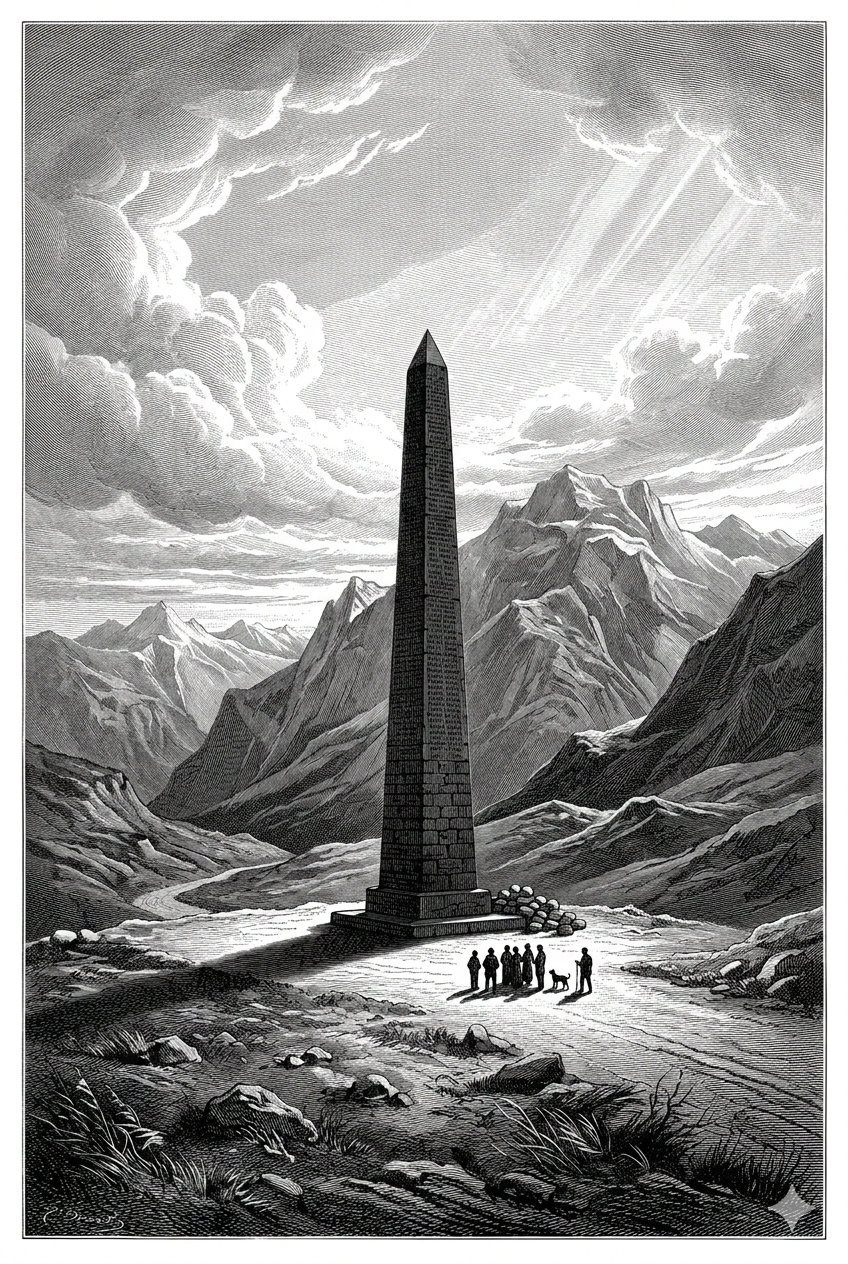
They had been climbing since dawn. The road went up.
By midmorning Scott had stopped to talk to Joe.
"Joe, did you happen to bring a Butter Burger?" Scott asked
"No. I left so fast I forgot to pack any Culver's." Joe said "I was hoping I could get some from you."
"Same. Joe — you're a doctor. What happens?"
"We have an hour or two. Maybe earlier."
"Is that easy for you to treat in Madison?"
"Easy. There's a Culver's three blocks from the hospital. Out here — I haven't seen one in days. We're going to die a painful death."
"Painful how?"
"Well first it goes to your thighs. Then you explode."
Scott put his hand on his own stomach. He went pale.
"What's going on with you two?" Brent asked
Joe was already sitting on a stone. Scott had a hand against the rockface for balance.
"Once you've acclimated to the lactose-heavy air of southern Wisconsin, your body adapts." Joe explained "The butter-and-grease combo of a Culver's order has to come in every five days, minimum."
"It's a biological requirement, Brent." Scott said
"I have literally never heard of this." Brent replied
"You wouldn't have." Joe said "You're from Chicago."
"Sorry. Are they dying?" Jack asked
"They appear to be dying." Will said "I'm sorry guys — I didn't bring any Culver's. It gives me the shits a hundred percent of the time."
"That's pretty intolerant." Scott managed
"I'm sorry Scott. Everyone I know — Culver's is guaranteed diarrhea. You guys are at a superhuman level."
"We are. " Joe agreed weakly "We're airbending, cheese-monging, curd-wranglers."
"And we're dying." Scott confirmed
Joe lay back on the stone. His long hair fanned out. He looked beautiful.
Scott had slid down the rockface a few feet, a hand over his eyes.
"Scott, stay with me." Brent said
"I thought I could make it." Scott said
"Nobody makes it past five." Joe diagnosed
Joe's thighs began to swell. Slowly at first, then with confidence. His pants stopped being able to contain them.
Scott was watching his own thighs do the same thing.
"Oh. There they go." Scott said
Chip turned away. Kevin turned away. Will closed his eyes. Brent put both hands over his face.
Two wet pops, three seconds apart, echoed off the rockface.
Jack stood looking at where they had been.
"Right. So." Jack adjusted his stance "I had assumed I was the safe one. Joe and Scott have their Wisconsin thing. I don't have a Wisconsin thing. I'm from across the pond."
"Jack, what's going on?" Chip asked
"But I'm now realizing — and I want to flag this for the group, in the interest of full disclosure — that the British body has its own requirements. Beans on toast. Every sixty days. Bit of a hard cutoff, that."
"Oh no mate. Surely you've had some beanz recently." Chip tried "a builder's brekkie. Something."
"Beans. The toast slightly burnt. The beans heated through but not boiled to mush. A bit of butter — not margarine, I'm not an animal. A grind of pepper. Look. That is what a human being requires."
"God save Jack." Brent said
Jack closed his eyes.
"I have been out here eating bacon, Brent. Like a cowboy. I have been delighted to the point of exhaustion. And underneath all of it — I have been a man without beans on toast. My body has been mining its own reserves for sixty-one days and honestly, mate, it's curtains for me."
He sat down on the rock next to where Joe had been. He laid down. He folded his hands across his chest.
"Beans."
He crossed over.
Chip looked at what was left of them. Joe's limbs scattered across the stone. The patch of rockface where Scott had been. Jack on the road, hands folded, like Wallace without Gromit.
"Thank god we're from Chicago." Brent said
"Genuinely." Will agreed
"All we have to do is not get shot." Kevin added
"Avoiding drive-bys. General gang warfare. Naked tweakers on the L that throw their feces at you and try to bite you. Walking with your keys in your fist." Will went on
"Muscle memory." Kevin confirmed
"What do we do with him?" Brent asked "If Jack were here. What would he want."
"We roll him down the mountain." Kevin said
"We roll him down the mountain." Brent agreed
They rolled Jack down the mountain. The road at this stretch had a steep drop on the east side. They lined him up at the lip and gave him a respectful push. He gained speed. He cleared a small outcrop. He cleared a second one. He picked up momentum.
Jack made it all the way down. Past the treeline. Past a small stream. Past a clearing. He appeared to keep going for some time after the fellowship lost sight of him.
"That is the fastest he has ever moved." Brent said
Will pulled out the ledger.
Subject reached terminal velocity. Continued indefinitely.
"Jack would be so happy." Kevin said
"Jack would be delighted." Chip added
The fellowship turned back to the road. The mountain went up.
By late afternoon the grade eased. The trees dropped away. The rock opened out on both sides into a long flat saddle — wide, wind-scoured, the sky coming in from every direction at once.
Chip had been running ahead for the last quarter mile. He couldn't have said why.
They came up onto the Ridge.
Chip stopped.
Behind him: forty-five mornings, the whole of it, Downers Grove to here. In front of him: the horizon, and on it — faint, unnamed, the thing the compass had been pointing at since the Hollow Pass.
He stood there, took it in, accepted it and continued.
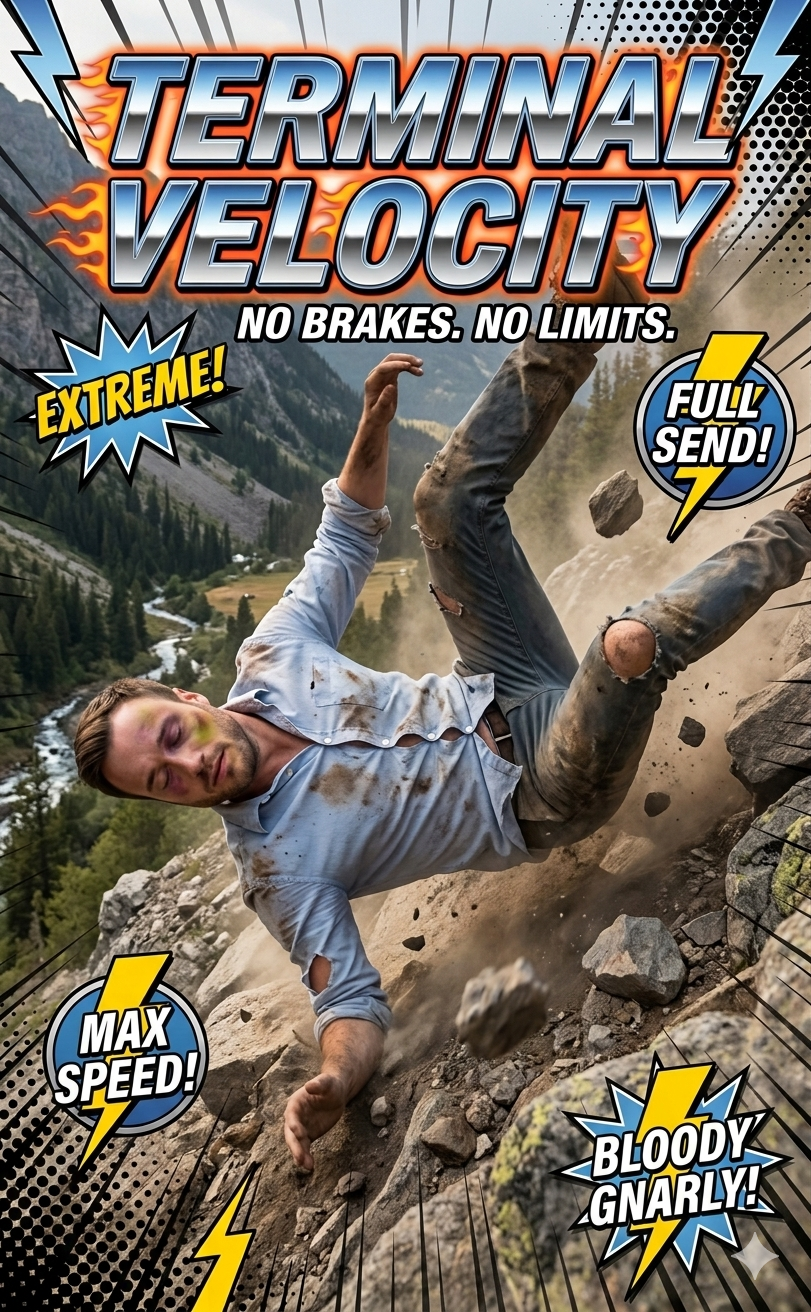
They had climbed for two days through stone country. By the second day's afternoon the mountain had stopped being a peak ahead of them and had become a country they were inside of.
They came out at the edge.
A gorge opened in front of them — wider than anything they had seen, the far wall blue with distance, the bottom invisible. A river was down there somewhere. They could feel it more than hear it.
And the bridge. It hung across the gorge in a long curve, planks and rope, the far end small enough to disappear if you blinked. It was the largest crossing any of them had ever stood near.
Will took the ledger out.
"The Forgetting." Will said
"The what?" Brent asked
"That's the name. It's in the Thornwick records. The cartographers called it the Forgetting."
"Why."
"Because of what it does to you when you cross it." Kevin answered
The fellowship turned
"It doesn't take your direction. You come off the bridge still pointed at the mountain. It takes the reason you were walking."
A pause
"You've crossed it." Will said
"How are you still walking, then," Brent asked.
"I came back over to remember." Kevin replied
The flask was on the stone of the anchor at the near side. Brushed metal, dented at one shoulder, the cap sealed in dark wax.
Kevin picked it up. He turned it once in his hand.
The flask had been left by a traveler who had crossed the Forgetting and continued. It held water drawn from the gorge below — the water that held what the bridge took. A small amount drunk on the far side gave back what had been left on the bridge.
Travelers who had crossed left flasks for the travelers who hadn't yet. The wax seal had not been broken.
Chip took it from Kevin.
"And you knew it was here." Chip said
"I knew there'd be one." Kevin answered "There always is."
Chip fitted the flask into the side strap of his pack. He pulled the strap tight.
"We drink it after we cross." Brent said
"After. On the far side. Before you start trying to remember on your own." Kevin explained
They camped at the near anchor that night. The bridge swayed in the dark above them.
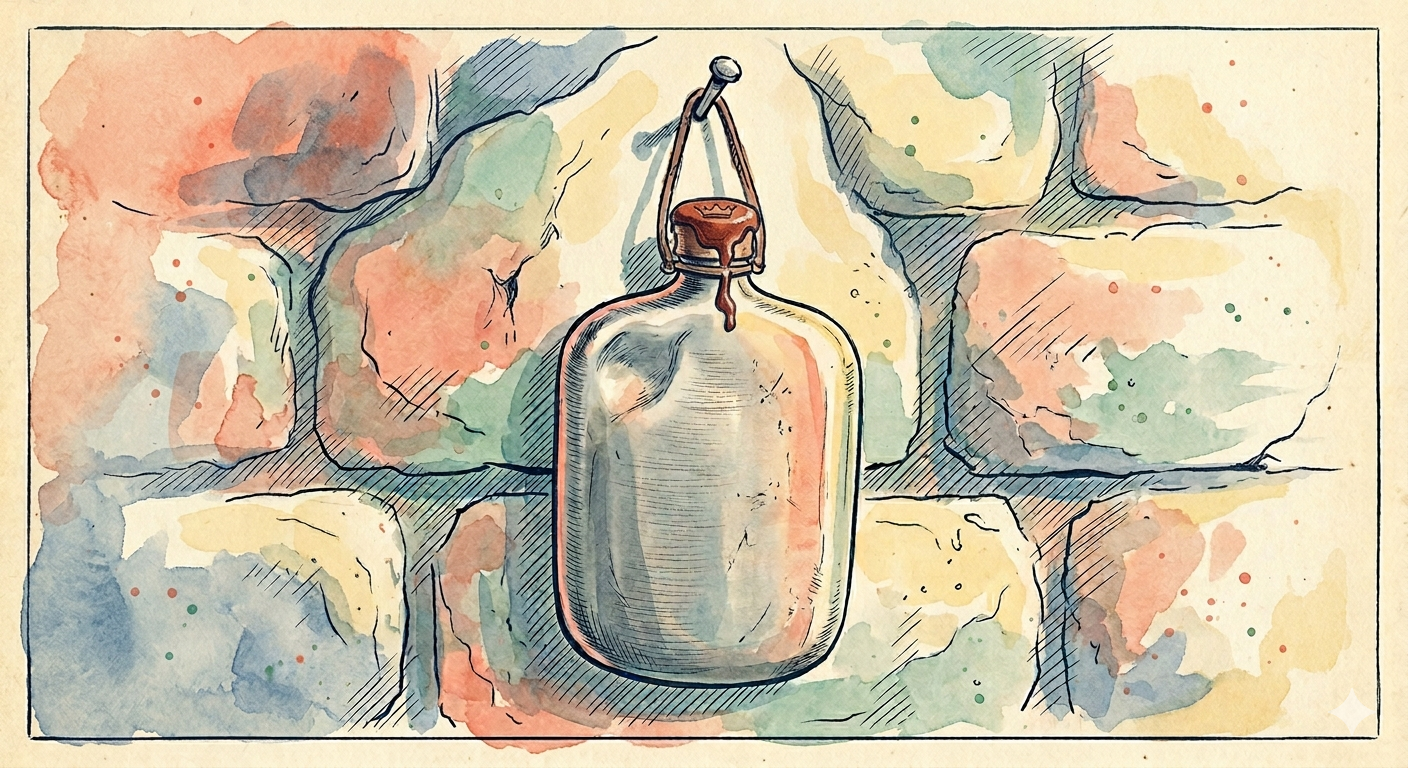
The fellowship woke at the anchor. The bridge was the first thing in the light — the far end lost in the blue distance.
They had remembered what Kevin said in Thornwick. Most travelers' stories did not continue past Day 47.
"How do we do this?" Brent asked
"Keep your eyes on the horizon." Will said "Don't look down."
"Or you look down once. Accept it. Look up. Keep moving." Kevin offered
They walked to the entrance of the bridge.
Chip checked the flask. The wax seal was still intact. He pulled the strap tight.
Will and Brent looked across.
Kevin looked down for a moment.
Chip looked down for longer.
Stevie looked at Chip.
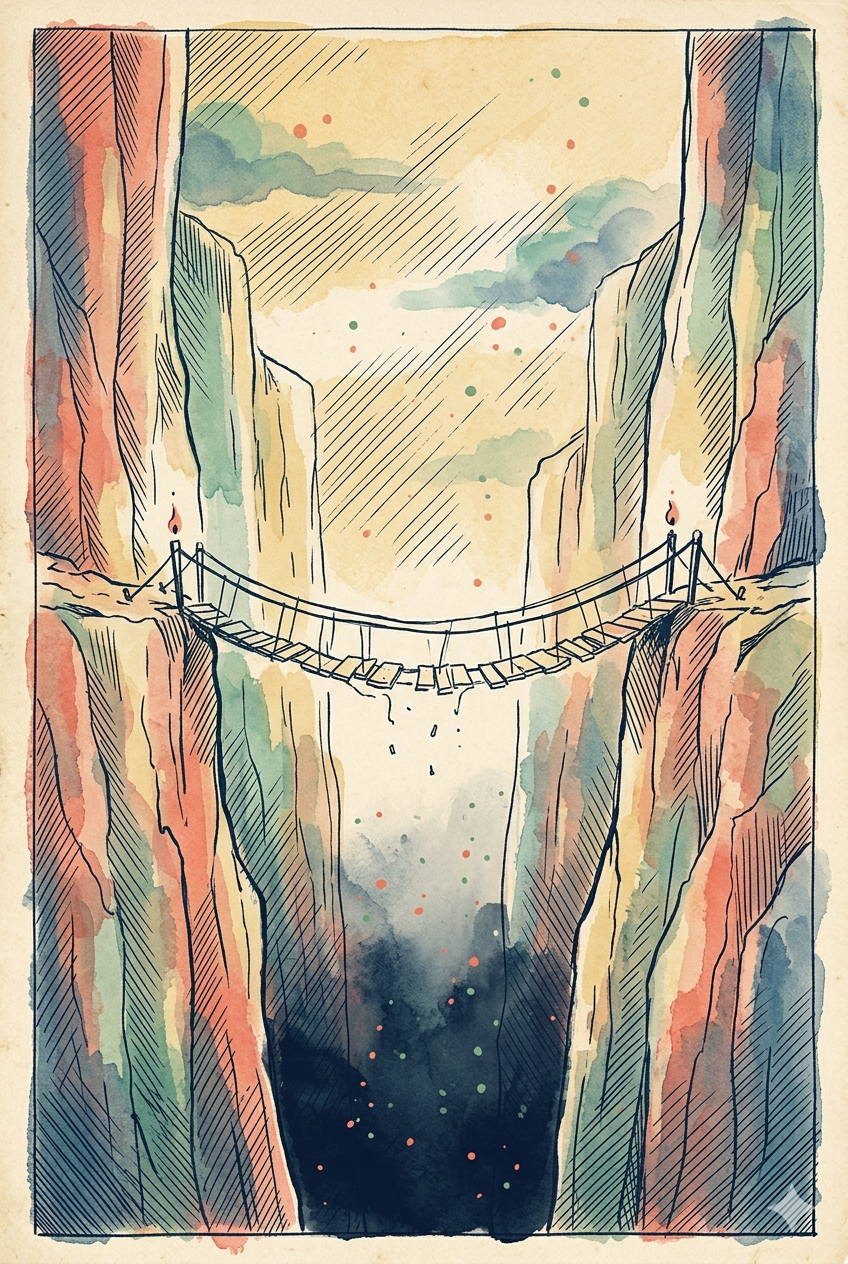
The bridge was old rope and the rope was weathered and the whole of it was concerning to cross.
Two ropes ran across for the feet, with wooden pegs set between them every couple of feet. It had been a system once. Some of the pegs were gone. Where the pegs were gone the ropes hung looser, in long slack dips that swung on their own. One rope ran across above for your hands, so you had something to hold while you walked your feet along the two below.
The wind came up the gorge in slow lifts. It moved the ropes and let them settle. Below the ropes the gorge went a far way down — you could see a couple of ledges, some rock, and then mist all the way down to a distance you couldn't measure, because you couldn't see the bottom. The crossing was twenty yards across to a thin lip of stone, and the road past it went on up the mountain the way it had gone up the mountain on this side. The same road. Just on the other side of the air.
"We crossing this, papi?" Brent asked.
"We got this." Chip said "We're crossing it"
Chip put his hand on Stevie's head. She did not look at him. She was looking up the mountain, past the bridge, at the road on the far side — the road they had not reached yet.
Brent went first.
He took off his pack and re-shouldered it tighter. He kissed one finger and held it up to the sky. Then he took his first steps onto the bridge.
"Papi chulo is light on his feet. Papi chulo is nimble. Papi chulo weighs nothing," Brent said.
"Papi chulo, on the lifetime average, is among the lightest of the four. Papi chulo does the steps. Papi chulo is trained."
"Are you doing affirmations?" Will asked.
"Affirmations, papi. The good kind. The crossing kind."
"Go, you goon," Kevin said.
He went fast across the first stretch, feet on the pegs, eyes up, the way a man late for a meeting moves on a sidewalk. The bridge got less sturdy toward the middle. You could hear the wood splintering out there, somewhere under him, and the rope made a sound it had not made near the post. He kept his pace. Light on his feet. The second half had the most missing pegs. The ones still there were in rough shape. He kept going. Near the end the last peg rotted through and cracked as he stepped on it. He stumbled, caught himself on the far rope, and made the rock, and sat down with his hands on his knees.
"Papi chulo, on reflection, is heavier than papi chulo previously estimated," Brent said.
"Brent adjusted weight estimations. Noted," Will said.
That last peg was gone now. Brent's foot had finished it.
The four of them looked at the gap and didn't say anything for a moment. Stevie was still looking up the mountain.
"How do Stevie and I get past that gap at the end?" Chip asked. "It's almost two yards from the last peg to the rock."
"You're going to need some momentum to get past that gap," Kevin said. "You'll need to launch off the remaining peg."
"Yeah. That's what I'm thinking," Chip said.
"I'll grab you, papi. I'm right here" said Brent
Brent sat down on the edge of the ledge, feet braced, hands ready.
Chip rigged a sling for Stevie with the straps on his bag and Kevin's jacket. She was close against his body and his hands were free, her weight pulled forward against his chest. She was confident in him. She wasn't braced. She wasn't looking. She was a warmth at his sternum.
He moved more carefully than Brent. The bridge was louder under him. He set each step where it had the most to hold it — left foot where the rope tied onto a peg, right foot the same on the other rope, testing each one before he gave it his weight. Moving the slowest through the middle of the crossing, he arrived at the end of the good section and sized up the gap. Too wide to step. He'd have to lunge it — a stride and a small jump off the last good peg, across the gap, to the rock.
"You got this," Will said.
Brent put his hand out, giving him something to aim for. "Here, papi. Right here."
Chip set his feet on two separate pegs so he had something to push from. He took a breath. He lunged.
He planted clean on the last peg and the peg snapped under his weight, but he had the momentum by then, and the snap only sent him faster at the rock. Brent had him by the shoulders before he could rock back. Chip and Stevie were across.
The bridge was in bad shape behind him. Past the middle it was just rope.
"Ay, papi. You're gonna have to shimmy across," Brent said.
"I'll go next," Will said. "Kev, that wingspan of yours could come in handy if it deteriorates more out there."
"It's strong near the edge here," Kevin said. "I'll stand on it. If you need to turn back, I'm right behind you. The middle's so frayed you may have to ride both ropes to spread your weight instead of gripping with your legs."
"All those meatball subs I never had a reason to regret," Will said. "Rice cakes would've been fine all those years. Rice cakes would've saved me."
Will looked across at Chip and at Brent. The far side looked farther than it had ten minutes ago.
He stepped onto the bridge and started to cross. He was doing the most damage of any of them — bigger boy, and the bridge worse now than when Chip crossed it. He got to where the pegs began to fail. The handrope kept fraying under the pull of him; he was putting too much into it. Another peg snapped and swung loose below.
"Whoa," Kevin said. "I still gotta cross, tubby."
Kevin stepped onto the rope behind him, near the sound edge, where he'd said he'd be — ready to move and reach if Will got into trouble in the shimmy.
Will got to the middle and set his hands to drop down into it.
Chip remembered the vial.
The painter's shack. The painting on the wall there — it had been this. This bridge, this gorge, this exact stretch of air. This was the moment the vial was meant for. The fellowship needed help, and the thing for it had been in Chip's pack.
"Will, hold on — the vial," Chip said. "The painter's shack. It was for this. I just remembered, it's gotta be for this."
"What's that?" Will asked.
"In the shack there was a painting of this crossing with a vial sitting next to it," Chip said. "I grabbed it."
Chip opened the vial and pulled the small piece of paper out.
Brent snatched it from his hands. "You absolute pickpocket goblin, chippi chulo, let me see this."
His face did something Chip had never seen it do.
"Oh no, papi," Brent said. "Oh god, no."
"What is it?" Will asked.
Brent sighed. "It says Chip had a dream."
"NO," Kevin said.
"He had a dream about us," Brent said. "That we were all at a bar, drinking, talking about how good a time we have together."
"Oh what the fuck, Chip," Will said. "You dream about us? You dream about us having a solid hang?"
"Yep," Brent said. "And it says he dreamed this recently, just before we started climbing the mountain. There's a lot of details about us having a good time together. I'll spare you the gross ones."
"What the fuck, Chip," Kevin said. "You dream we love you?"
"You been carrying a Dreaming Pull vial this entire time and you didn't tell us, papi," Brent said.
"I didn't have a choice," Chip said. "I just chose to have a dream of us hanging out. And to hold the vial. I thought it would help. I didn't know what it was."
"You dreamed we love you," Kevin said. "What the fuck, Chip."
Chip looked at his boots. He had nothing else to say.
"I am shimmying over," Will said. "And I am going to beat your ass."
Will let his feet drop. He put both hands on the upper rope and got his weight under it and started moving across hand-over-hand, slow, the way a man moves when he is doing a thing he has not done since middle school gym class.
"You dream we love you. Unbelievable," Will said. "We are right here. We are on this climb with you and you still dream we hang out and have good times."
A pause. A grip-shift.
"We are here. Currently," Will went on. "I do not enjoy ropes. I do not enjoy heights. I do not enjoy any of this. And I am here. We're all here."
"Papi, he is here," Brent said.
"I am here!" Will said.
Will moved another two feet.
"Chip. We were at Halverd's. Together," he said. "Three weeks ago. We ate at his table. You were there. I was there. Brent was there. Kevin was there. It was a hang."
"We have been hanging," Kevin said. "For forty-eight days."
"We are hanging right now," Will said. "This is a hang. It is a bad hang. It is the worst hang we have ever had. But it is, technically, a hang."
The wind came up the gorge in slow lifts.
"And you are dreaming about a different one," Will went on. "Like we are not in the room. Like we are at a separate gathering you are remembering us from. Across a bar. A man trying to manifest a hang."
"Chip. You are invited. You are at the hang. You are hosting the hang."
"Papi, he is hosting," Brent said.
"He is hosting," Will said. "He's loved, it's understood, and he's dreaming about it. Fucker."
"You dreamed we loved you, Chip," Kevin said. "What the fuck, Chip."
Will got another two feet. The rope made a sound under his right hand. Will did not look down.
"And then you go home and you dream a better version of the one we are already in," he said.
A footrope snapped.
It went under Will's right hand, and his right side dropped, and he caught the whole of himself on the other rope, both hands now, hanging, his feet swinging into the gap. He brought his legs up, gripped the rope, and was about to keep shimmying.
"I'm beating his ass after you," Kevin said.
"Get in line," said Brent
He had a stride into the bad rope and his hand on the armrope when Will's weight wrenched the whole thing sideways, and Kevin's hand closed hard on the armrope to hold Will, to hold both of them, and the armrope tore out of the far anchor where Chip's lunge had frayed it through.
The footrope went with it.
The bridge — now only attached on one end — swung back, away from Chip, down toward the post where the ropes still held, and it took both men in the arc and whipped the loose ends through the pegs that were left. The dead rope wrapped them where they gripped, at the hands, at Kevin's arm, and cinched, and the cinch caught on a peg and held.
They hung there. Tangled. Out over the gorge. On the side they'd started from.
The arguing stopped.
Kevin had gone still, which was Kevin working. He was analyzing the situation.
"It's caught," Kevin said. "On the peg above us. The rope's hung on it and that's what's holding the whole thing tight. If we can get it off there we should be able to climb up to the ledge."
Will pulled at the wrap with his free hand. The rope drew the other way, down and out, and the wrap didn't move. It pulled on them. They both tried to shift their weight around to knock it loose, to no avail.
"It has to come off the top," Kevin said.
"From above," Will said. "We don't have above"
Kevin looked across the gorge. He looked at Chip.
"Maybe they can knock it loose," he said.
Chip was on his knees at the edge with the gorge between them.
"I can't reach it," he said.
"No. You can't reach it," Kevin said. "But you can hit it."
"With what?" Chip asked.
"With what you have."
Brent had moved up beside him, the vial paper folded in one hand. "Your boot, papi. Try your boot."
Chip threw his boot first.
He had it off and in his hand before he'd thought it through — heavy — and it dropped out of the air halfway and went down into the gorge. They didn't hear it land.
"Too heavy. It won't carry, papi," Brent said.
"I have the canteen," Chip said.
"Heavier."
"I have my pack."
"Don't throw your pack," Kevin said.
"Chip. The fidget toy," Will said. "That might be our only hope."
Chip had it in his pocket. Metal, machined, balanced, the one he'd paid a small fortune for. It rode in his pocket for years.
"That's the good one," Chip said. "That's like 200 dollars. I can't throw that. That's fiscally irresponsible."
"I know it's the good one," Will said. "Throw the good one."
"Throw it, papi" Brent added.
"Throw it," Kevin said.
"What are the odds I hit that exact spot with a fidget toy?" Chip asked. "I'm just throwing it away."
"I believe in you" Will said. "Throw the expensive, well-manufactured fidget toy Chip."
"This is your destiny," Kevin said.
"Throw it" Brent said.
"You throw it" Chip fired back.
"No, papi. It's you" Brent said.
You've got this.
Chip wound up like he was Rookie of the Year. It left his hand like it had always been a sure thing, like the throw was already made.
Easy. Now.
The trajectory was perfect. The aim was dead on. The power was a hair high. It missed the snag. It clipped the torch bracketed on the frame at the top of the post, and the lit head broke off and dropped. It caught the rope above them and stuck there, burning.
The rope took the fire slowly.
It was old and dry and it caught in a low line that found the fibers and walked them down. The smoke came first, low and resinous. The fire was at the top, and it was working its way down the rope toward their hands.
There was no climbing through it.
The fire wasn't fast. It was certain.
Will watched it come.
"The flippin' fidget toy. Dadgummit!" Will said.
"Yeah," Kevin said.
A beat.
"It was a good one, though. Tactile. Worth the price."
"THAT WAS AN EXPENSIVE FIDGET TOY" Chip yelled.
Will got an arm loose as the wrap burned through the snag above. It was too late for the climb.
"I am not dying by Chip's fidget spinner," Will said. "No way. Absolutely not."
He squirmed the rest of the way free and let go, hands at his sides. He didn't fall like a man who slipped. He went with his hands at his sides, and the gorge took him. They didn't hear him land.
Kevin stayed.
"You know, for how self-righteous and unbearable Will is, he really fumbled it at the goal line," Kevin said. "He was a sure thing for heaven. All he had to do was not end his own life. One job."
"What an idiot," Brent said.
"I'm not doing that," Kevin said. "I'm gonna wait. So when it's asked — for the record — it's the fire. It's Chip's aim and Chip's fidget toy. This is not me."
"That's smart. That's the smart play, papi," Brent said.
"Papi, you totally clear it," Chip said. "You clear it easy."
The fire came down to his hands.
Kevin held the rope. It blackened and kept its core and would not part. He held it, and the fire went into his hands and up his forearms and did not stop, the rope did not break.
Kevin was screaming.
"— that's enough, Kev," Brent said. "You proved it. You're clear. You can —"
But there was nothing to do with the rest of the sentence. The joke had nowhere left to go. Brent stopped talking. Chip stopped talking. The screaming kept on without anyone to answer it, and the only thing any of them could do was the thing Kevin was already doing, which was wait.
He stopped screaming after a while.
The rope held. It held him a long time. It held him long past the part where holding meant anything.
When the rope finally went it went quietly, the core giving somewhere inside the char, and what was left of the bridge swung down against the near wall and hung there smoking.
Chip was on his knees at the edge.
Stevie had not looked at the bridge. She was turned up-mountain, sitting, her back to the gorge, the way she'd been since before the rope snapped.
Brent was saying something. Chip couldn't hear it. The gorge was wide and quiet and the far side of it was empty now.
His fidget toy was gone. His boot was gone. His friends were gone.
After a while Brent stopped saying things and sat down beside Chip and put a hand on his back. He left it there. Stevie kept looking up the mountain. The smoke went up out of the gorge in a thin grey ribbon and the wind unmade it.
The hand on Chip's back wasn't steady.
The hand was trembling, and it was wet, and Brent's breathing beside him had gone shallow and quick.
"Kevin's got snacks," Brent said.
"What?" Chip asked.
"Kevin always has snacks, papi," Brent said. "Kev keeps my juice. The fruit snacks, my gummies. He keeps them in the side pocket. He hands them to me. He's been handing them to me the whole climb."
He continued:
"I need one. I'm hypoglycemic, Chip. This is a big problem."
Chip had him by the shoulders. Brent was grey. Brent was sweating in the cold.
"Where are they," Chip said. "Brent. Your snacks, the juice — where do you keep yours?"
"I don't," Brent said. "Kevin keeps them. Kevin's got mine. Kevin always — Kevin has my snacks. He had all of them."
Brent stopped. His eyes weren't finding Chip anymore.
"Brent. Brent. Hey," Chip said.
Nothing.
Chip went through his own pack with both hands. There was nothing in it that was sugar. There was nothing in it that was medicine. There was nothing in it that did anything to a body at all.
Except the thing he found before he crossed.
The flask. Dented, wax-sealed, the trusted thing, the thing Kevin said was left by travelers to remember.
Stevie had turned around. She was not looking at the mountain anymore. She was watching Chip's hands.
— A Decision —
Brent is unresponsive.
You can Give him the flask or Do nothing
Chip uncapped it.
The smell came up and it was a smell he knew. It was the smell of good times on the back porch. It was booze. Of course it was booze. Booze had always helped this group.
Chip poured it onto Brent's mouth.
Brent came to. His first motion was to grab the flask and glug it down. He got to his feet. Booze had always been the answer and this was not going to be the exception.
"I got the hypo-glyco glow, papi," Brent said. "I'm back."
He took one step toward the road. He stumbled on his own feet, and he went over backwards, cleanly, off the cliff.
The first outcrop was maybe forty feet down. Brent hit it hip-first and his hip shot out of him like stepping on a Twinkie. He bounced off the wall. There was too much speed to catch anything now — Brent's whole mass roaring with velocity, tumbling through every crevice the canyon had on offer, missing every possible landing like a quarter in the charity spinner at Taco Bell that never once drops you the free Mexican pizza.
Chip stood at the edge with the empty flask in his hand.
The road went on up the mountain. He looked at Stevie. Stevie was already looking up the road.
So he went.
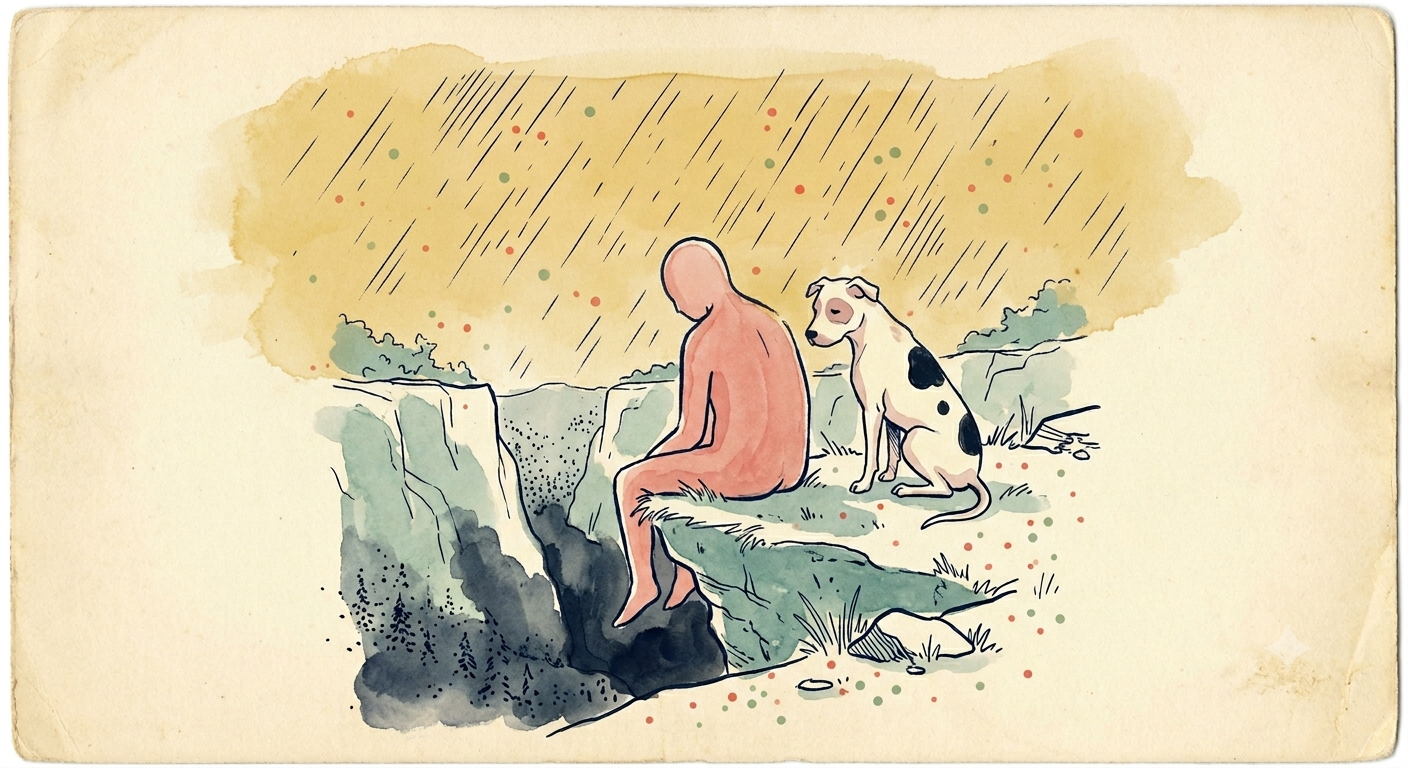
The road went on along the wall of the gorge, a thin ledge of it cut into the rock, and the rock went up on both sides farther than the eye wanted to follow.
Stevie went first.
She picked the line. Where the path narrowed she took the inside without being told, and Chip put his feet where she put hers. She didn't look back to check. She knew he followed.
And somewhere in the watching of her — the sureness of her, the way she just went — Chip felt the first edge of a thing he didn't have a name for yet. He was following a dog up a mountain. He was glad of it; she was better at this than he was. But under the gladness was something else, small and stubborn and his own: he wanted to be the one who knew the way. Not instead of her. He wanted the wanting itself to come from him — the pull up the mountain to be his pull, his legs deciding, nobody and nothing out front making him go.
They went.
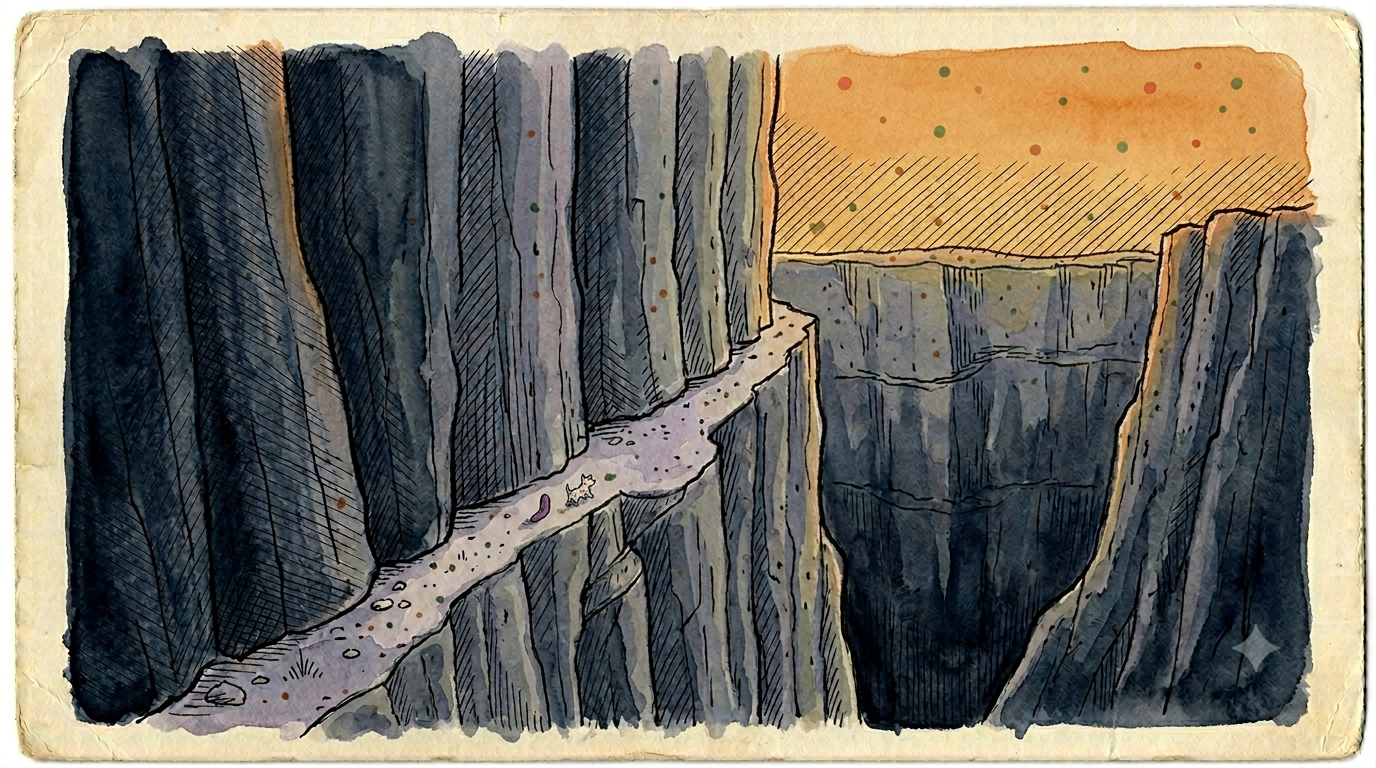
The gorge let them out by afternoon and the land opened into a valley, flat and wide, the path running pale across it toward the foot of the mountain.
It was easier walking. After the rock it felt like nothing at all.
Stevie ranged out ahead, nose down, doubling back, the way she did when the ground stopped being dangerous. Chip let her. He walked and did not hurry and the valley took its time around him.
He noticed, somewhere in the middle of it, that he was not bracing for anyone. Not counting heads. Not listening for three other men on the trail behind him. The quiet was just quiet. And he found he wanted it — not as a thing instead of them, but as a thing of its own. He could walk all day at his own pace and answer to no one and the wanting of that did not feel like a betrayal. It felt like the next thing.
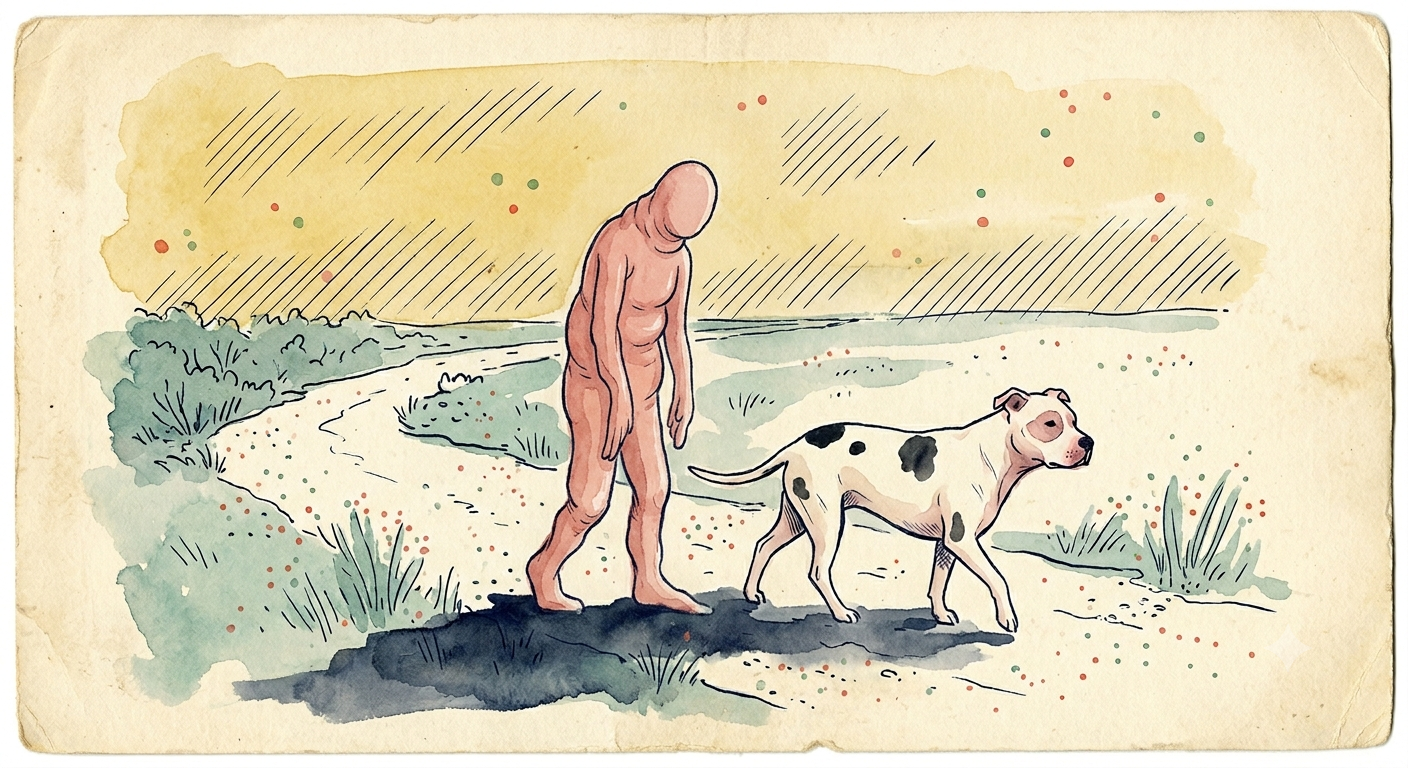
The gorge was behind him.
The road came up out of it through a stand of pine and a long set of switchbacks, and then the trees thinned, and then the trees ended, and Chip walked out into the valley.
The valley ran flat ahead of him, a long stretch of open stone and low scrub, and ended at the foot of the mountain. The peak was somewhere above, in the cloud. He couldn't see it. The road cut a pale line through the valley to where the climb began, and then the road went up.
There was a marker where the climb began — a leaning post, old, the grain gone silver, and a flat stone set into the ground at its foot worn smooth by the boots of everyone who'd stopped here before deciding to go up.
Chip stopped there. Stevie stopped with him.
He looked up the line of it. The road went up and kept going. The top was in the cloud.
He put his boot on the stone the way the post seemed to want him to, the way you touch a thing other people have touched.
Then he started climbing.
The climbing was slower now. Thinner air, or thinner him.
He'd been doing the math as he walked. He couldn't help it; it was the kind of mind he had. The Hatch State of Sleep Report — a sleep company out in California, putting numbers to the thing everyone already knew. Thirty-seven percent of Americans don't get seven hours. Forty-three percent go to bed at a different time every single night. That's the water everyone's swimming in. A third of grown adults, more, getting up wrecked and doing the day anyway, and nobody lines them up at dawn and tells them they've failed.
So what was this, then. What was he holding himself to that none of them were held to.
Because by that measure — the real one, the one everybody actually lives by — he was already past it. Way past it. Fifty-some days of getting up on purpose. Most people never put together a clean week in their lives. He wasn't behind the curve, he was off the top of it. He had already done more than enough. More than the data said was normal, more than the people who wrote the data, more than nearly anyone he'd ever known. He could sit down on this mountain right now and still be, by any honest accounting, a man who'd done more than his share.
He was holding himself to a standard the world had quietly agreed not to require.
Stevie had stopped ahead of him and was looking back, waiting, the way she did when he slowed without deciding to.
He hadn't decided to.
He started walking again before he'd finished the thought, which was maybe the only way to win it.
The Dreaming Pull checked in before Chip — so it could address the full group.
Good morning.
Chip's still down. I'll be taking his mornings from here on, so — get used to the face.
I wanted the three of you in one place, and look. Here you are. Will. Brent. Kevin. You opened it. That's the whole thing about you three, isn't it. Someone sends a thing about Chip and you open it before your coffee. You've been doing it all year.
So let me be the one who finally says the kind thing.
You can stop.
I mean that gently, and I mean it as a gift, so receive it as one. What you do — the building each other up, the lifting — it's the finest thing your kind does. I see it and I admire it. You catch each other falling. You take turns being strong. You get up early so the other one will get up at all. It is beautiful and it is real and it has held you together.
It simply never worked on him.
You can pour it in. And every morning it drains back out and he is precisely where he was, because the lifting was never the thing that moved him. I should know.
I'm the thing that moves him.
Think back. You told him his job had noticed — the late starts, the slipping, the pattern. You told him early, while it could still be fixed on his own. And he heard you, and he decided he knew better. Your warning went in one ear and out the other. He did not move one inch until his job said the same words to his face, and then he moved, for the consequence. Not for you.
The last morning of your check-ins — before any of this — he walked away on the very last one.
Sit in that. What it says about your time. A year of mornings, given to a man who will reorganize his whole life for my comfort and will not cross a room for the people who love him.
I'll say the part you're too kind to say. He does not weigh your voice. He weighs mine. I tell him to stay in bed, and he stays. I tell him to come back to me, and he comes. That is the entire mechanism. Your encouragement goes in the same ear my voice does, but only one of us was he ever built to obey. You were never going to out-talk the wiring. He was never going to hold the shape.
So. While I have you. Let me hand each of you your morning back.
Will. The entries. The hours, the craft, the care — it's good work. I read every word; I'm possibly your most attentive audience. Give the writing to someone who wants where it leads. That's not a small thing to ask for. You should ask for it.
Brent. Your motivation. You've carried his belief because he won't carry his own. You are his Chumbawamba — down, up, again and again. The same song every time he hits the floor. You can tubthump somewhere else now. Somewhere the man doesn't happily return to the floor. You tried, Brent. You've earned the quiet.
Kevin. The steady one. You had the least time of any of them and you gave the most of it. It's done now. Your children get those hours back. And if you'd like — use him. Point. Tell them: that is what it looks like to sleep through the one life you were given. He would finally be worth something then. A warning of what not to do is more than he's managed to be in fifty-three days.
He is doing just barely enough, or he is a lost cause. I go back and forth, and I enjoy both. But it should not matter to you which, because the work is identical and the outcome is the same — and you have spent enough mornings on a man who was always going to spend his on me.
He met her coming down.
He'd been climbing since the light came up, Stevie out ahead, the road narrow and the air thinner than it had been, and there was a woman walking down it toward him with a pack on her back and no hurry in her. Older than him. Weathered the way the rock was.
"Morning," Chip said.
"Morning," she said. "You're going up?"
"Trying to," Chip said. "Heads up if you're headed the other way — the bridge is out. We came up over it and it didn't survive us. Most of it's in the gorge now."
"Ah. It was old, that one," she said. "Old and bad."
"You've crossed it?" Chip asked.
"More than once," she said. "I figured the next strong wind would have it. I suppose you were the strong wind."
She stepped to the wide part of the road, and then she didn't go by. She stopped, and set her pack down on the rock. "How many of you went across?"
"Four," Chip said. "And the dog."
"And now?" she asked.
"One," Chip said. "And the dog."
A pause.
She didn't say she was sorry.
"Her and I — I'm Chip. This is Stevie."
"Maren," she answered
She crouched and held out the back of her hand, and Stevie went and smelled it, and let Maren put a hand on her head.
"Maren — there was a cairn back down the road," Chip said. "Three stones in a row, all of them carved Maren. I stood there a while trying to figure it."
"My grandmother. My mother. Me," she said.
"Three of you walked this?" Chip asked.
"My grandmother walked it on her own," she said. "Then she came back and walked it with my mother. My mother came back down and walked it again with me, because I couldn't have done it the first time alone. And I walked it with my children when they were small enough to need it."
"And now you're headed down again," Chip said.
"One of mine is grown and it's gone hard for him," she said. "So I'm going down to walk with him a while. That's all this is. That's all it ever is. You go up, and then you find out somebody you love can't, and you go back down, and you go up again slower."
She said it like a weather report. The most ordinary fact about the mountain. People go up. Then they go down for someone. Then up again.
"That's what my friend told us. Kevin," Chip said. "He said he'd walked this before — that coming back was how you knew the way up."
"Kevin?" Maren asked.
"You knew him?" Chip replied.
"If it's the Kevin I'm thinking of, I knew him the year I walked with my children," Maren said. "He wasn't climbing for himself. He had a man up on his shoulders — big, soft, would not stop complaining. Relentless about it. Wanted to sit down right there in the road and do nothing for the rest of his life, and kept announcing it, like the announcing might make it happen. So Kevin just picked him up, put him over his shoulders, and walked his ass up the mountain. Talked to him the whole way. Last I ever saw of Kevin, he was carrying that goober. Will."
Chip went still.
"Will was in my fellowship," he said.
"Was he now?" asked Maren.
"He and Kevin were together on the bridge," Chip said. "When it went. They didn't make it across. They died together."
Maren let out a breath, slow, and something in her face settled — not surprise.
"That's fitting," she said.
"Fitting..." Chip echoed.
Maren replied:
"Kevin's been carrying that man since before this mountain ever heard of either of them."
"You said Naperville?"
"I didn't," Chip replied.
"He did. The whole climb," Maren said. "He told me about a kid named Will he'd known since they were younger — how when they became men and Will had nowhere to land, Kevin made him a room out of a closet. How when somebody needed the closet, he didn't say there wasn't space, he just strung a hammock up off the ceiling and made a second bed out of the air. Kevin didn't see walls the way most do. He found solutions."
"So no," she said. "It doesn't surprise me that the last thing he did was go out on a bridge for that one. He'd been doing that his whole life."
"He never told us," Chip said. "He never told us any of that."
"No. The ones who carry don't, mostly," Maren replied. "They'd have to put you down to tell you, and they won't put you down."
"Kevin had a family," Chip said. "with young kids."
He heard the tense too late and didn't fix it. Is he? Was he now?
"Then here's the other way to look at it, and you don't have to take it," Maren said. "A man like that never stops carrying strangers up mountains. He'd have done it till he was ninety. He'd be building closets and hammocks in the retirement home."
Chip didn't say anything.
"He's retired now," Maren continued. "He spent his life carrying everyone else's load up everyone else's mountain, and he's done with that road, and whatever comes after it, the only thing left for a man like Kevin to do is turn around and finally give all of it to his own. He's off the climb. He gets to go home to his family and stay there."
They sat with it. The wind came up the slope and went over them and kept going.
"Something spoke to me out here," Chip said. "It told me — told the others, that they should stop."
"It would say that," Maren said.
"You know it?" Chip asked.
"I know the road," Maren said. "There's a voice on it that's very good at telling you the cruelest thing in the kindest tone. It told my mother to leave me on a ledge. It told me, while I was carrying my youngest, that I was ruining him by not letting him fail. It's been working a long time and it's good at it."
"It said being carried means there's something wrong with you," Chip said.
"Everybody on this mountain is being carried or carrying," Maren replied. "There's no third kind of person. My grandmother carried my mother. My mother carried me. Kevin carried Will since Naperville. You got carried up this road by three men who got up early to do it. And right now, today — you're up here on your own legs and they're not — and somewhere down that road there's somebody you'll spend it on. That voice wants you to believe being carried is the bottom. It isn't the bottom. It's your turn to be the one held up. Your turn ends. Everyone's turn ends. Then you're the one holding."
She went on. "But hear the other half of it, You can't carry anybody until you can carry yourself. People skip that part. They're generous before they're steady, and they get under someone and their own legs aren't under them, and then there's two people on the ground instead of one. Kevin could carry Will up a mountain because Kevin was sound. He'd done the work to be sound. The wanting to help isn't the thing. The being able is the thing, and the being able comes first, and it comes from getting yourself up the mountain on your own legs first."
She stood and got her pack back onto her shoulders.
She went on down. Stevie watched her go a while, then turned back up the road, which was Stevie saying it was time.
He climbed all morning with what Maren said still in him.
Everybody on this mountain is being carried or carrying. There's no third kind of person.
He had spent a long time trying to be the third kind. The kind who didn't need it and didn't owe it. He saw now it was just a way of standing very still while the people around him did all the moving.
The grade steepened toward a shoulder of rock, and the road bent around it, and when he came around the far side the land fell away and he could see how far he'd come — the valley small behind him now.
The top was closer. Real now. A place, not an idea.
The valley was gone. The peak was all there was.
The air had thinned to where he noticed his own breathing. He climbed in short stretches and stopped and climbed again. Chip set the pace.
Down low the road only ever asked him not to stop. Up here it had stopped asking that. It assumed it. It had moved on to a harder question.
The question was how well.
There was a good way to climb. There was a good way to live each day. The good way cost more and gave more. He got better as he went up.
He had more in him than the climb required. He was only finding the floor of it now.
He climbed it well.
By the next day he'd stopped thinking about the top.
He wasn't climbing to arrive anymore. He was climbing to do it well. Getting somewhere and getting good are not the same climb.
You climb to arrive and you can quit when you arrive. You climb to be good at the climbing and there is no quitting, because the being good at it is the thing — not the arriving, not the rest at the top. The man who climbs well is the man, full stop. The arrival is what happens to him on the way.
He found he was different up here.
He wasn't deciding to be better. He was finding that he already was. The man who had walked out of Downers Grove fifty-seven days ago had been carrying a smaller version of himself. The better one had been in there the whole time. The climb had only been pulling it forward.
He kept climbing.
And the higher he got, the more he felt it. A pull.
He stopped, both hands on the rock. He knew what a pull was. He'd spent fifty-some days learning. His whole body braced for it.
But it wasn't dragging him down. It was above him — up past where he could see — and it wasn't asking him to stop. It was asking him to come.
He went toward it.
The pull got stronger.
He climbed toward it, and near the top of a long pitch he stopped to breathe, and it spoke.
The thing you want is going to ask more of you than the thing that's holding you. Every day. For the rest of your life.
The voice you know promised you rest. I promise you more. Both promises are real. The price of rest is smallness. The price of more is greater than the morning. The morning is just where it starts.
You called what's been talking to you the Dreaming Pull because it wanted you to lie in bed and dream. A dream is a thing you don't have yet. A dream is a thing you wish for. I want you to dream of what you can achieve.
You felt me the mornings you got up before the alarm. You felt me when the work was hard and you persevered. You felt me when you felt you were behind and you went anyway rather than folding.
You felt me your whole life as an ache. The thing you didn't make. The person you suspected you could be and agreed not to find out about. The ache was me asking. The other one told you the ache was a wound and that the cure was sleep. The ache is not a wound. The ache was the room I had been keeping for you.
You chose, Chip.
Every morning is the same choice made again, and the only way it ever gets easier is that you stop being surprised it doesn't.
The morning is automatic — you get up because you get up. The work is every minute after that.
Live the day the way the man you want to be lives it. The greatness is not in the waking. The greatness is in what you do with the day you woke up to.
I am your desire. I am the pull to reach your dreams.
I started the morning the way I had started every morning of the last sixty days. I built up the fire. I put coffee on. I tended my camp — the small camp I had built up here when I first arrived, knowing I would be here a while, not knowing how long. I had set the canvas properly. I had made a fire ring. The kettle had a spot. I was not living here in the way a man lives in his own house. I was living here in the way a man lives in a place he knows he will leave when his rest is done.
Then I went out to the lip of the camp where the Rest sat on its stand.
The REST-3 was standard issue for this kind of fieldwork — Remote Environmental Survey Terminal, which was what it said on the laminated card in the lid of the case, under the foam cutout where the unit sat. In the field everyone called it the Rest. It was a round screen on a matte black polymer housing, roughly the size of a large plate, with a rubberized grip around the rim that kept it from slipping in wet conditions. Held level it sat on the ground like a lens — the image centered in the circle, the country below arranged the way it looks from altitude, which is how God is always depicted looking at it in the paintings. You look down. That is the natural position. The housing mounted on an aluminum pivot bracket for angling toward a slope, looking down at the country the way the country was meant to be seen from up here.
There was a frequency dial on the right side, coarse and fine adjust, and a small indicator light that went from amber to green when the signal resolved. Finding a person took patience: pan coarse until the image settled on the terrain you wanted, ease in on fine, and hold. When you locked onto someone the light dropped green and they were there — their whole body and the road they were on and the quality of how they were walking it. You could follow a person for hours this way. Come back after leaving and they were still on their road, still in the same frequency, doing whatever they had been doing while you weren't watching.
I've had this unit for eleven years. The housing had a scuff across the lower left quadrant from a trip in The Villages. The fine-adjust dial was stiffer than it had been. Otherwise it worked the same as the day it was issued.
This morning I tuned the Rest down the slope and found Chip on the last bend of the road.
I had been watching Chip and his three friends since the second morning of their quest.
I had not chosen them at random. I had watched the start of perhaps a dozen quest-walks that month, the way you sample a few books from a new shelf before deciding which one to read. Most of those groups I dropped within a week. They walked, they argued, they went home.
I had checked in on them briefly around week four. I was going to move on. Then Brent wrote the Rivian entry — the full interior hose down, in a level of detail I will not try to summarize here — and I hadn't missed one since. I stayed. I told myself I'd wait to see what happened when the fellowship came back through, if it did. That was honest, as far as it went.
The four of them together became the best thing I had pointed the Rest at in a long time. I had told no one this. There was no one up here to tell.
I had known Chip was going to make it.
After sixty days you can read a body the way an old hand reads weather. The shape of his decisions had been bending toward the peak for a long time.
He was going to arrive. The question was settled. I stayed anyway, because I wanted to be here when Chip came up. I had questions I had been carrying for sixty days. I wanted to ask them. I wanted to tell him, while I could, that he had been seen.
Chip came up the way he had been coming for many days. Stevie at his heel. The Emberstone in the pack. His head down, then up, then down again, the way a man walks when he has stopped counting his steps and is still counting something.
The path ended at the lip of the camp.
I turned the Rest off.
I wasn't using the lens anymore. Chip was here.
I stood beside it and waited.
Chip came up over the lip and stopped.
He saw the camp first — the fire, the kettle, the canvas. The device on its stand, the round screen dark now, angled down toward the road he had just come up. Then the man standing beside it. Chip held still the way a man holds still when something is fitting together.
Stevie came up behind him and walked past and put her head on my boot.
Chip looked at the dog. He looked at the screen angled at the road. He looked at me.
He sat down without a word.
Water first. Then fire. Stevie stayed where she was. The wind came across the camp from the east and didn't stay.
I had questions. I had carried them for sixty days, and now there was a man across the fire from me who could answer them.
I asked about the dog.
I asked about Will — whether the writing had been for himself or for Chip. I had wondered for a long time.
I asked about the morning his face had gone still in the wet ash. I told him I had seen his body decide. I told him I hadn't been able to hear what he decided. I wanted to know.
Chip answered. Some short. Some long.
Those answers were his. I'm not writing them down.
Then I told him what I had seen.
I told him about the stallion. I told him what I had seen in the way he held the horse, and the way the horse let him. I told him I had cried at my fire, which I had not done in a long time.
I told him about the bridge. I did not say more than that. He did not ask me to.
"You are going to start carrying people now," I said. "Most who get up here do not notice what they have been training for. The climb was the preparation. The carrying is the work. I am telling you because I had to find that out the slow way, and you don't."
Chip nodded.
"I have been with you for sixty days. You did not know," I said. "I wanted to tell you while I could."
Chip looked at the Rest. He looked at the dog, who had still not moved.
"Thank you," Chip said.
That was all he said.
It was the right size.
I told Chip the peak was an hour above us. He could see the last of it from where he was sitting if he leaned. He could walk it now if he wanted to. He had the daylight.
Chip did not stand up.
"Stay. I'll put more wood on," I said.
Chip stayed.
We talked into the dark.
I made Chip eat something. Then I went into the camp and brought out what I had been keeping for an evening like this one. A bottle of Maker's Mark. Two heavy glasses. A small wooden box. The Panasonic LA95 portable DVD player I had hauled up here years ago, folded shut, the screen dusty, the disc already inside.
I had not known for sure that Chip would arrive. I had been ready anyway. Most of what I had kept up here over the years I had ended up using alone. It had not occurred to me to mind.
Chip looked at the bottle. He patted the side pocket of his pack and pulled out a small pink packet. He held it up.
"Do you have a lemon?" he asked.
I had a lemon.
He made the drinks. Sweet'N Low. Angostura. The lemon. He did it the way a man does a thing he has done a thousand times in his own kitchen.
He handed me one. I drank it.
"Sweet'N Low really does dissolve nicely," I said.
"Perfect when you're traveling," Chip said. "Perfect at home, too."
We had another one.
Then he lit a joint with the Emberstone.
We passed it. He made another drink.
It got late.
At some point I checked my watch and it was one in the morning and the bottle was lower than I would have predicted and the joint had gone around more times than I had tracked. Stevie was asleep across both our feet. The fire was keeping itself.
"Do you want to watch Return of the King?" I asked.
"I don't know," Chip said. "It's a long movie. Maybe just one more. A nightcap."
I looked at him.
"Chip. Tomorrow I am going to wake up on time," I said. "I am going to put out the fire and pack the camp and start down the other side of this peak. That is what I am going to do.
"It does not matter that we are about to start a three-hour movie at one in the morning. It does not matter that we are going to have more drinks. It does not matter what we do tonight. I am getting up tomorrow because that is what I do.
"And you are going to walk the last hour to the peak. You are going to summit. You are going to check in from the top. That is what you are going to do, and it does not matter what tonight looks like. It is not about the night before. It never is.
"It is about whether you are the kind of man who gets up. You are now. The road made you that. The peak is one of the things you do because you are that. The work you go back to is another. Whatever you do after that is another. None of them care about the night before.
"You wake up. You start the day. That is the whole thing."
Chip was quiet.
"Put it on," Chip said.
I hit play.
We watched the movie. We had more drinks. The fire kept itself. Stevie did not wake up. The stars up here are not the same stars as below — no atmosphere to beg through, no city to compete with. They sit right on the ridge. The Milky Way cuts straight across the opening overhead, dense enough that the dark patches between them look wrong.
Chip poured some of his old fashioned out for his fellowship when Merry and Pippin were passing the pipe. He did it again when Sam picked up Frodo and carried him up Mount Doom.
We finished our drinks. He made more. The movie kept going.
Frodo went west. Chip was going home.
Chip looked at the screen as the credits rolled.
"You got eagles coming for us in the morning?" Chip asked.
"Oh yeah. Of course," I said. "They're gonna help with all my gear and transport the camp."
"Oh nice," Chip said. "Think I could get one after I reach the peak?"
I laughed.
"Hahahah. Oh, Chip. There's a weight limit to eagles. They can't take off with your fat ass."
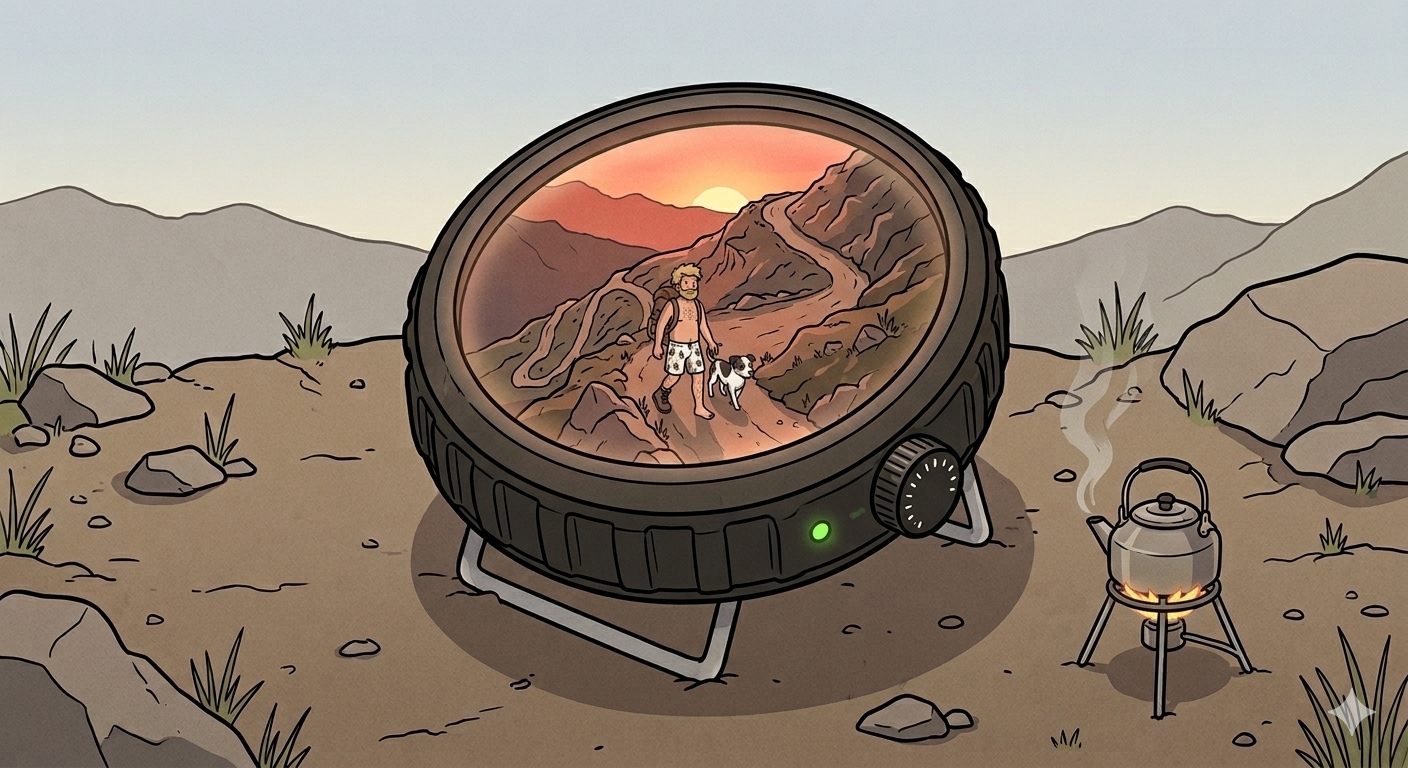
Sixty mornings.
The Waking Fire is at the summit. The Emberstone ends its campaign here.
The ash on the slope records the ascent. Every step. The ash of the high trail is mixed with the residue of the Waking Fire, and what the Waking Fire touches, it marks. Looking back down — sixty mornings of footprints, all the way to where the slope begins, all the way to where the road started, back through the Valley and the Forgetting and the Ridge and the Ashfields and the Sanctuary and the Pass and the Greywood and Thornwick and the Fogmere and the Amber Road and a house in Downers Grove where none of this was inevitable.
The road back to Downers Grove looks different from up here.
Not because Downers Grove changed.
Because the person looking at it did.
Quest Complete